
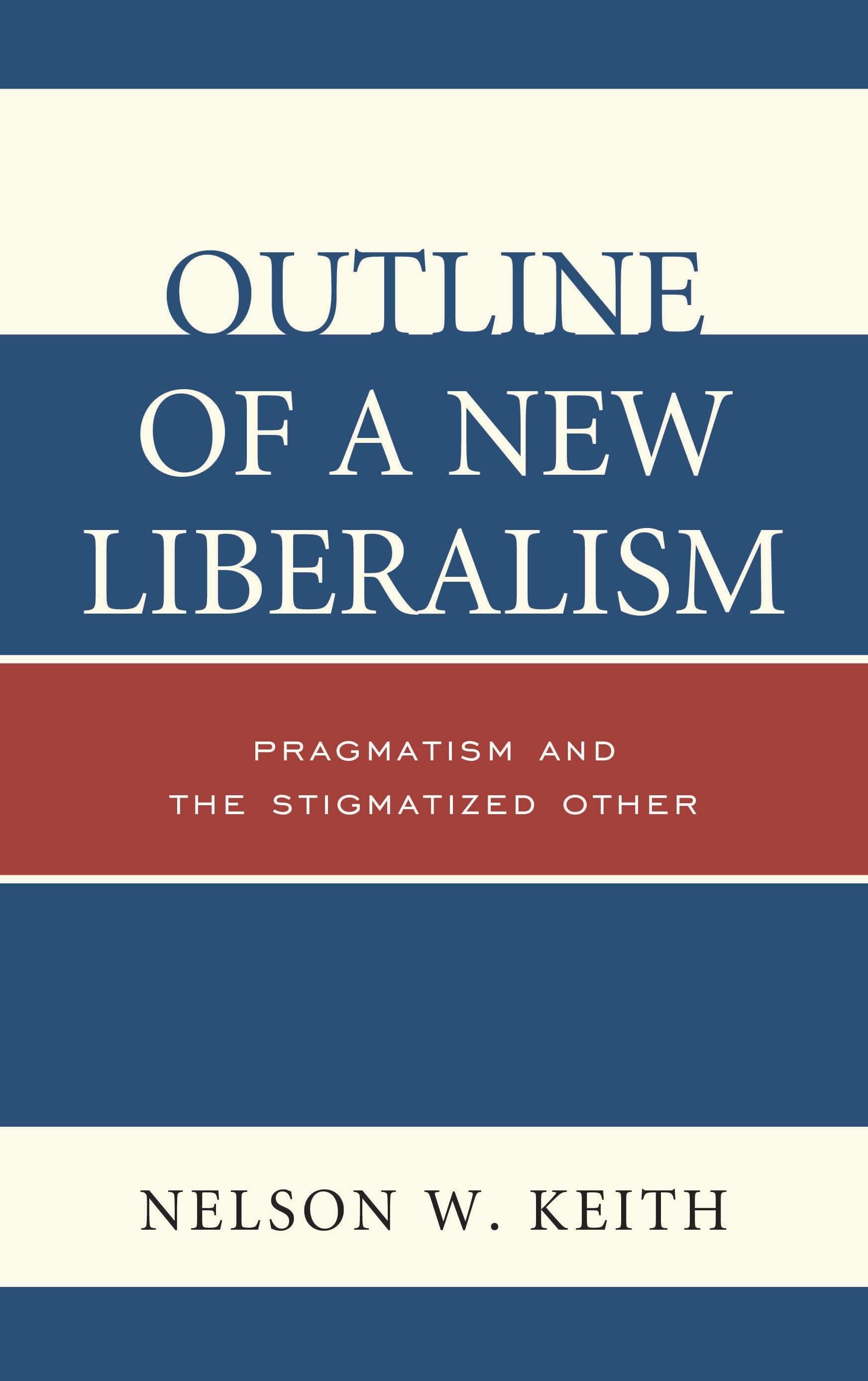
This book is revolutionary in intent, and is in many ways quite an uncommon work. It is iconoclastic, as it goes about dislodging roots. It attempts to release the stigmatized Other from entrapment by rationalism and modern liberalism. The stigmatized Other are legendarily marginalized from congenial social relations with mainstream society. They include peoples of color, women, gays and lesbians, among others.
Entrapment through misrecognition is captured via marked contrasts existing between two major liberal configurations: modern liberalism and pragmatism. Accordingly the book is tasked with overcoming the systemic constraints placed upon the stigmatized Other to conform when such a demand runs disastrously counter to their inherently irrefragable self-definition. Conformity is reductionist, beholden to dyadic forms of thinking which impose a singular, mathematically-derived God’s Eye View upon reality. The difficulty here is that the imposed criteria for giving meaning, value and purpose to human life, have no place for what the stigmatized Other adopts.
On the other hand, pragmatism of a particular stripe establishes a naturalistic, instead of the mathematical basis, for our understanding of human life. Naturalism counsels that human beings should situate themselves directly in the midst of what constitutes their sense of life, with experience providing the bases for all the related determinations. Experience draws upon conditions of flux and uncertainty as the basis of human life. To adhere to the God’s Eye View is to make human beings into ‘desiccated calculating machines.’
This book is located in the heart of this tension. Programmatically, it deconstructs the rationalism/modern liberalism combine, and constructs its replacement in pragmatism complemented by phronesis, as carriers of this alternative mode of thought. Consequential change emerges: a modern liberal world of fixity in social relations, mathematically-derived is displaced by one characterized by intersubjective relations, where lived experience forms its scientific and philosophical bases. The Ancients figure prominently in this book, as it is shaped around the central idea that the emancipation of the stigmatized Other is occurring in the context of perhaps the first engagement between the Platonic and the Protagorean (Sophistic) confrontation which lies at the heart of early Greek thought.
Entrapment through misrecognition is captured via marked contrasts existing between two major liberal configurations: modern liberalism and pragmatism. Accordingly the book is tasked with overcoming the systemic constraints placed upon the stigmatized Other to conform when such a demand runs disastrously counter to their inherently irrefragable self-definition. Conformity is reductionist, beholden to dyadic forms of thinking which impose a singular, mathematically-derived God’s Eye View upon reality. The difficulty here is that the imposed criteria for giving meaning, value and purpose to human life, have no place for what the stigmatized Other adopts.
On the other hand, pragmatism of a particular stripe establishes a naturalistic, instead of the mathematical basis, for our understanding of human life. Naturalism counsels that human beings should situate themselves directly in the midst of what constitutes their sense of life, with experience providing the bases for all the related determinations. Experience draws upon conditions of flux and uncertainty as the basis of human life. To adhere to the God’s Eye View is to make human beings into ‘desiccated calculating machines.’
This book is located in the heart of this tension. Programmatically, it deconstructs the rationalism/modern liberalism combine, and constructs its replacement in pragmatism complemented by phronesis, as carriers of this alternative mode of thought. Consequential change emerges: a modern liberal world of fixity in social relations, mathematically-derived is displaced by one characterized by intersubjective relations, where lived experience forms its scientific and philosophical bases. The Ancients figure prominently in this book, as it is shaped around the central idea that the emancipation of the stigmatized Other is occurring in the context of perhaps the first engagement between the Platonic and the Protagorean (Sophistic) confrontation which lies at the heart of early Greek thought.
Pagine: 298
Categoria: Statsvetenskap & Politik
e-ISBN: 9780739178096
Peso di spedizione: 1.2 kg
Spedito in: 1-2 giorni
Paga facilmente con carta, Klarna, Apple Pay o Google Pay. Non sei soddisfatto? Hai sempre 14 giorni per il rimborso. Leggi di più nei nostri termini. Per qualsiasi domanda, scrivici a hello@memmo.org.
Memmo rende lo studio più facile, ovunque tu sia nel mondo. Qui trovi i tuoi libri di testo e strumenti di studio intelligenti, tutto in un unico posto: riassunti, quiz, podcast e flashcard. E poi c'è Ted, il tuo compagno di studio che risponde a ogni tua domanda. Oltre 50.000 studenti studiano già qui: è stato creato per aiutarti a imparare più velocemente e a stressarti meno.