
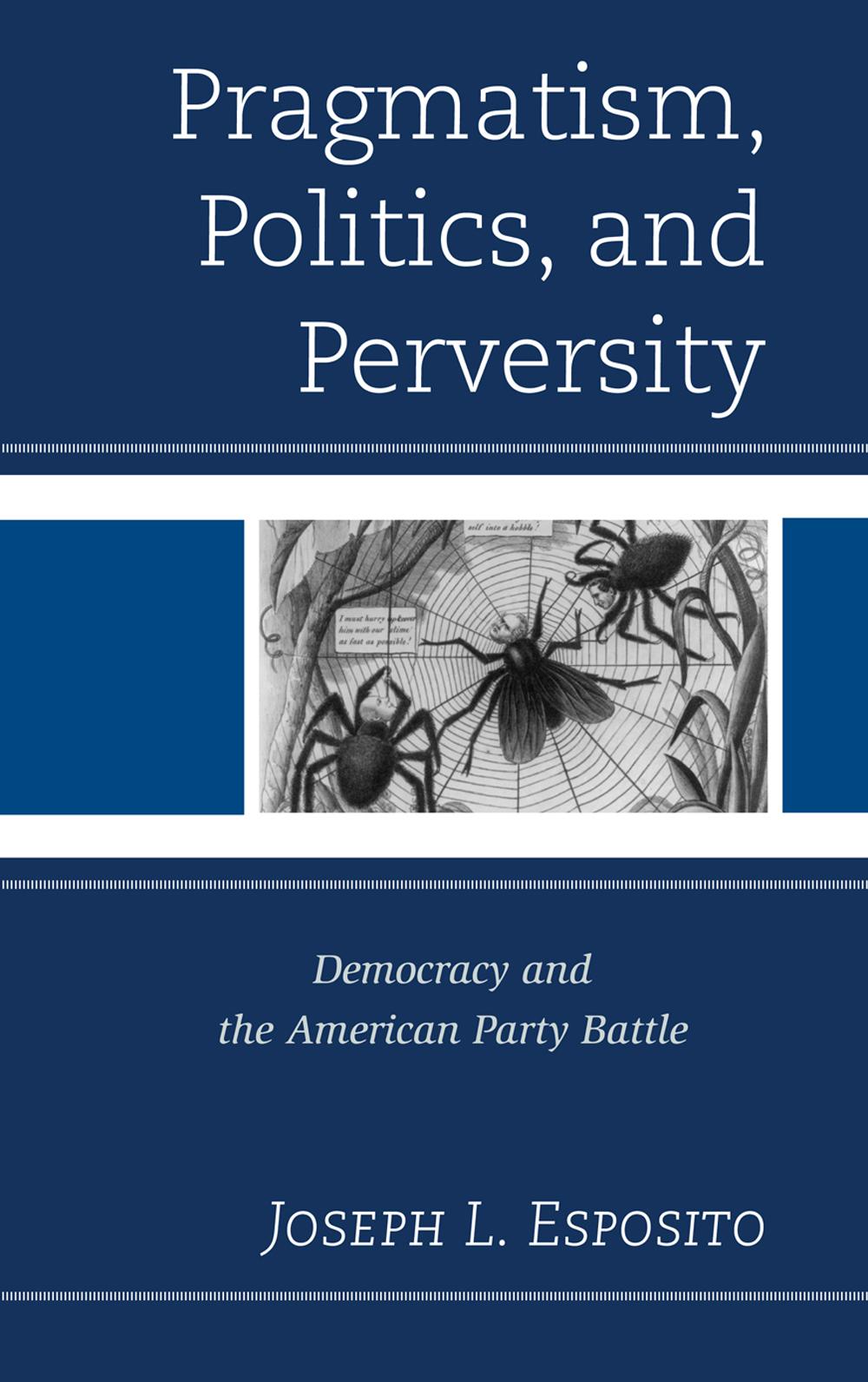
The political project of pragmatism has focused primarily on its defense of democracy as the best political system to maintain and improve human well-being over lifetimes and generations. Pragmatism Politics and Perversity: Democracy and the American Party Battle describes this project of Peirce, Dewey, Hook, and Rorty, and combines it with Charles Beard’s study of the party battle as the most determinative influence upon American democracy. The book updates and confirms Beard’s hypothesis that the history of the party battle is a chronicle of perverse schemes and self-inflicted wounds – the most salient to date being the American Civil War – because it reflects a ceaselessly disruptive contest over the creation of two largely incompatible political states: nation state and market state.
The book supports its thesis with detailed historical accounts of the formation of the Constitution and early federal judiciary, the sedition trials and political schemes of the 1790s, the frustration of market state Whigs to attract white working-class voters by exploiting their religious identities, the reckless machinations of Whig Republicans in precipitating a national crisis over a contrived threat of oligarchy and white slavery, and the ideological oscillations of the Supreme Court from market state to nation state jurisprudence and back again.
To reduce perversity in political rhetoric and free up pragmatic democratic practices, the book proposes a robust neo-Madisonian view of free speech, where political actors and their surrogates are not only free to speak and write, but are also obligated to explain, retract, and revise what they have said and written.
The book supports its thesis with detailed historical accounts of the formation of the Constitution and early federal judiciary, the sedition trials and political schemes of the 1790s, the frustration of market state Whigs to attract white working-class voters by exploiting their religious identities, the reckless machinations of Whig Republicans in precipitating a national crisis over a contrived threat of oligarchy and white slavery, and the ideological oscillations of the Supreme Court from market state to nation state jurisprudence and back again.
To reduce perversity in political rhetoric and free up pragmatic democratic practices, the book proposes a robust neo-Madisonian view of free speech, where political actors and their surrogates are not only free to speak and write, but are also obligated to explain, retract, and revise what they have said and written.
Paga facilmente con carta, Klarna, Apple Pay o Google Pay. Non sei soddisfatto? Hai sempre 14 giorni per il rimborso. Leggi di più nei nostri termini. Per qualsiasi domanda, scrivici a hello@memmo.org.
Memmo rende lo studio più facile, ovunque tu sia nel mondo. Qui trovi i tuoi libri di testo e strumenti di studio intelligenti, tutto in un unico posto: riassunti, quiz, podcast e flashcard. E poi c'è Ted, il tuo compagno di studio che risponde a ogni tua domanda. Oltre 50.000 studenti studiano già qui: è stato creato per aiutarti a imparare più velocemente e a stressarti meno.