
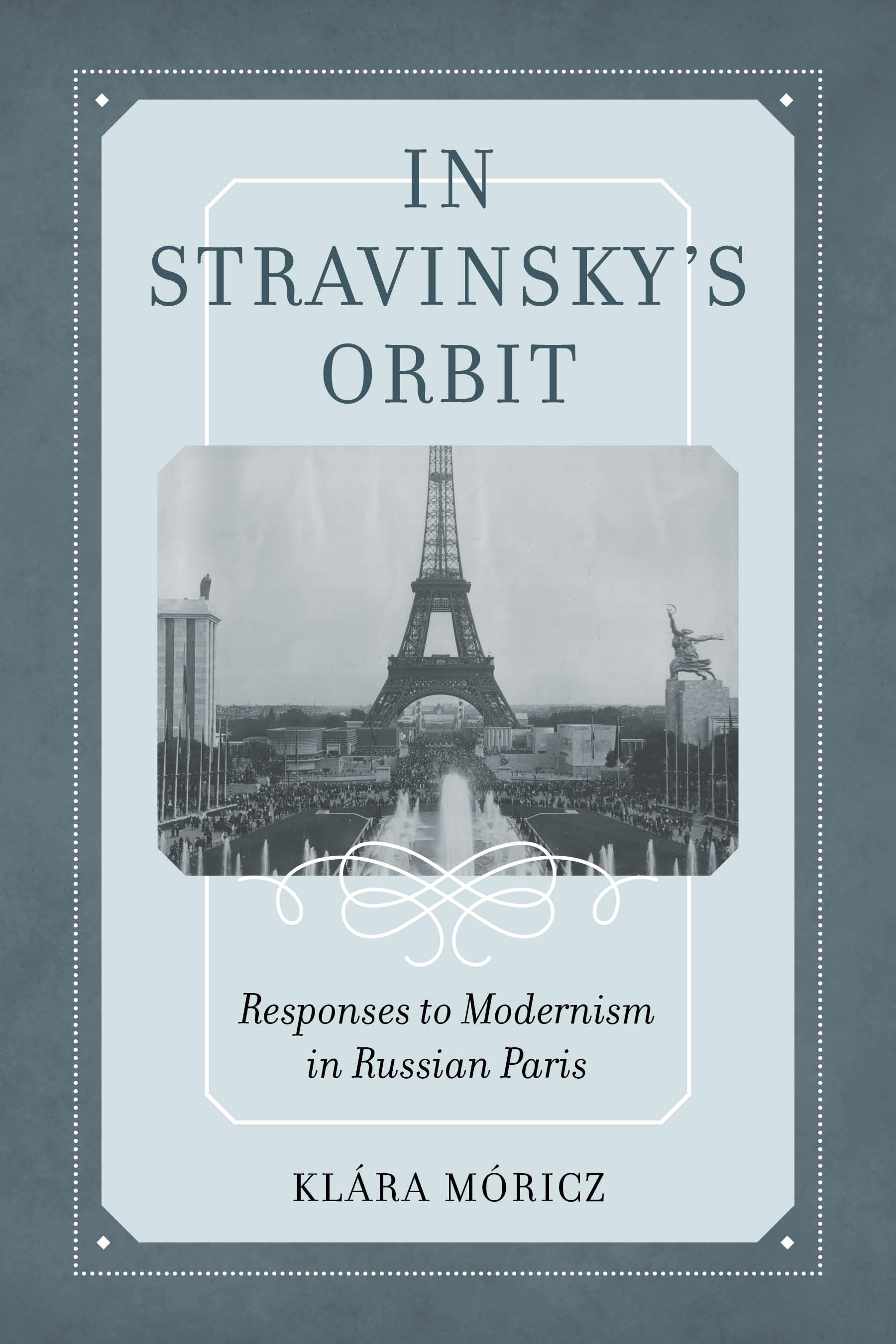
The Bolsheviks’ 1917 political coup caused a seismic disruption in Russian culture. Carried by the first wave of emigrants, Russian culture migrated West, transforming itself as it interacted with the new cultural environment and clashed with exported Soviet trends. In this book, Klára Móricz explores the transnational emigrant space of Russian composers Igor Stravinsky, Vladimir Dukelsky, Sergey Prokofiev, Nicolas Nabokov, and Arthur Lourié in interwar Paris.
Their music reflected the conflict between a modernist narrative demanding innovation and a narrative of exile wedded to the preservation of prerevolutionary Russian culture. The emigrants’ and the Bolsheviks’ contrasting visions of Russia and its past collided frequently in the French capital, where the Soviets displayed their political and artistic products. Russian composers in Paris also had to reckon with Stravinsky’s disproportionate influence: if they succumbed to fashions dictated by their famous compatriot, they risked becoming epigones; if they kept to their old ways, they quickly became irrelevant. Although Stravinsky’s neoclassicism provided a seemingly neutral middle ground between innovation and nostalgia, it was also marked by the exilic experience. Móricz offers this unexplored context for Stravinsky’s neoclassicism, shedding new light on this infinitely elusive term.
Their music reflected the conflict between a modernist narrative demanding innovation and a narrative of exile wedded to the preservation of prerevolutionary Russian culture. The emigrants’ and the Bolsheviks’ contrasting visions of Russia and its past collided frequently in the French capital, where the Soviets displayed their political and artistic products. Russian composers in Paris also had to reckon with Stravinsky’s disproportionate influence: if they succumbed to fashions dictated by their famous compatriot, they risked becoming epigones; if they kept to their old ways, they quickly became irrelevant. Although Stravinsky’s neoclassicism provided a seemingly neutral middle ground between innovation and nostalgia, it was also marked by the exilic experience. Móricz offers this unexplored context for Stravinsky’s neoclassicism, shedding new light on this infinitely elusive term.
Pagine: 310
Categoria: Musikvetenskap
e-ISBN: 9780520975521
Peso di spedizione: 1.2 kg
Spedito in: 1-2 giorni
Paga facilmente con carta, Klarna, Apple Pay o Google Pay. Non sei soddisfatto? Hai sempre 14 giorni per il rimborso. Leggi di più nei nostri termini. Per qualsiasi domanda, scrivici a hello@memmo.org.
Memmo rende lo studio più facile, ovunque tu sia nel mondo. Qui trovi i tuoi libri di testo e strumenti di studio intelligenti, tutto in un unico posto: riassunti, quiz, podcast e flashcard. E poi c'è Ted, il tuo compagno di studio che risponde a ogni tua domanda. Oltre 50.000 studenti studiano già qui: è stato creato per aiutarti a imparare più velocemente e a stressarti meno.
Potrebbe interessarti anche
Acquista il libro0