
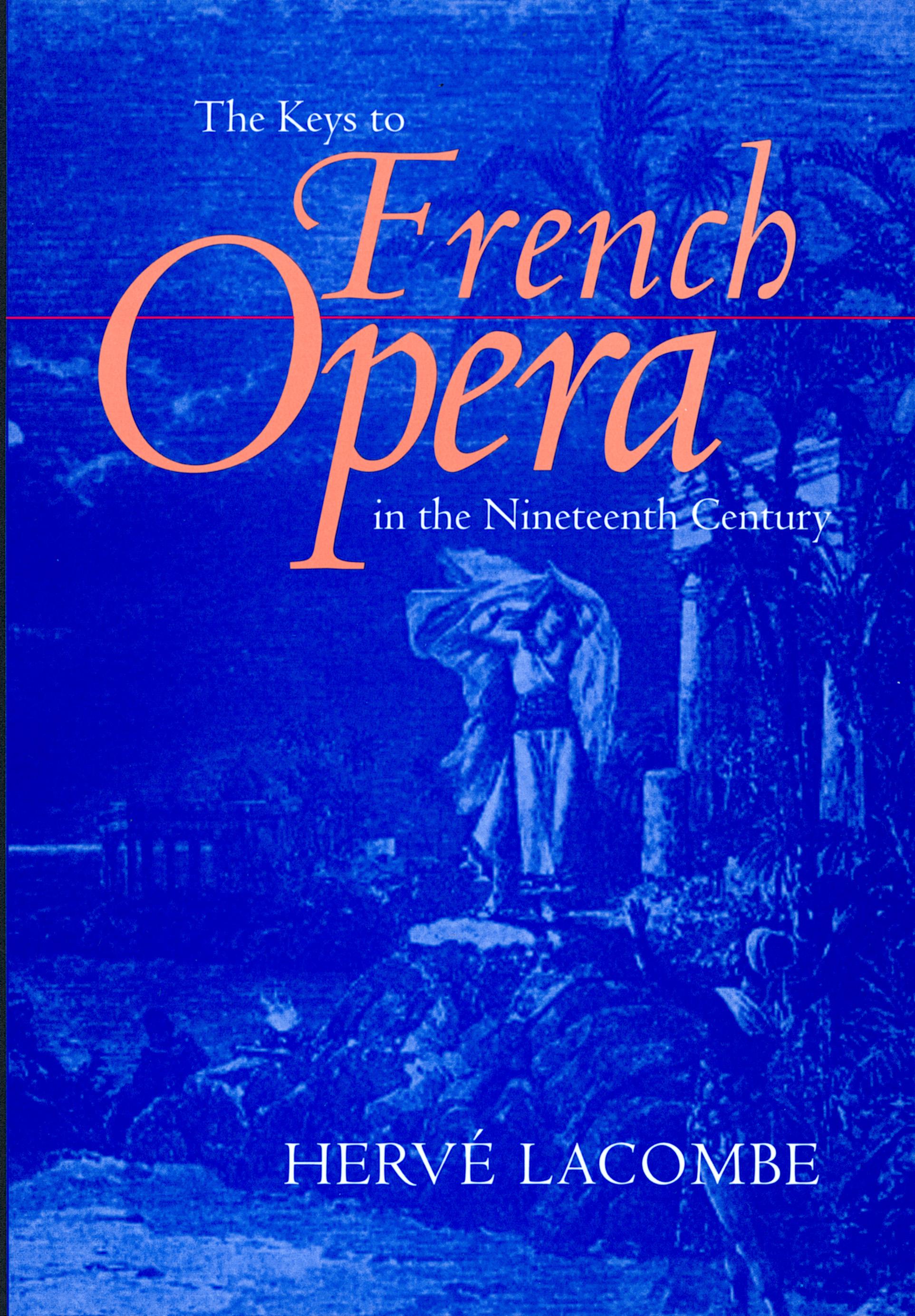
The "keys" provided by Hervé Lacombe in this richly informed book open the door to understanding the essence of nineteenth-century French lyric theater. Lacombe illuminates the diverse elements that constitute opera by focusing his investigation around three main categories: composition and production; words, music, and drama; and the interaction of society, genre, and aesthetics.
Lacombe chooses Bizet's Pearl Fishers (1863) as the exemplar of French opera that combines tradition and innovation. He uses Pearl Fishers as a paradigmatic point of reference for exploring questions of genesis, style, and aesthetic in other nineteenth-century French operatic works. French opera was a social art, he writes, and looping between past and future, between tradition and innovation, it achieved the seemingly impossible union of two antithetical aspects of Romanticism: the taste for theatricality and the desire for intimacy.
The voices of contemporary witnesses are heard throughout Lacombe's book. He makes abundant use of the writings of such musician-critics as Berlioz, Reyer, and Saint-Saëns and also draws on the works of many French writers, including Stendhal, Balzac, Baudelaire, and Zola. Illustrations showing costume sketches, scenery, posters, paintings, photographs, and magazine articles are attractive complements to discussions of particular operas. Together with Edward Schneider's accessible translation, the illustrations make this well-rounded and original study a trove of information for both music scholars and French historians.
Lacombe chooses Bizet's Pearl Fishers (1863) as the exemplar of French opera that combines tradition and innovation. He uses Pearl Fishers as a paradigmatic point of reference for exploring questions of genesis, style, and aesthetic in other nineteenth-century French operatic works. French opera was a social art, he writes, and looping between past and future, between tradition and innovation, it achieved the seemingly impossible union of two antithetical aspects of Romanticism: the taste for theatricality and the desire for intimacy.
The voices of contemporary witnesses are heard throughout Lacombe's book. He makes abundant use of the writings of such musician-critics as Berlioz, Reyer, and Saint-Saëns and also draws on the works of many French writers, including Stendhal, Balzac, Baudelaire, and Zola. Illustrations showing costume sketches, scenery, posters, paintings, photographs, and magazine articles are attractive complements to discussions of particular operas. Together with Edward Schneider's accessible translation, the illustrations make this well-rounded and original study a trove of information for both music scholars and French historians.
Pagine: 442
Categoria: Musikvetenskap
e-ISBN: 9780520922372
Peso di spedizione: 1.2 kg
Spedito in: 1-2 giorni
Paga facilmente con carta, Klarna, Apple Pay o Google Pay. Non sei soddisfatto? Hai sempre 14 giorni per il rimborso. Leggi di più nei nostri termini. Per qualsiasi domanda, scrivici a hello@memmo.org.
Memmo rende lo studio più facile, ovunque tu sia nel mondo. Qui trovi i tuoi libri di testo e strumenti di studio intelligenti, tutto in un unico posto: riassunti, quiz, podcast e flashcard. E poi c'è Ted, il tuo compagno di studio che risponde a ogni tua domanda. Oltre 50.000 studenti studiano già qui: è stato creato per aiutarti a imparare più velocemente e a stressarti meno.
Potrebbe interessarti anche
Acquista il libro0