
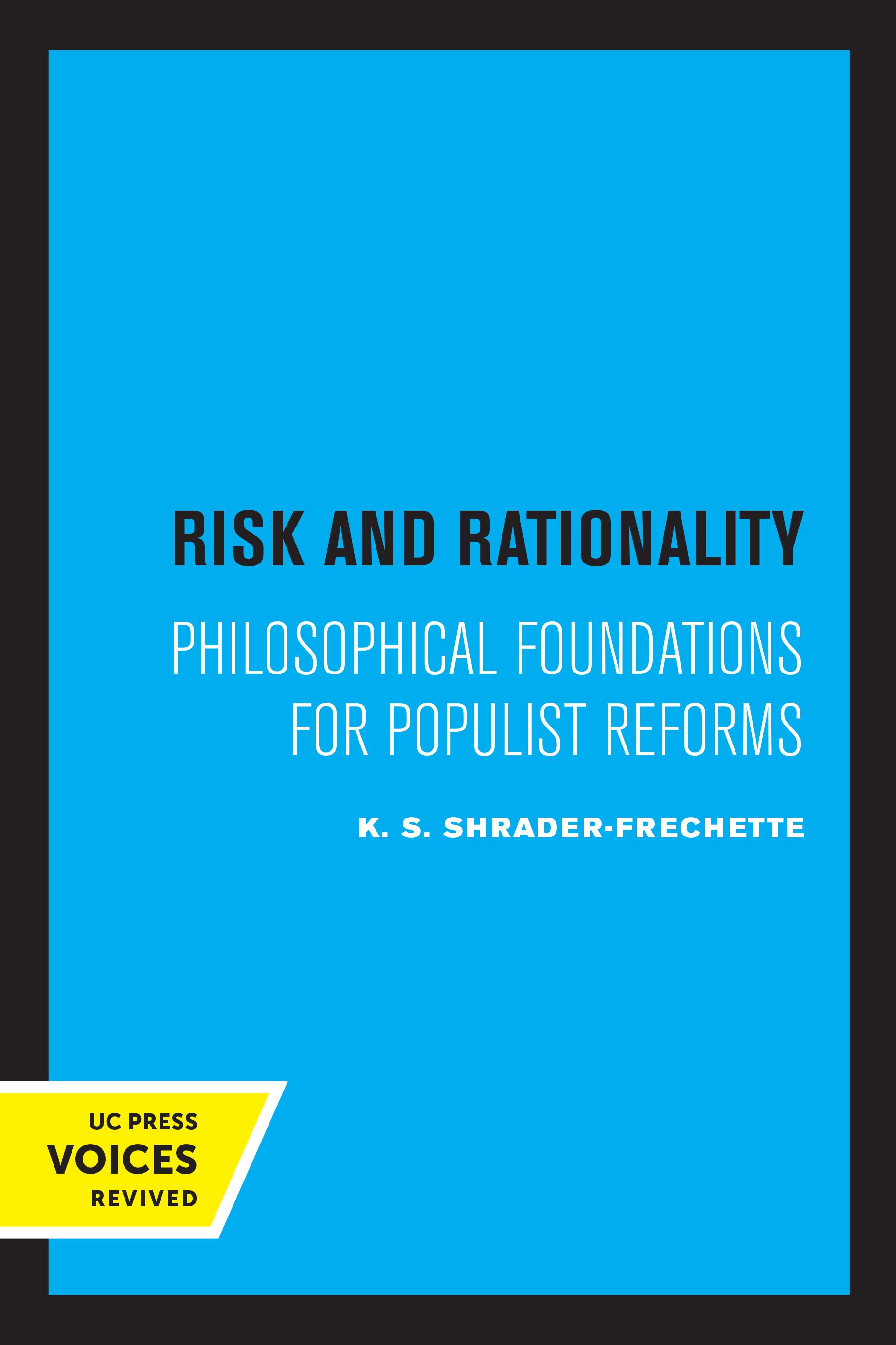
Risk and Rationality: Philosophical Foundations for Populist Reforms offers a rigorous philosophical reconstruction of how societies should evaluate and govern technological hazards. K. S. Shrader-Frechette charts a "middle path" between cultural relativism and naive positivism, demonstrating why risk evaluation is neither a mere social construct nor a value-free technical exercise. After situating modern risk analysis in its institutional history (NEPA, OSHA, RARADA), she dissects the value judgments embedded in all three stages of assessment—identification, estimation, and evaluation—showing how methodological choices shape policy outcomes. Through targeted critiques of prevailing strategies—expert/lay splits between "perceived" and "actual" risk, probability-only decision rules, Bayesian–utilitarian maximization under deep uncertainty, producer-favoring default choices, and the "isolationist" discounting of Third-World harms—Shrader-Frechette argues that lay aversion to involuntary, catastrophic, or inequitably distributed risks is often more rational than experts concede. The book's constructive core advances "scientific proceduralism," a normative framework that weds empirical objectivity to democratic ethics. Risk evaluations, Shrader-Frechette contends, can be objective—insofar as they are probabilistically revisable and open to critical testing—while also answerable to principles of equity, consent, and due process. She proposes methodological reforms (ethically weighted risk–cost–benefit analysis; performance-based ranking of expert judgments by predictive accuracy) and procedural reforms (free, informed consent for imposed risks; compensation and due-process rights; market-share liability) that realign assessment and management with public reason. Bridging philosophy of science, environmental ethics, and policy analysis, Risk and Rationality supplies scholars and practitioners with a defensible account of rational risk governance—one that explains persistent public opposition to hazardous sitings without pathologizing citizens, and that equips analysts to design evaluations and institutions capable of earning democratic legitimacy. This title is part of UC Press's Voices Revived program, which commemorates University of California Press's mission to seek out and cultivate the brightest minds and give them voice, reach, and impact. Drawing on a backlist dating to 1893, Voices Revived makes high-quality, peer-reviewed scholarship accessible once again using print-on-demand technology. This title was originally published in 1991.
Many titles in the Voices Revived program are also newly available as books, offered at a discounted price to support wider access to scholarly work.
Many titles in the Voices Revived program are also newly available as books, offered at a discounted price to support wider access to scholarly work.
Pagine: 324
Categoria: Vetenskapsteori och forskningsmetod
e-ISBN: 9780520320789
Peso di spedizione: 1.2 kg
Spedito in: 1-2 giorni
Paga facilmente con carta, Klarna, Apple Pay o Google Pay. Non sei soddisfatto? Hai sempre 14 giorni per il rimborso. Leggi di più nei nostri termini. Per qualsiasi domanda, scrivici a hello@memmo.org.
Memmo rende lo studio più facile, ovunque tu sia nel mondo. Qui trovi i tuoi libri di testo e strumenti di studio intelligenti, tutto in un unico posto: riassunti, quiz, podcast e flashcard. E poi c'è Ted, il tuo compagno di studio che risponde a ogni tua domanda. Oltre 50.000 studenti studiano già qui: è stato creato per aiutarti a imparare più velocemente e a stressarti meno.
Potrebbe interessarti anche
Acquista il libro0