
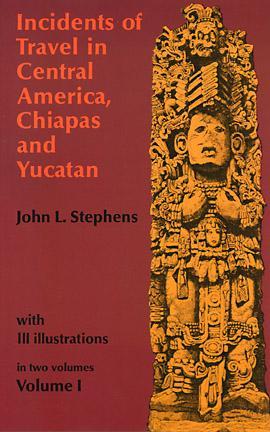
Few explorers have had the experience of uncovering a civilization almost entirely unknown to the world. But Stephen's two expeditions to Mexico and Central America in 1839 and 1841 yielded the first solid information on the culture of the Maya Indians. In this work, and in his other masterpiece Incidents of Travel in Yucatan, he tells the story of his travels to some 50 ruined Mayan cities.
In this book, he describes the excitement of exploring the magnificent ruined cities of Copan and Palenque, and his briefer excursions to Quirigua, Patinamit, Utatlan, Gueguetenango, Ocosingo, and Uxmal. For all these cities, his details are so accurate that more recent explorers used the book as a Baedeker to locate ruins forgotten by even the Indians.
In addition to being a great book on archaeological discovery, Stephen's work is also a great travel book. Telling of journeying by mule back on narrow paths over unimaginable deep ravines, through sloughs of mud and jungles of heavy vegetation, describing dangers of robbery, revolution, fever, mosquitoes and more exotic insects, Stephen's narrative remains penetrating and alive. His account of his attempt to buy Copan for $50 is told with the adroitness of a Mark Twain, and his descriptions of Indian life — primitive villages a few miles from the ruins, burials, treatment of the sick, customs, amusements, etc. — never lose their interest.
Frederick Catherwood's illustrations virtually double the appeal of the book. Highly exact, remarkably realistic drawings show overall views, ground plans of the cities, elevations of palaces and temples, free-standing sculpture, carved hieroglyphics, stucco bas-reliefs, small clay figures, and interior details.
In this book, he describes the excitement of exploring the magnificent ruined cities of Copan and Palenque, and his briefer excursions to Quirigua, Patinamit, Utatlan, Gueguetenango, Ocosingo, and Uxmal. For all these cities, his details are so accurate that more recent explorers used the book as a Baedeker to locate ruins forgotten by even the Indians.
In addition to being a great book on archaeological discovery, Stephen's work is also a great travel book. Telling of journeying by mule back on narrow paths over unimaginable deep ravines, through sloughs of mud and jungles of heavy vegetation, describing dangers of robbery, revolution, fever, mosquitoes and more exotic insects, Stephen's narrative remains penetrating and alive. His account of his attempt to buy Copan for $50 is told with the adroitness of a Mark Twain, and his descriptions of Indian life — primitive villages a few miles from the ruins, burials, treatment of the sick, customs, amusements, etc. — never lose their interest.
Frederick Catherwood's illustrations virtually double the appeal of the book. Highly exact, remarkably realistic drawings show overall views, ground plans of the cities, elevations of palaces and temples, free-standing sculpture, carved hieroglyphics, stucco bas-reliefs, small clay figures, and interior details.
Paga facilmente con carta, Klarna, Apple Pay o Google Pay. Non sei soddisfatto? Hai sempre 14 giorni per il rimborso. Leggi di più nei nostri termini. Per qualsiasi domanda, scrivici a hello@memmo.org.
Memmo rende lo studio più facile, ovunque tu sia nel mondo. Qui trovi i tuoi libri di testo e strumenti di studio intelligenti, tutto in un unico posto: riassunti, quiz, podcast e flashcard. E poi c'è Ted, il tuo compagno di studio che risponde a ogni tua domanda. Oltre 50.000 studenti studiano già qui: è stato creato per aiutarti a imparare più velocemente e a stressarti meno.
Potrebbe interessarti anche
Acquista il libro0