
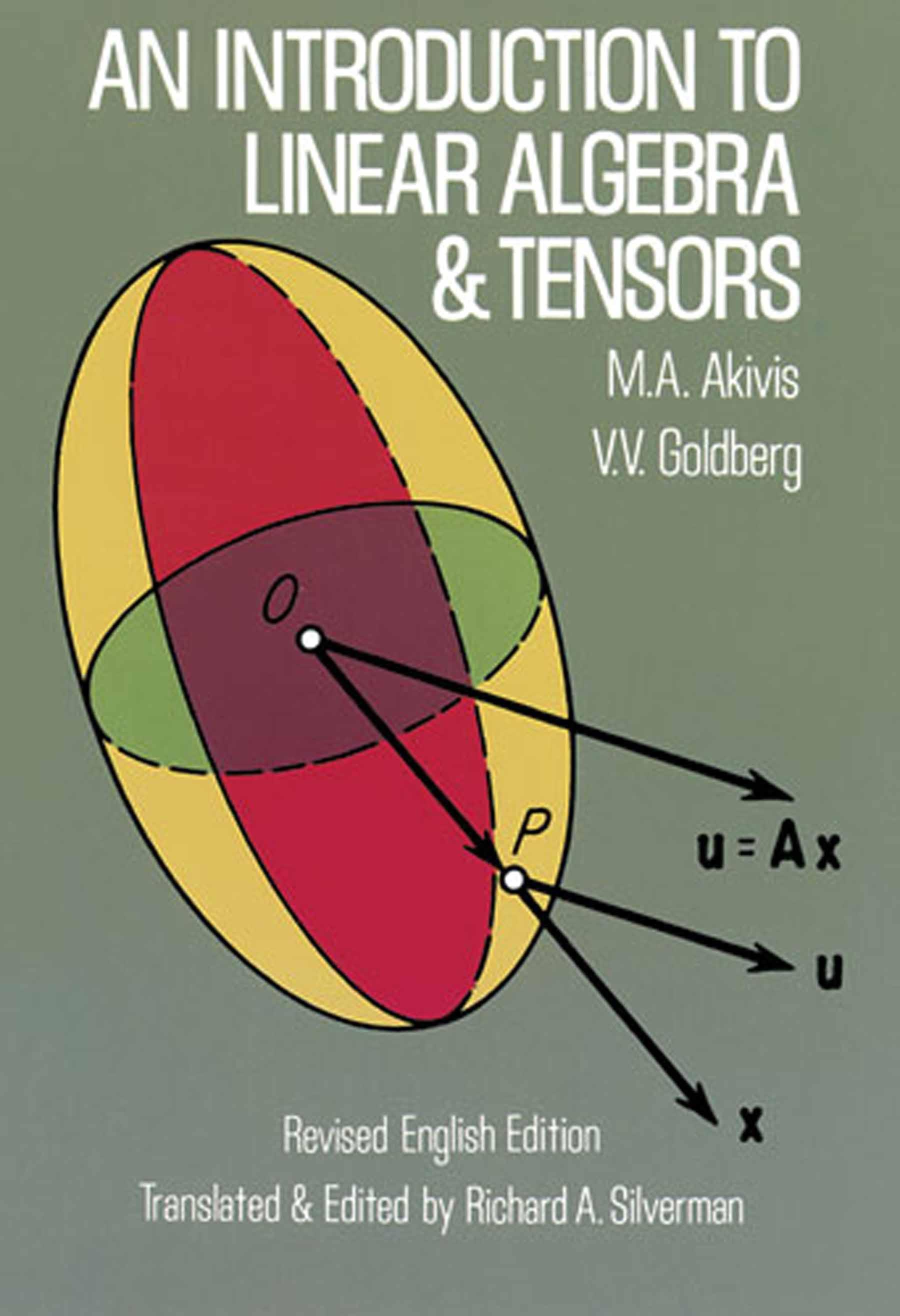
The present book, a valuable addition to the English-language literature on linear algebra and tensors, constitutes a lucid, eminently readable and completely elementary introduction to this field of mathematics. A special merit of the book is its free use of tensor notation, in particular the Einstein summation convention. The treatment is virtually self-contained. In fact, the mathematical background assumed on the part of the reader hardly exceeds a smattering of calculus and a casual acquaintance with determinants.
The authors begin with linear spaces, starting with basic concepts and ending with topics in analytic geometry. They then treat multilinear forms and tensors (linear and bilinear forms, general definition of a tensor, algebraic operations on tensors, symmetric and antisymmetric tensors, etc.), and linear transformation (again basic concepts, the matrix and multiplication of linear transformations, inverse transformations and matrices, groups and subgroups, etc.). The last chapter deals with further topics in the field: eigenvectors and eigenvalues, matrix ploynomials and the Hamilton-Cayley theorem, reduction of a quadratic form to canonical form, representation of a nonsingular transformation, and more. Each individual section — there are 25 in all — contains a problem set, making a total of over 250 problems, all carefully selected and matched. Hints and answers to most of the problems can be found at the end of the book.
Dr. Silverman has revised the text and numerous pedagogical and mathematical improvements, and restyled the language so that it is even more readable. With its clear exposition, many relevant and interesting problems, ample illustrations, index and bibliography, this book will be useful in the classroom or for self-study as an excellent introduction to the important subjects of linear algebra and tensors.
The authors begin with linear spaces, starting with basic concepts and ending with topics in analytic geometry. They then treat multilinear forms and tensors (linear and bilinear forms, general definition of a tensor, algebraic operations on tensors, symmetric and antisymmetric tensors, etc.), and linear transformation (again basic concepts, the matrix and multiplication of linear transformations, inverse transformations and matrices, groups and subgroups, etc.). The last chapter deals with further topics in the field: eigenvectors and eigenvalues, matrix ploynomials and the Hamilton-Cayley theorem, reduction of a quadratic form to canonical form, representation of a nonsingular transformation, and more. Each individual section — there are 25 in all — contains a problem set, making a total of over 250 problems, all carefully selected and matched. Hints and answers to most of the problems can be found at the end of the book.
Dr. Silverman has revised the text and numerous pedagogical and mathematical improvements, and restyled the language so that it is even more readable. With its clear exposition, many relevant and interesting problems, ample illustrations, index and bibliography, this book will be useful in the classroom or for self-study as an excellent introduction to the important subjects of linear algebra and tensors.
Paga facilmente con carta, Klarna, Apple Pay o Google Pay. Non sei soddisfatto? Hai sempre 14 giorni per il rimborso. Leggi di più nei nostri termini. Per qualsiasi domanda, scrivici a hello@memmo.org.
Memmo rende lo studio più facile, ovunque tu sia nel mondo. Qui trovi i tuoi libri di testo e strumenti di studio intelligenti, tutto in un unico posto: riassunti, quiz, podcast e flashcard. E poi c'è Ted, il tuo compagno di studio che risponde a ogni tua domanda. Oltre 50.000 studenti studiano già qui: è stato creato per aiutarti a imparare più velocemente e a stressarti meno.
Potrebbe interessarti anche
Acquista il libro0