
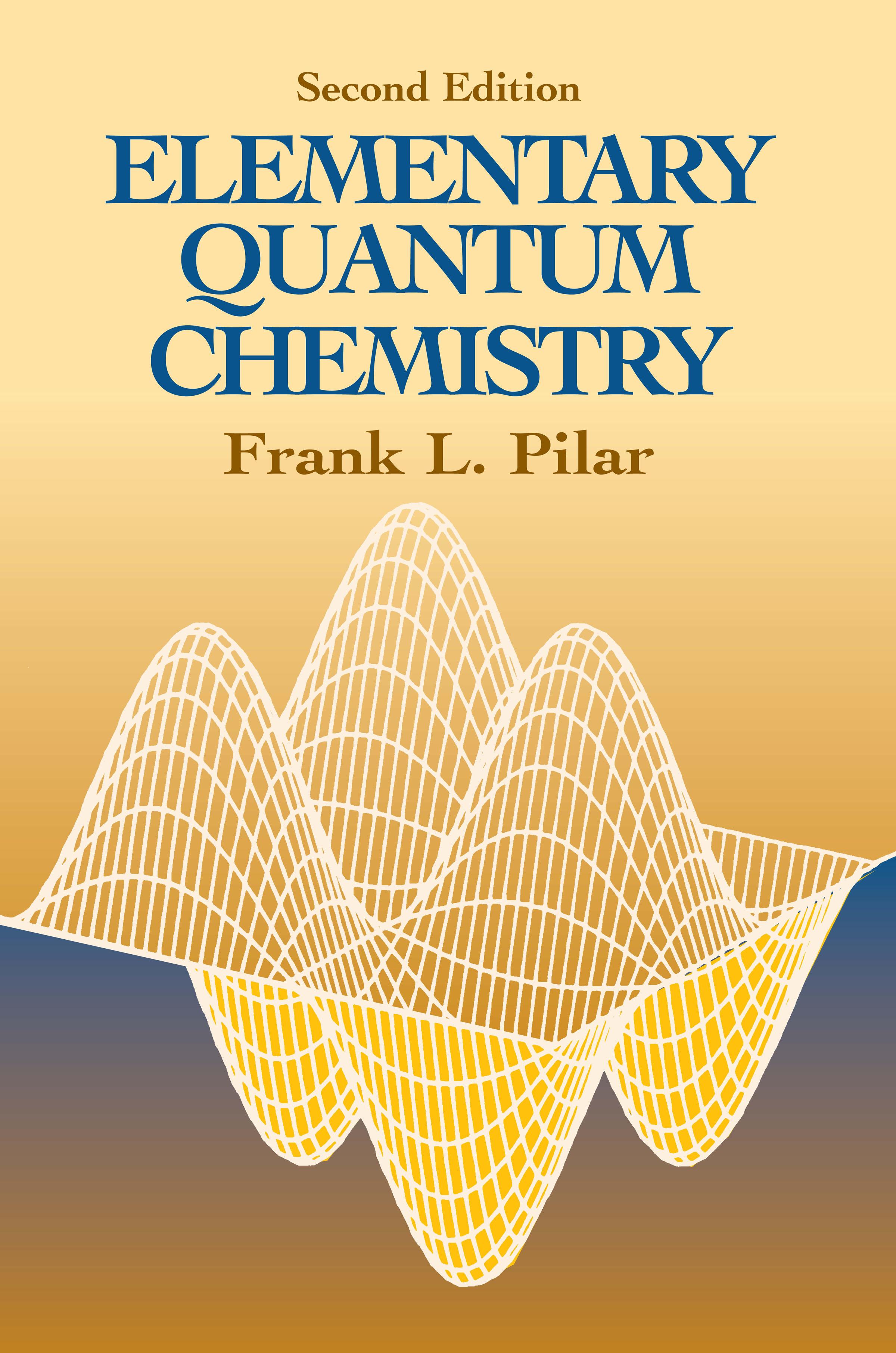
As the author notes in the Preface to this valuable text, experimental chemists have moved past studying the average behavior of atoms or molecules "to probe the step-by-step behavior of individual atoms and molecules as they collide, form 'transition states,' and ultimately form products." In such experiments, quantum mechanical computations do two useful tasks: They fill in the observational gaps and help to interpret what has been observed.
This introductory course — developed by the former chairman of the chemistry department at the University of New Hampshire — covers, among other topics, the origins of the quantum theory, the Schrödinger wave equation, the quantum mechanics of simple systems, the rigid rotator, the hydrogen atom, electron spin and many-electron systems, the quantum states of atoms, the Hartree-Fock self-consistent field method, the electronic structure of molecules, and semi-empirical molecular orbital methods. One of the great values of the course is its calculations and diagrams, which were created specifically for this text and which students will be able to replicate on their home computers.
The text will be most useful for advanced undergraduate or beginning graduate students who have had calculus and at least a year of undergraduate physics. A knowledge of differential equations, linear algebra, and atomic physics is helpful but not essential. Seven appendices give a concise exposition of mathematical and physical material that may not be part of the students' background.
This introductory course — developed by the former chairman of the chemistry department at the University of New Hampshire — covers, among other topics, the origins of the quantum theory, the Schrödinger wave equation, the quantum mechanics of simple systems, the rigid rotator, the hydrogen atom, electron spin and many-electron systems, the quantum states of atoms, the Hartree-Fock self-consistent field method, the electronic structure of molecules, and semi-empirical molecular orbital methods. One of the great values of the course is its calculations and diagrams, which were created specifically for this text and which students will be able to replicate on their home computers.
The text will be most useful for advanced undergraduate or beginning graduate students who have had calculus and at least a year of undergraduate physics. A knowledge of differential equations, linear algebra, and atomic physics is helpful but not essential. Seven appendices give a concise exposition of mathematical and physical material that may not be part of the students' background.
Paga facilmente con carta, Klarna, Apple Pay o Google Pay. Non sei soddisfatto? Hai sempre 14 giorni per il rimborso. Leggi di più nei nostri termini. Per qualsiasi domanda, scrivici a hello@memmo.org.
Memmo rende lo studio più facile, ovunque tu sia nel mondo. Qui trovi i tuoi libri di testo e strumenti di studio intelligenti, tutto in un unico posto: riassunti, quiz, podcast e flashcard. E poi c'è Ted, il tuo compagno di studio che risponde a ogni tua domanda. Oltre 50.000 studenti studiano già qui: è stato creato per aiutarti a imparare più velocemente e a stressarti meno.
Potrebbe interessarti anche
Acquista il libro0