
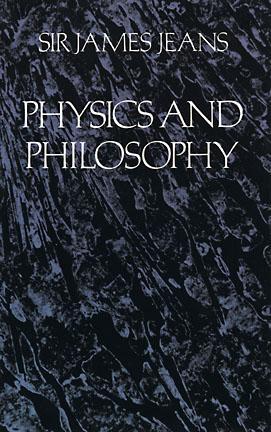
"There is no more eloquent, interesting or persuasive exposition of what may be called science of philosophy than Sir James Jeans's." — The New York Times
Can we have any knowledge of the world outside us other than we gain by the methods of science? Are we humans endowed with free will, or are we mere cogs in a vast machine that must follow its predestined course until it finally runs down? Is the world we perceive the world of ultimate reality, or is it only a curtain veiling a deeper reality beyond?
In this strikingly lucid and often poetic book, one of the twentieth century's greatest scientists grapples with these age-old questions, achieving in the process a brilliant and non-technical exposition of the interrelationship between physics and philosophy. He begins by defining physics and philosophy, pointing out the difference in their respective attempts to explain physical reality and man's place in it. This discussion paves the way for an outline of epistemological methods in which the rationalism of thinkers like Descartes, Leibniz, and Kant is compared to the empiricism of Locke and Hume.
Over the course of the book, in a manner that is careful and methodic but never dull, Jeans marshals the evidence for his startling conclusion: recent discoveries in astronomy, mathematics, sub-atomic physics, and other disciplines have washed away the scientific basis of many older philosophic discussions. Such long-standing problems as causality, free will and determinism, the nature of space and time, materialism and mentalism must be considered anew in the light of new knowledge and information attained by twentieth-century physical science. Even then, however, Jeans cautions against drawing any positive conclusions, pointing out that both physics and philosophy are both relatively young and that we are still in Newton's words, like children playing with pebbles on the sea-shore, while the great ocean of truth rolls, unexplored, beyond our reach.
Although first published in 1943, nothing in physics has happened to affect Jeans's account in this book; it remains remarkably fresh and undated, a classic exposition of the philosophical implications of scientific knowledge.
Can we have any knowledge of the world outside us other than we gain by the methods of science? Are we humans endowed with free will, or are we mere cogs in a vast machine that must follow its predestined course until it finally runs down? Is the world we perceive the world of ultimate reality, or is it only a curtain veiling a deeper reality beyond?
In this strikingly lucid and often poetic book, one of the twentieth century's greatest scientists grapples with these age-old questions, achieving in the process a brilliant and non-technical exposition of the interrelationship between physics and philosophy. He begins by defining physics and philosophy, pointing out the difference in their respective attempts to explain physical reality and man's place in it. This discussion paves the way for an outline of epistemological methods in which the rationalism of thinkers like Descartes, Leibniz, and Kant is compared to the empiricism of Locke and Hume.
Over the course of the book, in a manner that is careful and methodic but never dull, Jeans marshals the evidence for his startling conclusion: recent discoveries in astronomy, mathematics, sub-atomic physics, and other disciplines have washed away the scientific basis of many older philosophic discussions. Such long-standing problems as causality, free will and determinism, the nature of space and time, materialism and mentalism must be considered anew in the light of new knowledge and information attained by twentieth-century physical science. Even then, however, Jeans cautions against drawing any positive conclusions, pointing out that both physics and philosophy are both relatively young and that we are still in Newton's words, like children playing with pebbles on the sea-shore, while the great ocean of truth rolls, unexplored, beyond our reach.
Although first published in 1943, nothing in physics has happened to affect Jeans's account in this book; it remains remarkably fresh and undated, a classic exposition of the philosophical implications of scientific knowledge.
Pagine: 244
Categoria: Vetenskapsteori och forskningsmetod
e-ISBN: 9780486119175
Peso di spedizione: 1.2 kg
Spedito in: 1-2 giorni
Paga facilmente con carta, Klarna, Apple Pay o Google Pay. Non sei soddisfatto? Hai sempre 14 giorni per il rimborso. Leggi di più nei nostri termini. Per qualsiasi domanda, scrivici a hello@memmo.org.
Memmo rende lo studio più facile, ovunque tu sia nel mondo. Qui trovi i tuoi libri di testo e strumenti di studio intelligenti, tutto in un unico posto: riassunti, quiz, podcast e flashcard. E poi c'è Ted, il tuo compagno di studio che risponde a ogni tua domanda. Oltre 50.000 studenti studiano già qui: è stato creato per aiutarti a imparare più velocemente e a stressarti meno.
Potrebbe interessarti anche
Acquista il libro0