
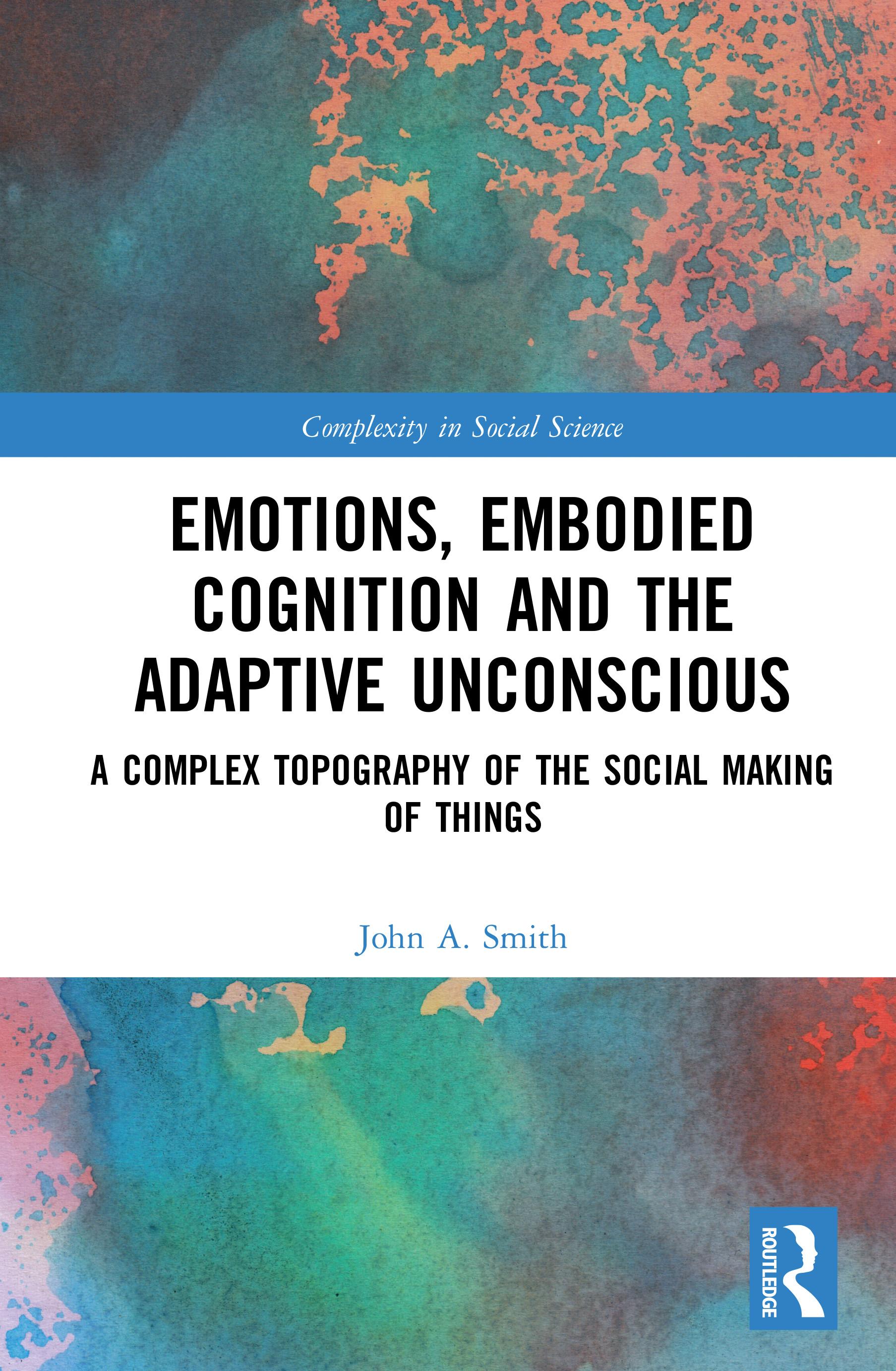
Emotions, Embodied Cognition and the Adaptive Unconscious argues for the need to consider many other factors, drawn from disciplines such as socio-biology, evolutionary psychology, the study of the emotions, the adaptive unconscious, the senses and conscious deliberation in analysing the complex topography of social action and the making of things.
These factors are taken as ecological conditions that shape the contemporary expression of complex societies, not as constraints on human plasticity. Without ‘foundations’, complex society cannot exist nor less evolve. This is the familiar pairing from complexity theory: path dependency and dynamic emergence. Inter-disciplinary and complexity perspectives need to be incorporated into the social sciences. Routinely, sociologists think of social phenomena as a distinct field, expressed in the term: the ‘social construction of’ without apparent need to refer to other material, biological, psychological, material or ecological conditions or agents.
This book shows how the familiar sociological dynamics of identity, solidarity, differentiation and communication are shaped through the persistent interaction of unconscious and affective processing with conscious deliberation in newly emergent contexts. It is this re-expression, not the surpassing, of human characteristics in contemporary social action that needs to re-inform a complex, ecological approach to the theory and methodologies of the social sciences. The book is intended for a postgraduate/research audience and doctoral students to introduce and synthesise inter-disciplinary contributions to research into complexity theory in the social sciences.
Paga facilmente con carta, Klarna, Apple Pay o Google Pay. Non sei soddisfatto? Hai sempre 14 giorni per il rimborso. Leggi di più nei nostri termini. Per qualsiasi domanda, scrivici a hello@memmo.org.
Memmo rende lo studio più facile, ovunque tu sia nel mondo. Qui trovi i tuoi libri di testo e strumenti di studio intelligenti, tutto in un unico posto: riassunti, quiz, podcast e flashcard. E poi c'è Ted, il tuo compagno di studio che risponde a ogni tua domanda. Oltre 50.000 studenti studiano già qui: è stato creato per aiutarti a imparare più velocemente e a stressarti meno.