
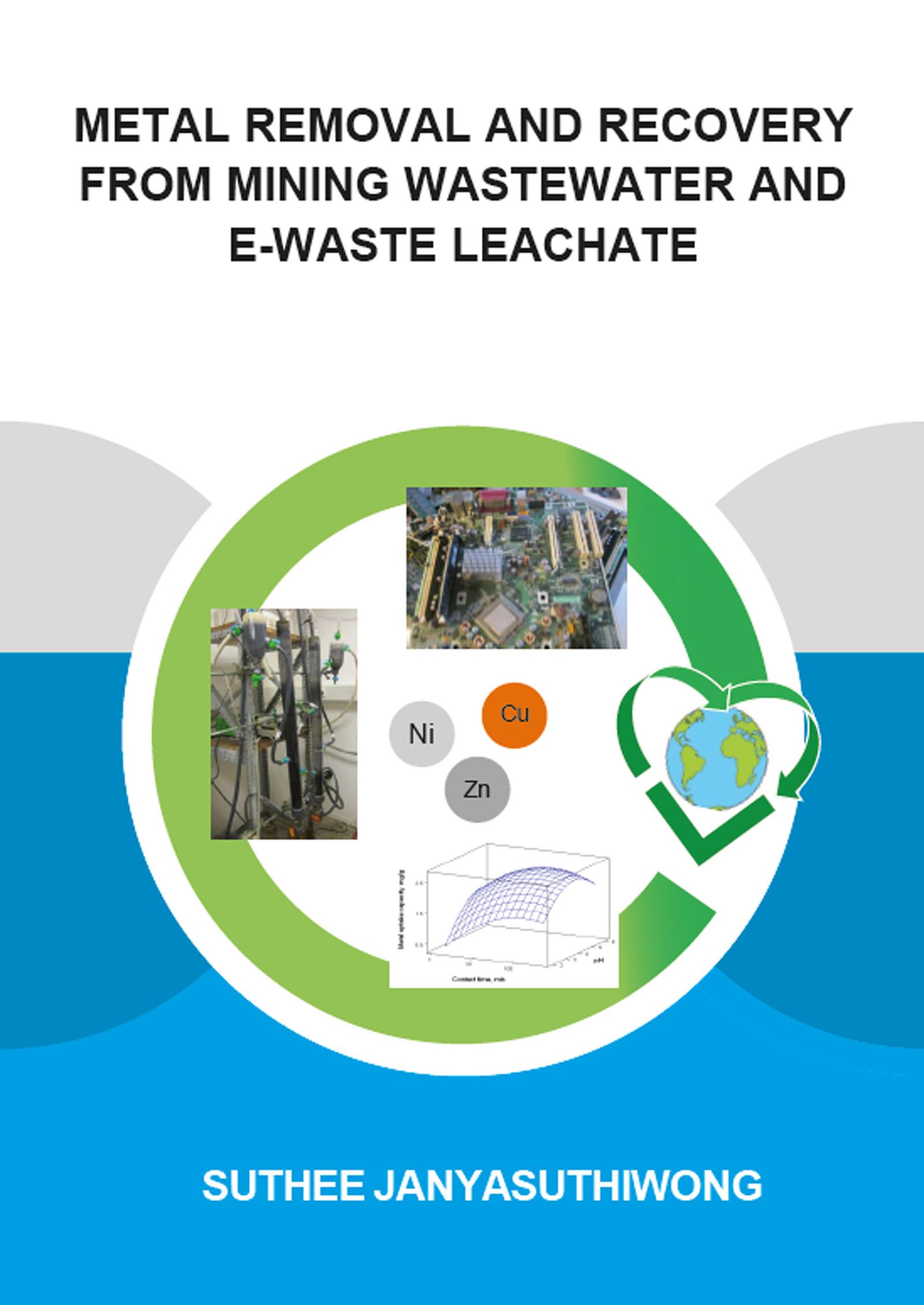
Metal contamination in the environment is a persisting global issue. The metal reservoirs in the earth have declined due to society’s needs and due to uncontrolled mining activities. Therefore, the idea to recover metals from waste streams has emerged.
In this thesis, cost competitive technologies such as adsorption using agro-wastes and precipitation using an inverse fluidized bed (IFB) reactor were investigated, with special emphasis on the recovery of base metals. Groundnut shell showed good potential for metal (Cu, Pb and Zn) removal. From artificial neural network modeling, the performance of the sulfate reducing bacteria (SRB) was found to be strongly pH dependent; the removal efficiency of Cu and Zn in the IFB at pH 5.0 was >97%. Electronic waste is a good candidate as secondary metal resource. The recovery of Cu from computer printed circuited boards (PCBs) using biogenic sulfide precipitation was investigated as well. Using this technology, Cu could be recovered at ~0.48 g Cu/g PCBs.
Paga facilmente con carta, Klarna, Apple Pay o Google Pay. Non sei soddisfatto? Hai sempre 14 giorni per il rimborso. Leggi di più nei nostri termini. Per qualsiasi domanda, scrivici a hello@memmo.org.
Memmo rende lo studio più facile, ovunque tu sia nel mondo. Qui trovi i tuoi libri di testo e strumenti di studio intelligenti, tutto in un unico posto: riassunti, quiz, podcast e flashcard. E poi c'è Ted, il tuo compagno di studio che risponde a ogni tua domanda. Oltre 50.000 studenti studiano già qui: è stato creato per aiutarti a imparare più velocemente e a stressarti meno.