
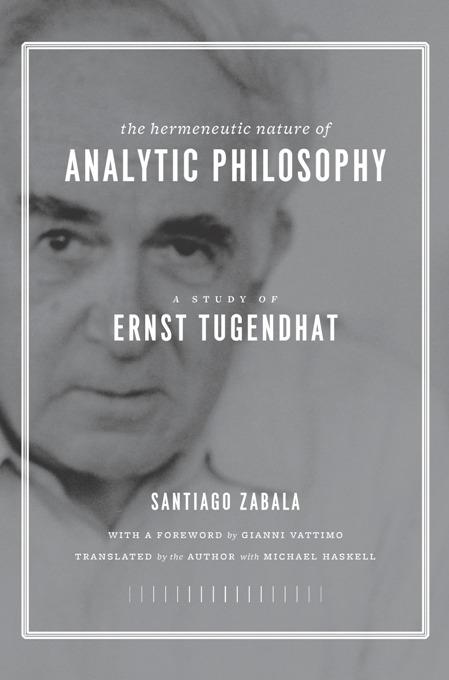
Contemporary philosopher—analytic as well as continentaltend to feel uneasy about Ernst Tugendhat, who, though he positions himself in the analytic field, poses questions in the Heideggerian style. Tugendhat was one of Martin Heidegger's last pupils and his least obedient, pursuing a new and controversial critical technique. Tugendhat took Heidegger's destruction of Being as presence and developed it in analytic philosophy, more specifically in semantics. Only formal semantics, according to Tugendhat, could answer the questions left open by Heidegger.
Yet in doing this, Tugendhat discovered the latent "hermeneutic nature of analytic philosophy"its post-metaphysical dimension—in which "there are no facts, but only true propositions." What Tugendhat seeks to answer is this: What is the meaning of thought following the linguistic turn? Because of the rift between analytic and continental philosophers, very few studies have been written on Tugendhat, and he has been omitted altogether from several histories of philosophy. Now that these two schools have begun to reconcile, Tugendhat has become an example of a philosopher who, in the words of Richard Rorty, "built bridges between continents and between centuries."
Tugendhat is known more for his philosophical turn than for his phenomenological studies or for his position within analytic philosophy, and this creates some confusion regarding his philosophical propensities. Is Tugendhat analytic or continental? Is he a follower of Wittgenstein or Heidegger? Does he belong in the culture of analysis or in that of tradition? Santiago Zabala presents Tugendhat as an example of merged horizons, promoting a philosophical historiography that is concerned more with dialogue and less with classification. In doing so, he places us squarely within a dialogic culture of the future and proves that any such labels impoverish philosophical research.
Paga facilmente con carta, Klarna, Apple Pay o Google Pay. Non sei soddisfatto? Hai sempre 14 giorni per il rimborso. Leggi di più nei nostri termini. Per qualsiasi domanda, scrivici a hello@memmo.org.
Memmo rende lo studio più facile, ovunque tu sia nel mondo. Qui trovi i tuoi libri di testo e strumenti di studio intelligenti, tutto in un unico posto: riassunti, quiz, podcast e flashcard. E poi c'è Ted, il tuo compagno di studio che risponde a ogni tua domanda. Oltre 50.000 studenti studiano già qui: è stato creato per aiutarti a imparare più velocemente e a stressarti meno.