
Antes de Memmo, mis apuntes estaban dispersos en PDFs. Ahora, un espacio de trabajo lo reúne todo y veo exactamente lo que me queda por estudiar.
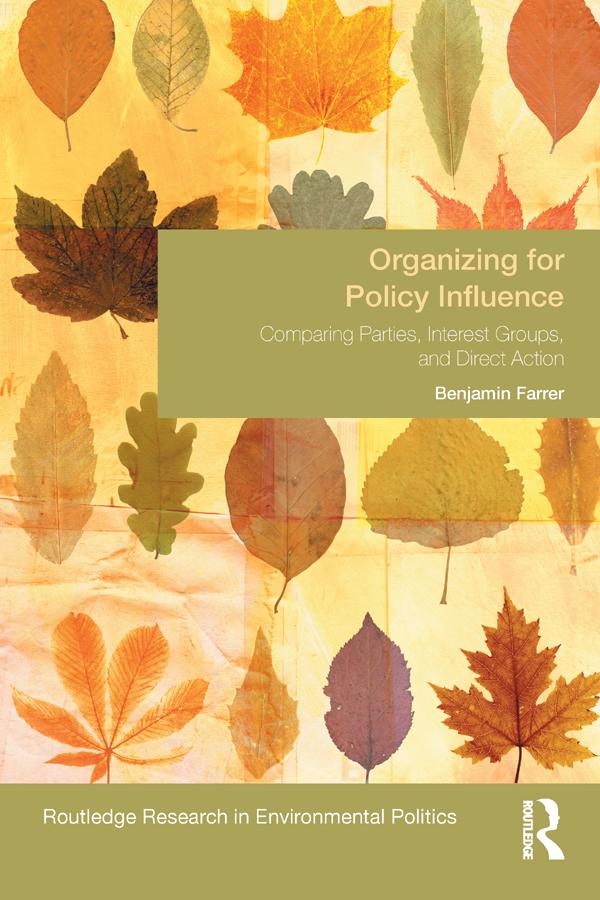
In this book, Benjamin Farrer explains how activists can influence the policies they care about, even when they are outnumbered and their issues are ignored. The solution lies in a surprising place: organizational choice. Different types of organizations will be more influential under particular democratic institutions. If they choose the optimal type of organization - given their institutional context - then even minority groups can be influential. Environmentalists are a key example of how small groups can sometimes punch above their weight. Environmentalists in different countries have made different organizational choices. These choices explain whether or not they succeeded in influencing policy. In the empirical chapters that follow, Farrer shows that environmentalists can sometimes be more influential if they form interest groups, but under other institutions, political parties are the optimal organizational choice. Although interest groups are often easier to create, national institutions can sometimes insulate mainstream politicians from niche interest groups. When institutions deny access to interest groups, activists are forced to send the stronger signal of party entry.
Using a variety of methods, including a formal model, an experiment, and a wealth of empirical data from a variety of settings, Farrer proves that this theory of organizational choice adds to our understanding of several crucial phenomena. First, it helps explain patterns of political participation, by showing the importance of instrumental, rather than purely expressive, motivations for activism. Second, it provides an important modification to Duverger’s (1954) law, by showing that new party entry is a function not only of electoral rules but also of the rules that govern interest groups. Third, it extends research on the role of institutions in determining policy outputs, by showing that policy outcomes are a function of the interaction between organizational choices and institutional context.
Antes de Memmo, mis apuntes estaban dispersos en PDFs. Ahora, un espacio de trabajo lo reúne todo y veo exactamente lo que me queda por estudiar.
Los resúmenes de Memmo son oro antes de los exámenes. No tengo que releer 800 páginas dos semanas antes, solo las partes importantes.
El chat de IA me ha salvado la noche antes de un examen más de una vez. Sigo preguntando hasta que lo entiendo, sin esperar a que un grupo de estudio responda.
Los cuestionarios aciertan exactamente lo que necesito saber. Memmo registra dónde me atasco, así que solo practico lo que vale la pena.
Las flashcards con repetición espaciada son magia. Memmo sabe cuándo estoy a punto de olvidar algo y me lo recuerda.
Los pódcasts de IA son mis favoritos. Los escucho de camino a la universidad y obtengo un resumen sin tener que sentarme frente a un ordenador.

Handbok i kvalitativa metoder
281 kr

Hållbar utveckling: en introduktion för ingenjörer och andra problemlösare
334 kr

Brymans Samhällsvetenskapliga metoder
390 kr

Projektledning
491 kr

Den orättvisa hälsan: om socioekonomiska skillnader i hälsa och livslängd
326 kr

Organizational Leadership
429 kr

Vetenskapsteori för nybörjare
196 kr

På väg mot läraryrket
172 kr

Det sociala livet i skolan: Socialpsykologiska perspektiv
253 kr

Betygsättningens didaktik
151 kr

Personality
402 kr

Studying Leadership
404 kr

Managing Innovation
477 kr

Introduktion till samhällsvetenskaplig metod
347 kr

The Psychology of Sex and Gender
698 kr

Introduction to Leadership
605 kr

Evidens och kunskap för socialt arbete
207 kr