
Antes de Memmo, mis apuntes estaban dispersos en PDFs. Ahora, un espacio de trabajo lo reúne todo y veo exactamente lo que me queda por estudiar.
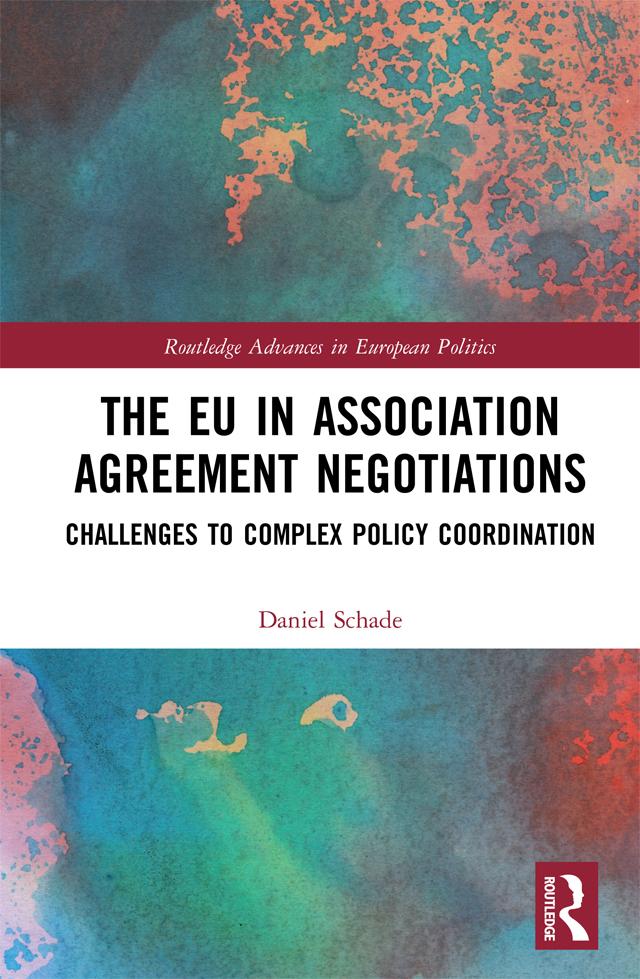
Through its focus on EU Association Agreement negotiations, this book goes beyond the study of traditional EU trade negotiations and puts the spotlight on the increasing number of negotiations where trade relations are discussed alongside political ones. This setting makes both the negotiations themselves and the definition of the EU’s positions more complicated, raising the question as to what ultimately determines the EU’s behaviour in such complex negotiations spanning multiple of the EU’s policy areas.
Offering a generalizable analytical model to study such complex EU international negotiations, the book illuminates the preferences and interactions between individual parts of the EU’s foreign affairs bureaucracy, and those between the lead actors, the Directorate General for Trade, and the European External Action Service (EEAS), in particular. In doing so, it demonstrates the utility of adapting the concept of bureaucratic politics from Foreign Policy Analysis (FPA) to the EU’s foreign policy decision-making apparatus across different stages of EU international negotiations. It also discusses how the institutional changes of the Treaty of Lisbon have altered the institutional set-up of the EU’s foreign affairs bureaucracy and thereby changed the foundations of the EU’s bureaucratic politics. Finally, the book finds that the EU’s behaviour in these negotiations is ultimately shaped, on the one hand, by the presence of diverging positions between its institutional actors, and the difficulty to bridge them through policy coordination mechanisms, on the other. Empirically, it explores these dynamics by considering the EU’s Association Agreement negotiations on the Latin American continent over the last twenty years before demonstrating the analytical model’s utility in the context of the EU’s negotiations with Ukraine and Japan.
This book will be of key interest to scholars, students, and practitioners in EU foreign affairs/external relations, EU public administration and public policy, EU trade policy, and more broadly to Foreign Policy Analysis and International Relations.
Antes de Memmo, mis apuntes estaban dispersos en PDFs. Ahora, un espacio de trabajo lo reúne todo y veo exactamente lo que me queda por estudiar.
Los resúmenes de Memmo son oro antes de los exámenes. No tengo que releer 800 páginas dos semanas antes, solo las partes importantes.
El chat de IA me ha salvado la noche antes de un examen más de una vez. Sigo preguntando hasta que lo entiendo, sin esperar a que un grupo de estudio responda.
Los cuestionarios aciertan exactamente lo que necesito saber. Memmo registra dónde me atasco, así que solo practico lo que vale la pena.
Las flashcards con repetición espaciada son magia. Memmo sabe cuándo estoy a punto de olvidar algo y me lo recuerda.
Los pódcasts de IA son mis favoritos. Los escucho de camino a la universidad y obtengo un resumen sin tener que sentarme frente a un ordenador.

Handbok i kvalitativa metoder
281 kr

Hållbar utveckling: en introduktion för ingenjörer och andra problemlösare
334 kr

Brymans Samhällsvetenskapliga metoder
390 kr

Projektledning
491 kr

Den orättvisa hälsan: om socioekonomiska skillnader i hälsa och livslängd
326 kr

Organizational Leadership
429 kr

Vetenskapsteori för nybörjare
196 kr

På väg mot läraryrket
172 kr

Det sociala livet i skolan: Socialpsykologiska perspektiv
253 kr

Betygsättningens didaktik
151 kr

Personality
402 kr

Studying Leadership
404 kr

Managing Innovation
477 kr

Introduktion till samhällsvetenskaplig metod
347 kr

The Psychology of Sex and Gender
698 kr

Introduction to Leadership
605 kr

Evidens och kunskap för socialt arbete
207 kr