
Can you use AI in your studies? The rules, the cheating, and how to do it right
The short answer: yes, usually – but not always, and not just any way you like. "Can you use AI in your studies?" is right now one of the most common questions among students in Sweden, and the honest truth is that there is no single answer that applies everywhere. The rules differ between institutions, between courses, and sometimes even between different parts of the same course.
This guide unpacks how things actually stand at Swedish universities, where the line into cheating is drawn, and how to use AI in a way you can stand behind – both in front of your examiner and in front of yourself.
There is no national rulebook – it is decided locally
Many people believe there is a central Swedish rule for AI in studies. There isn't. Each institution sets its own guidelines, and they are also interpreted differently across the departments.
Karolinska Institutet, Lund University, Uppsala University, Chalmers and Stockholm University have all produced guidance on generative AI – but they land in different places. Some courses encourage AI as a study aid, others allow it on the condition that you disclose how you used it, and some ban it entirely during examination. The point is this: your course decides, not the university as a whole and definitely not what a friend on another programme says.
So the first thing you should do is concrete: read the course syllabus, the examination instructions and your institution's student web pages. If they say nothing – ask your examiner before you hand in. It is always permitted to ask, and it protects you.
If you use AI in a way the course does not allow, and you don't disclose it, it can be classified as deception during examination under the Higher Education Ordinance. The case then goes to the institution's disciplinary board, which can decide on a warning or a suspension. This is the same serious track as plagiarism and unauthorised collaboration – AI is not some grey zone that sits outside the system.
Allowed or risky? A simple overview
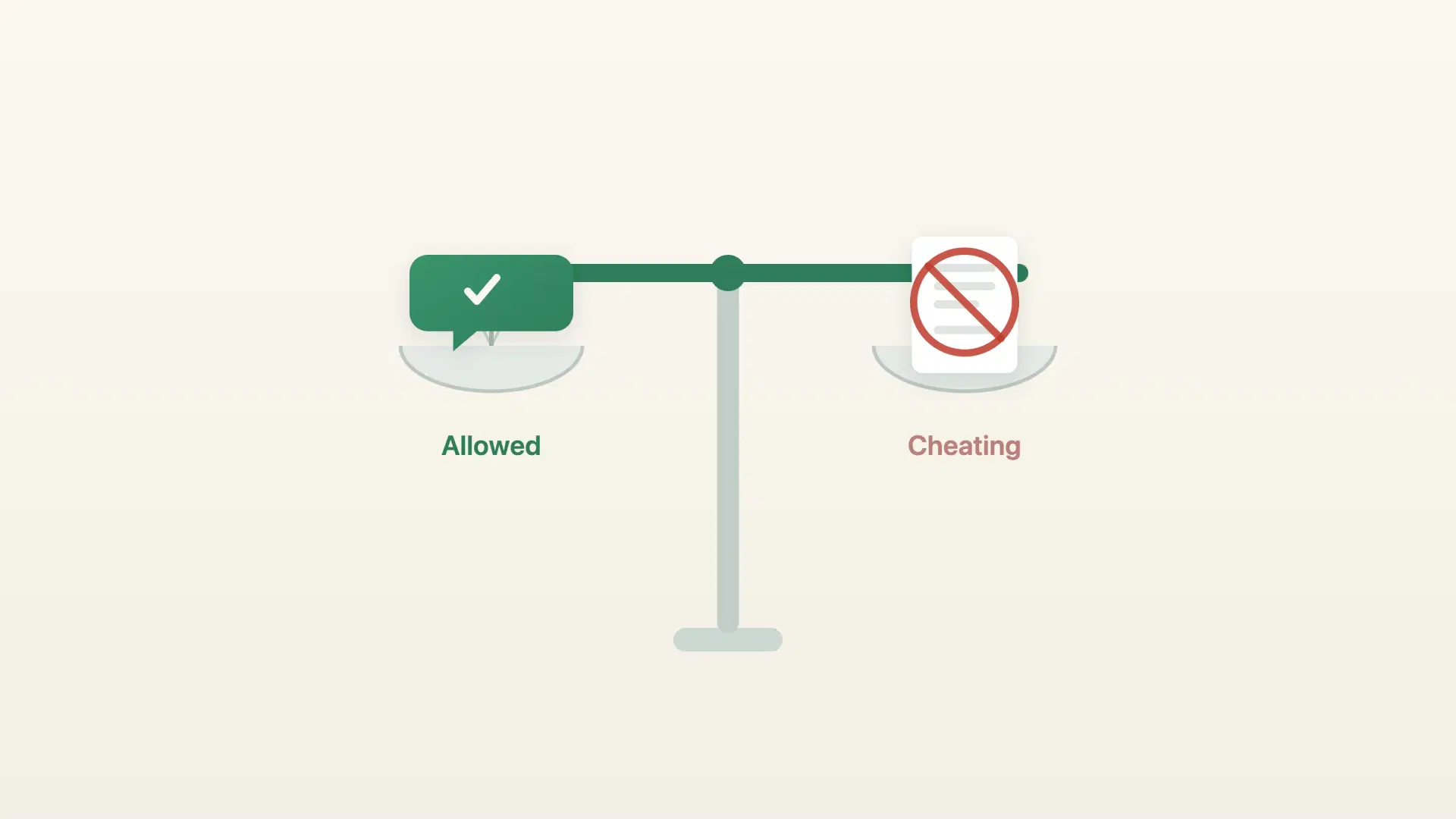
The exact rules vary, but the pattern is fairly clear: AI that helps you learn is usually fine, whereas AI that replaces your own work is where it gets dangerous.
| What you do | Usually OK | Risky / often cheating |
|---|---|---|
| Letting AI explain a difficult concept | ✔️ Yes | |
| Summarising your own notes | ✔️ Yes | |
| Creating a quiz to revise for an exam | ✔️ Yes | |
| Planning out a study week or an essay structure | ✔️ Yes | |
| Getting help finding the right wording for a sentence | ✔️ Usually | |
| Letting AI write the entire essay for you | ❌ Cheating | |
| Pasting in AI text you don't understand or can't explain | ❌ Risk | |
| Using AI in an in-hall or take-home exam where it is banned | ❌ Cheating | |
| Submitting AI-generated sources without checking them | ❌ Risk |
Note that even the "usually OK" column can tip over into risk if your particular course bans all use of AI. The table is a rule of thumb, not a guarantee.
The two-question test: how to know you're doing it right
When you're unsure, ask yourself two questions. If you pass both, you're on safe ground.
1. Do the course rules allow what I'm about to do? Not AI in general – this specific task, in this specific course.
2. Can I stand behind and explain what I'm handing in? If the examiner points at a paragraph and asks "tell me how you arrived at this" – can you answer without hesitating? If the answer is no, AI has done the work in your place, and then it is no longer your work.
The beauty of the test is that it works regardless of what the rules say in detail. It shifts the focus from "what can I get away with" to "what have I actually learned".
The myth of the AI detectors
A common worry is: "What if I use AI legitimately but a detector flags me anyway?" That worry is justified – but not in the way people think.
AI detectors are unreliable. They regularly misflag text written entirely by hand, and they more often hit those who write in their second language or in a tight, academic style. At the same time, they miss text that has been lightly rewritten. No institution can base a cheating case solely on a detector's verdict.
The conclusion is not "so it doesn't matter". On the contrary: because the technology can't settle the matter, the responsibility falls on you to be transparent. Disclose how you used AI when the course requires it. Be open in your methodology section. Transparency is your best protection – far better than hoping no one notices anything.
Choose an AI you can trust
The big problem with ordinary chatbots in a study context isn't that they are banned – it's that they make things up. They can deliver a confident source, a quote or a date that simply does not exist. If you hand that in, you have a problem that is yours, not the chatbot's.
This is where AI built for studying is different. Memmo's AI is source-verified: it answers based on your own uploaded material and states where the information comes from, instead of guessing freely. That way you can actually check a claim against the source – exactly what the two-question test demands. It also makes it easier to handle your referencing correctly, and to ask follow-up questions about your uploaded material without sinking into the swamp of made-up answers.
It isn't about whether AI is cheating or not cheating. It's about using a tool that helps you understand and be able to stand behind your work – not one that produces text you have to trust blindly.
FAQ
Can you use AI in your studies?
Yes, in the vast majority of cases – but it is decided by your course, not by any national rule. AI as a study aid (explaining, summarising your notes, quizzing yourself, planning) is usually allowed. Letting AI do the actual examination work, on the other hand, rarely is. Always read the course syllabus and ask your examiner if you're unsure.
Is using ChatGPT cheating?
Not in itself – it depends entirely on how and where. Using Memmo to understand a concept is one thing; letting a chatbot write your submission and handing it in as your own, in a course that forbids it, is something else entirely – and it can be classified as deception during examination and end up before the disciplinary board. The two-question test applies: do the rules allow it, and can you stand behind it?
Which AI is best for schoolwork?
The one you can trust and check. For studying, source-verified AI that answers based on your own material and cites its sources – like Memmo – beats general chatbots that sound convincing but sometimes make up facts and references. The best AI for schoolwork is the one that helps you learn and that you can disclose openly.