
Best AI study apps for university students (2026)
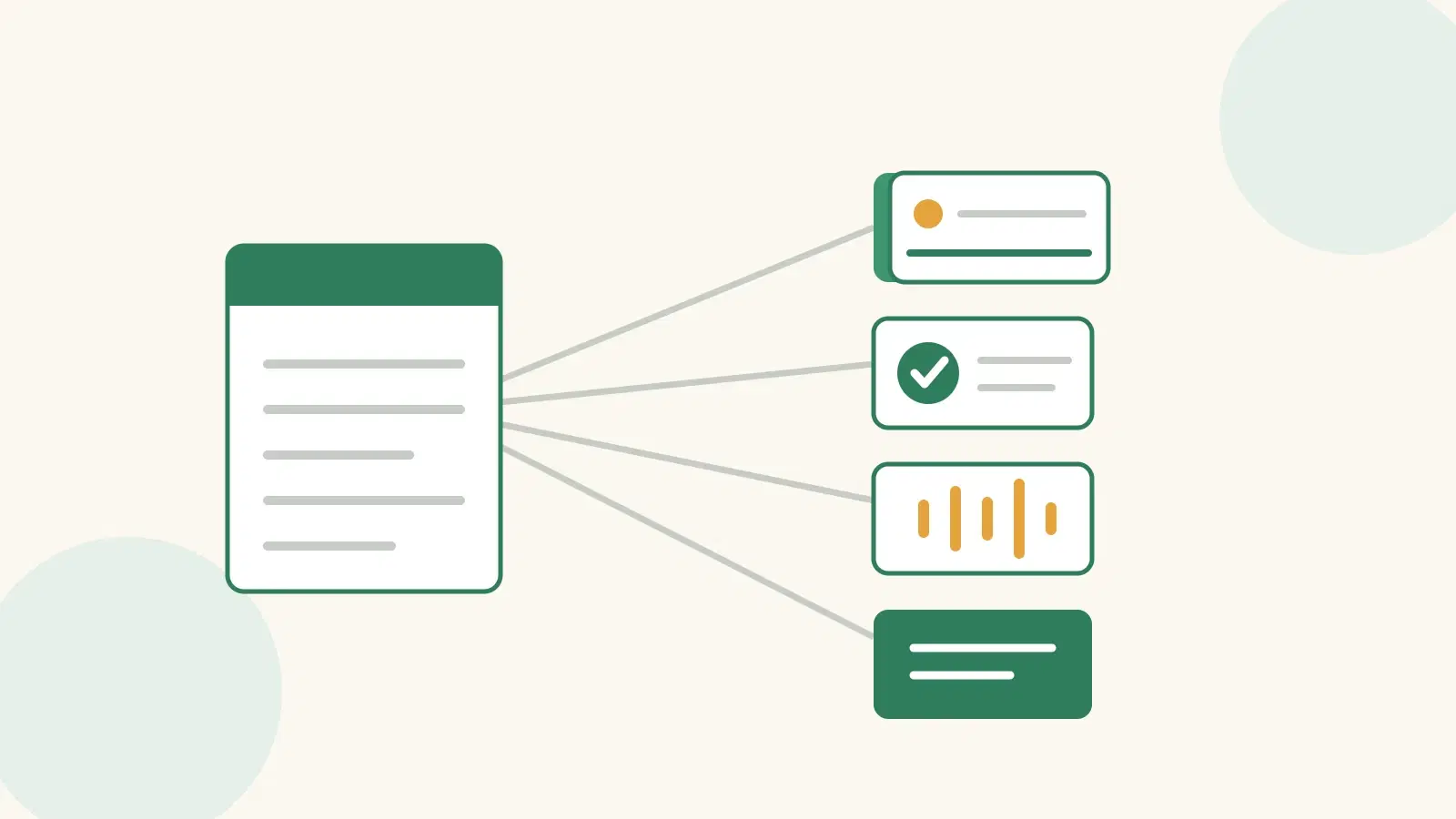
There is no single best AI study app — the right one depends on what you study from and how you revise. Anki is the benchmark for spaced repetition if you build cards by hand; NotebookLM is the strongest free tool for grounded questions on sources you paste in; Quizlet wins on shared decks; and Memmo is built for the case the others leave out — one upload, your own course textbook or lecture notes, turned into flashcards, quizzes, summaries and a podcast at once. Studocu is a document library rather than a study tool, and Coconote and StudyFetch sit in between.
Key takeaways
- Match the tool to your material: fact-heavy courses need spaced repetition, reading-heavy ones need summaries and grounded Q&A.
- These are purpose-built study apps. For general chatbots like ChatGPT and Gemini, see our AI tools comparison instead.
- Memmo's edge is one source, every format — and that it works from your course textbook, not only audio or web links.
- Honest limits apply to all of them: Anki has a learning curve, Quizlet paywalls its AI, Studocu is a repository, and Memmo is the newer, smaller name.
How do you choose an AI study app?
Start from your material and your exam, not the feature list. If your course is fact-dense — anatomy, law, vocabulary — you need spaced repetition, and the app's scheduling matters more than anything else. If it is reading-heavy, you need fast summaries and a way to ask questions of the text. If you learn by listening, an audio format earns its place. The right tool is the one that turns what you already have — a textbook chapter, a stack of lecture notes, a past paper — into the format your brain revises from.
Two findings sit underneath every good study app. Roediger and Karpicke (2008) showed that retrieving a fact from memory strengthens it far more than rereading, and Dunlosky and colleagues (2013) ranked practice testing and distributed practice as the two most effective techniques of the ten they reviewed. An app that only helps you reread — however slick — is working against the evidence.
Is Quizlet still worth it for university?
Yes for shared decks, less so for AI. Quizlet's library of student-made sets is unmatched, and for a common first-year module someone has usually already built the deck. Its "Magic Notes" can generate cards from pasted text, and Learn mode gives you a basic testing loop. The honest catch: the AI generation and unlimited Learn sit behind Quizlet Plus, the free tier carries ads, and a stranger's deck is built for a stranger's exam — the coverage rarely matches your syllabus. Great for quick, popular topics; weaker when your course is niche or your lecturer sets the questions.
Is Anki the best app for spaced repetition?
For scheduling, yes — with one caveat: Anki is not an AI app. It is the open-source benchmark for spaced repetition, and since it adopted FSRS it shows you each card at the moment recall is about to fail, which is exactly what fact-heavy revision needs. Medical students live in it for good reason. The price you pay is effort: you build every card by hand, the interface is dated, and the learning curve is real. If you love making cards and want the deepest scheduling, nothing beats it. If you want that scheduling without the manual card-building, that is the gap other tools fill.
What is Studocu good for?
Finding documents, not studying them. Studocu is a large repository of student notes, summaries and past papers, useful when you want to see how others summarised a course or get hold of an old exam. But it is a library, not a study tool: there is no spaced repetition, no quiz engine built from your own material, and access often runs on an upload-to-unlock model. Treat it as a source you feed into a study app, not as the study app itself.
What can NotebookLM do — and not do?
NotebookLM (Google) is the best free tool for asking grounded questions of your own sources. You add documents, and it answers with citations back to them and can generate a surprisingly good audio overview — a real strength for reading-heavy courses. What it does not do is revise you: there is no spaced-repetition flashcard system, no quiz that tracks what you keep getting wrong, and nothing built around courses, exams or a study schedule. It is a superb reading and Q&A companion, and a poor substitute for a revision system.
What about Coconote and StudyFetch?
Both are purpose-built and worth knowing. Coconote turns audio — recorded lectures, videos — into notes and flashcards, which is genuinely useful if your learning is lecture-first; its weakness is that it is built around audio more than your textbook, and it is a smaller product. StudyFetch bundles an AI tutor (Spark.e), flashcards and quizzes into one set, but it paywalls quickly and is US-centric. Neither is a bad choice; both are narrower than their marketing suggests, which is exactly the kind of honesty a comparison should give you.
Where does Memmo fit in?
Memmo is built for the case the others leave out: turning one source you already have into every study format at once. Upload a course textbook chapter, your lecture notes or a past paper, and Memmo generates flashcards, a quiz, a summary and even a study podcast from it — and the flashcards are scheduled with FSRS, the same algorithm Anki uses. It is built around university courses, with 13,000+ public past exams across real modules. The honest limits: it is the newer and smaller name here, the free tier runs on a weekly quota, and it works best on material you upload rather than as a marketplace of ready-made decks. If your problem is "I have the textbook and no time", it is the most direct fit; if your problem is "I want a deck for a popular first-year course", Quizlet may get you there faster.
Which AI study app should you pick?
Pick by material and by how you revise, not by brand.
| Tool | Best for | Works from your own material | Spaced repetition | Honest limitation | Cost |
|---|---|---|---|---|---|
| Memmo | One upload → flashcards, quiz, summary, podcast | Yes — textbook, notes, past papers | Yes — FSRS | Newer, smaller brand; best on your own uploads | Free weekly quota; paid for more |
| Anki | Deep spaced repetition, fact-heavy courses | You build cards by hand | Yes — FSRS, best-in-class | Not AI; steep learning curve, dated UI | Free and open source (paid iOS app) |
| NotebookLM | Grounded Q&A and audio from your sources | Yes — you add the sources | No | No revision system, quizzes or scheduling | Free |
| Quizlet | Shared decks for common courses | Partly — paste text, not a full PDF | Basic (Learn mode) | AI and unlimited study behind Quizlet Plus | Free tier; paid Plus |
| Studocu | Finding notes and past papers | No — it is a library | No | A repository, not a study tool | Upload-to-unlock; paid |
| Coconote | Turning recorded lectures into notes/cards | Yes — audio and video | Basic | Audio-first, smaller product | Free tier; paid |
| StudyFetch | All-in-one AI set with a tutor | Yes — upload documents | Basic | Paywalls quickly, US-centric | Free trial; paid |
A few concrete cases. Medical students drowning in facts should lean on spaced repetition — Anki or Memmo — and feed in past papers early. Students with ADHD tend to do better with one place that turns a source into structure automatically, rather than five apps to juggle. In exam week, the fastest wins are a summary of what you have not read and a quiz on what you have — generate them early enough that spaced repetition has room to work. And if you are weighing Memmo against Quizlet specifically, we compare them head to head here.
Frequently asked questions
What is the best AI study app for university students?
It depends on your material. For deep spaced repetition, Anki; for grounded Q&A on your readings, NotebookLM; for shared decks, Quizlet. If you want one upload — your textbook or notes — turned into flashcards, a quiz, a summary and a podcast at once, that is what Memmo is built for.
Is there a free AI study app?
Yes. NotebookLM is free, Anki is free and open source, and Quizlet, Memmo, Coconote and StudyFetch all have free tiers — though the AI features and unlimited study are usually part of a paid plan.
What is the best AI study tool for medical students?
Fact volume is the deciding factor, so prioritise spaced repetition: Anki is the long-standing choice, and Memmo gives you the same FSRS scheduling without building every card by hand. Feeding in past exam papers early is what separates a pass from a strong pass.
Can an AI study app replace studying?
No — and any that claims to is overselling. The apps that work do so by making you retrieve information yourself (Roediger and Karpicke, 2008); the ones that only summarise for you leave you feeling prepared without being prepared. Use them to run active recall, not to avoid it.