
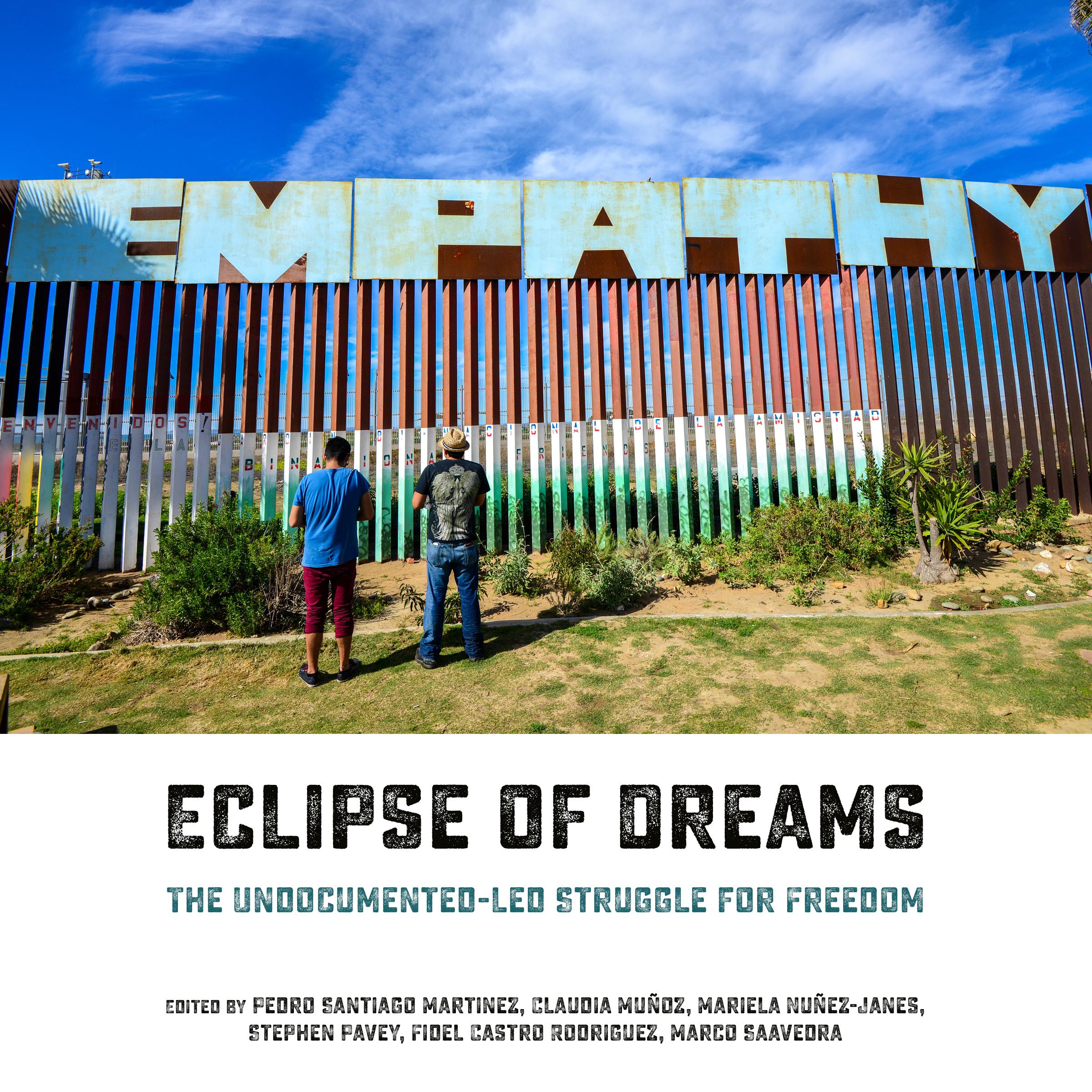
excerpts from Introduction
Some things can only be learned in the darkness. We had already come to realize this somewhere deep within our bodies, from sharing our stories and listening to the ones of so many other courageous youth coming out of the shadows, declaring, “I am undocumented and unafraid.” What we have come to know as true, we learned by navigating the contradictions lived deep within experiences of illegality, inequality and the everyday threat of deportability. Our common struggle for human freedom, and at times simply for survival, led to this moment, imbued with optimism, hard work and determination – this moment where belonging, civil rights, upward mobility, and a path to citizenship might come true. This was our dream.
On December 18, 2010, the Senate Gallery of the U.S. Capitol could scarcely hold the multitude of undocumented youth, family and friends. The Senate Gallery was crowded with hope. Some of us woke early that morning to brave the harsh cold, the long lines passing through the Capitol’s visitor center security, and most importantly to brave the senate vote on the DREAM Act (Development Relief and Education for Alien Minors). Others gathered across the U.S. in living rooms, classrooms and community halls sitting in front of televisions tuned in to the senate vote streaming live on C-Span. Some waited and watched alone.
. . .
Two and a half hours after the Senate was called to order, at 11:31 AM, the chair reminded the Gallery that “expressions of approval or disapproval are not permitted.” Around the Gallery we all held each other’s hands. The fate of the DREAM Act, our fate, was clear as we watched each Senator come forward to cast their vote, some very visibly with their thumbs down. “The motion is not agreed to.” The DREAM Act failed to pass 55 years to 41 nays, just five votes short to overcome a Republican filibuster. It was so close. There was a visible numbness, a shock that immediately gave way to tears and strong embraces across the gallery. What now – now that we witnessed this eclipse of dreams?
. . .
In other places and times, an eclipse warned of imminent danger, disaster, even the end of the world. The failure of the DREAM Act felt like this. Yet in the darkness of this moment it did not take long to realize a glimpse of light. Maybe, just maybe, the eclipse was a warning to us. What if our dreams, what if the very scope of our horizons, what we dreamt for ourselves and others, was limited not by our personal dreams, but by a dream framework, the American Dream? What if out of our real pain and desire for freedom, we had become pawns in a system where freedom is an illusion? Did we loose track of our ends and compromised on our means because of this Dream framework? What if the organizations that claimed to represent us under a united dream were never united? What if from the onset our framing of the issue, our struggle for freedom was itself problematic? In the darkness we began to realize that the search for a solution to the immigration problem, when mired in the rationale of the American Dream, becomes itself part of the problem.
As we asked ourselves these questions and contemplated the end of our world, the end of the dream, the light that we witnessed and we began to follow was in our own lives. We began to understand the choices and lives of our parents as filled with dignity and courage. Instead of blaming them we praised them for their faith to risk everything for their children. And now that darkness eclipsed our personal dreams, we saw the absurdity of what W.E.B Du Bois described as the “strong man,” the DREAMer, “fighting to be free in order that another people should not be free.”
What passed as an eclipse, was possibly a reminder, a warning, that what was lost, if we had won, might have truly destroyed us. We might have won our rights to the American Dream, at the expense of the greater struggle for our freedom. “Uncle” Vincent Harding would later tell us that it was lazy journalists and historians that framed our movement as a civil rights movement; it was always for us the black-led struggle for freedom. Michele Alexander challenges us to consider what was lost, when we celebrated our win of civil rights and embraced a politics of respectability.
We were reminded of what we were learning in the dark when President Barack Obama spoke to the nation just a month later, saying, “Today, there are hundreds of thousands of students excelling in our schools who are not American citizens. Some are the children of undocumented workers, who had nothing to do with the actions of their parents . . . as soon as they obtain advanced degrees, we send them back home to compete against us. It makes no sense . . . let's stop expelling talented, responsible young people who could be staffing our research labs or starting a new business, who could be further enriching this nation.”
For the “strong man,” the perfect Dreamer, to gain rights, meant, the bad Dreamer is deportable, and further, disparage the “illegal” dreams of the parents of the perfect Dreamer. We began to see that the criteria for the DREAM Act re-inscribed and re-enforced race and class barriers to inclusion in this society. The DREAM Act would bar the rest of the undocumented community from gaining access to freedom in the U.S. This framework of the American Dream came with great costs.
We continue to search for light and discover hope in the darkness. And James Baldwin may best describe what we learned, saying, “Any real change implies the breakup of the world as one has always known it, the loss of all that gave one an identity, the end of safety. Yet, it is only when a man is able, without bitterness or self-pity, to surrender a dream he has long cherished or a privilege he has long possessed that he is set free – he has set himself free – for higher dreams, for greater privileges.” This greater privilege is the struggle for our collective freedom, for our collective humanity, for our collective dignity. Du Bois, warned us that the great tragedy of our time, for undocumented families, for this nation and this world is not poverty, wickedness, or ignorance, but “that humans know so little of humanity.”
In the next pages we invite you to learn about our journeys through the darkness as we search for light after the eclipse of dreams; to learn, through our stories of struggle and fear of living “illegal”, a little more about what it means to be human, to discover dignity and what it might mean to shed light on our global humanity.
Pay easily by card, Klarna, Apple Pay or Google Pay. Not happy? You always have a 14-day money-back guarantee. Read more in our terms. If you have any questions, email us at hello@memmo.org.
Memmo makes studying easier – wherever you are in the world. We bring your course books and smart study tools together in one place: summaries, quizzes, podcasts and flashcards. Plus Ted, your study buddy who answers anything you wonder. Over 50,000 students already study here – built to help you learn faster and stress less.