
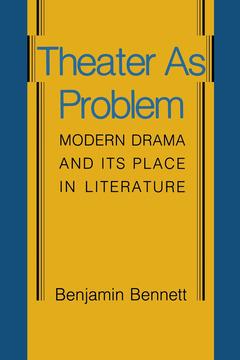
Using examples ranging from nineteenth-century Viennese comedy to Friedrich Dürrenmatt's atomic-age theater, Benjamin Bennett explores what is at stake in the theory of drama; what sort of questioning makes up that theory; and in what direction such questioning leads.
Bennett takes as his starting point the inescapably literary nature of theater in the European tradition, theater in its most concrete dimensions: as an institution, as a tradition of ritual or stylized behavior, as a particular type of physical space, as an economic venture. He maintains that, precisely because of its radical categorical disjunction from the domain of the literary, theater in the European tradition has been appropriated as the principal vehicle by which literature repeatedly problematizes itself. Theater, he says, is "the church of literature." Although he is concerned with drama as a literary type, therefore, Bennett does not treat the theory of drama as part of the theory of literature. For the special relation of drama to literature calls into question the whole idea of literary theory as a stable discourse divisible into parts.
Bennett considers plays by Nestroy, Schnitzler, Ibsen, Strindberg, Brecht, Ionesco, Genet, Pirandello, Artaud, and Dürrenmatt. He focuses on such theoretical issues as the idea of generic boundaries; the relation between drama and the culture of reading; the relevance between drama and the culture of reading; the relevance of hermeneutic and semiotic views of literature to drama; and the operation of fascism as a literary phenomenon. In conclusion, he frames a problem that his readings have brought to light: at least two separate historical accounts of modern drama are necessary—theories that imply each other, yet remain irreconcilable.
Pay easily by card, Klarna, Apple Pay or Google Pay. Not happy? You always have a 14-day money-back guarantee. Read more in our terms. If you have any questions, email us at hello@memmo.org.
Memmo makes studying easier – wherever you are in the world. We bring your course books and smart study tools together in one place: summaries, quizzes, podcasts and flashcards. Plus Ted, your study buddy who answers anything you wonder. Over 75,000 students already study here – built to help you learn faster and stress less.