
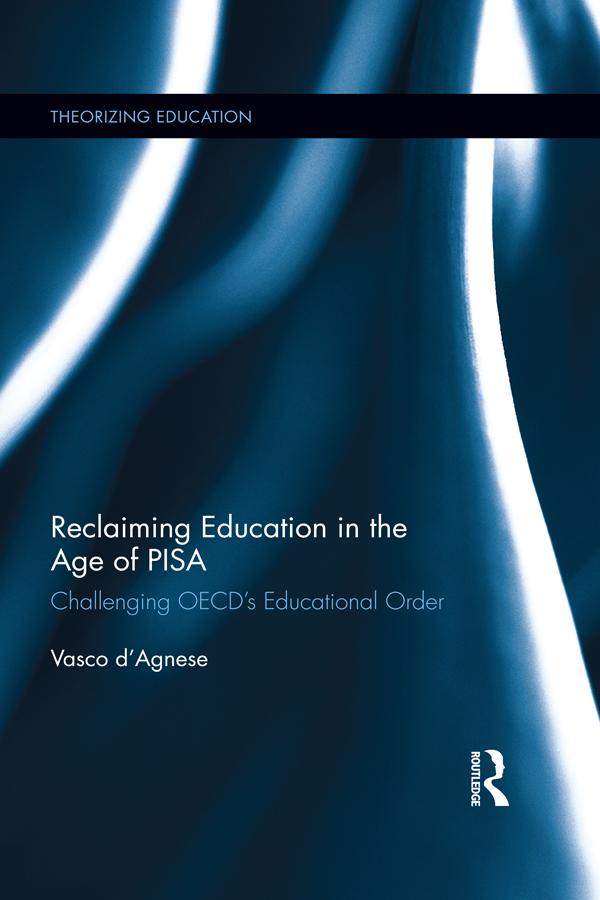
Reclaiming Education in the Age of PISA provides a critical analysis of the OECD’s educational agenda and its main tool, namely, PISA (Programme for International Student Assessment). Based on an analysis of the OECD’s public documents, including publications, webpages, and videos, d’Agnese argues that PISA is not just an assessment tool, but rather an all-encompassing framework that intends to govern education, schooling, living and society worldwide. This creation of what d’Agnese calls a life-brand raises concerns that education and learning are becoming wares and that, consequently, we run the risk of transforming schools into providers and teachers into agents of preconceived learning packages.
In pursuing only one concept of education, and a very narrow one at that, d’Agnese argues that OECD not only narrows down education to a mere reproductive process, but that such an approach also erases the basic rules by which living develops and evolves. In this sense PISA is but another form of authoritarian teaching, authoritarian teaching being understood as any and every educational project which sets aims and purposes of education without giving the possibility to discuss and challenge such aims and purposes.
Reclaiming Education in the Age of PISA suggests a different educational logic, emphasizing that schooling is not just a place to produce the correct skills, but is also a matter of experimentation, hesitation and wait, one in which teachers and students attempt to dwell in pure potentiality for growth.
Providing a strong argument that a different way to conceive of schooling deserves our attention, this book will be essential reading for academics, researchers and postgraduates in the fields of educational philosophy and theory, inclusive education and social justice. It should also be of interest to policymakers and educational activists.