
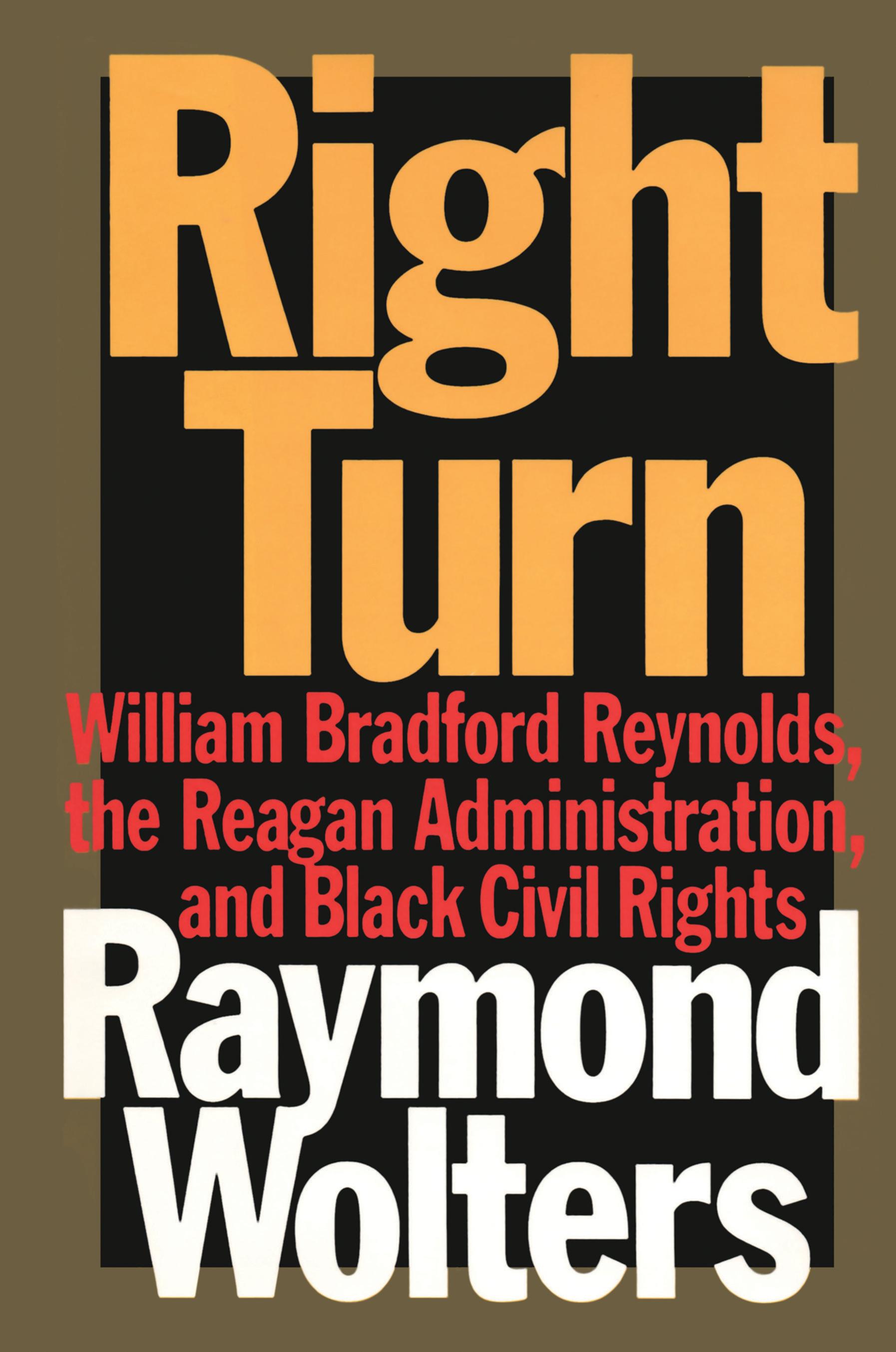
In the spirit of the time, the Civil Rights Act of 1964 and the Voting Rights Act of 1965 called for nondiscrimination for American citizens, seeking equality without regard for race, color, or creed. After the mid-1960s, to make amends for wrongs of the past, some people called for benign discrimination to give blacks a special boost. In business and government this could be accomplished through racial preferences or quotas; in public education, by considering race when assigning students to schools. By 1980 this course reached a crossroads.
Raymond Wolters maintains that Ronald Reagan and William Bradford Reynolds made the "right turn" when they questioned and limited the use of racial considerations in drawing electoral boundaries. He also documents the Reagan administration's considerable success in reinforcing within the country, and reviving within the judiciary, the conviction that every person black or white should be considered an individual with unique talents and inalienable rights.
This book begins with a biographical chapter on William Bradford Reynolds, the Assistant Attorney General who was the principal architect of Reagan's civil rights policies. It then analyzes three main civil rights issues: voting rights, affirmative action, and school desegregation. Wolters describes specific cases: at-large elections and minority vote dilutions; congressional districting in New Orleans; legislative districting in North Carolina; the debates over the Civil Rights Act of 1964; social science critiques of affirmative action; the question of quotas; and school desegregation and forced busing.
Because Ronald Reagan and William Bradford Reynolds were men of the right, and because most journalists and historians are on the left, Wolters feels the "people of words" have dealt harshly with the Reagan administration. In writing this book, he hopes to correct the record on a subject that has been badly represented. Wolters points out that, beginning in the 1980s and continuing in the 1990s, the Supreme Court endorsed the legal arguments that Reagan's lawyers developed in the fields of voting rights, affirmative action, and school desegregation. In Right Turn, Wolters responds to those who claimed that Reagan and Reynolds were racists who wanted to turn back the clock on civil rights, and he describes civil rights cases and controversies in a way that is comprehensible to general readers as well as to lawyers and historians.
Pay easily by card, Klarna, Apple Pay or Google Pay. Not happy? You always have a 14-day money-back guarantee. Read more in our terms. If you have any questions, email us at hello@memmo.org.
Memmo makes studying easier – wherever you are in the world. We bring your course books and smart study tools together in one place: summaries, quizzes, podcasts and flashcards. Plus Ted, your study buddy who answers anything you wonder. Over 50,000 students already study here – built to help you learn faster and stress less.