
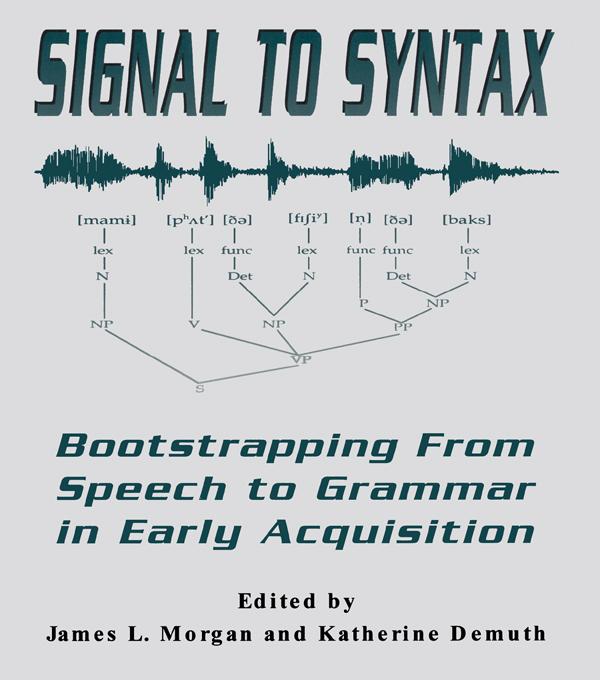
In the beginning, before there are words, or syntax, or discourse, there is speech. Speech is an infant's gateway to language. Without exposure to speech, no language--or at most only a feeble facsimile of language--develops, regardless of how rich a child's biological endowment for language learning may be. But little is given directly in speech--not words, for example, as anyone who has ever listened to fluent conversation in an unfamiliar language can attest. Rather, words and phrases, or rudimentary categories--or whatever other information is required for syntactic and semantic analyses to begin operating--must be pulled from speech through an infant's developing perceptual capacities. By the end of the first year, an infant can segment at least some words from fluent speech. Beyond this, how impoverished or rich an infant's representations of input may be remains largely unknown. Clearly, in the debate over determinants of early language acquisition, the input speech stream has too often been offhandedly dismissed as a potential source of information.
This volume brings together internationally-known scholars from a range of disciplines--linguistics, psychology, cognitive and computer science, and acoustics --who share common interests in how speech, in its phonological, prosodic, distributional, and statistical properties, may encode information useful for early language learning, and how such information may be deciphered by very young children. These scholars offer a spectrum of viewpoints on the possibility that aspects of speech may provide bootstraps for language learning; contribute important, state-of-the-art findings across a variety of relevant domains; and illuminate critical directions for future inquiry. The publication of this volume represents a significant step in renewing the bonds between two fields that have long been sundered--speech perception and language acquisition.