
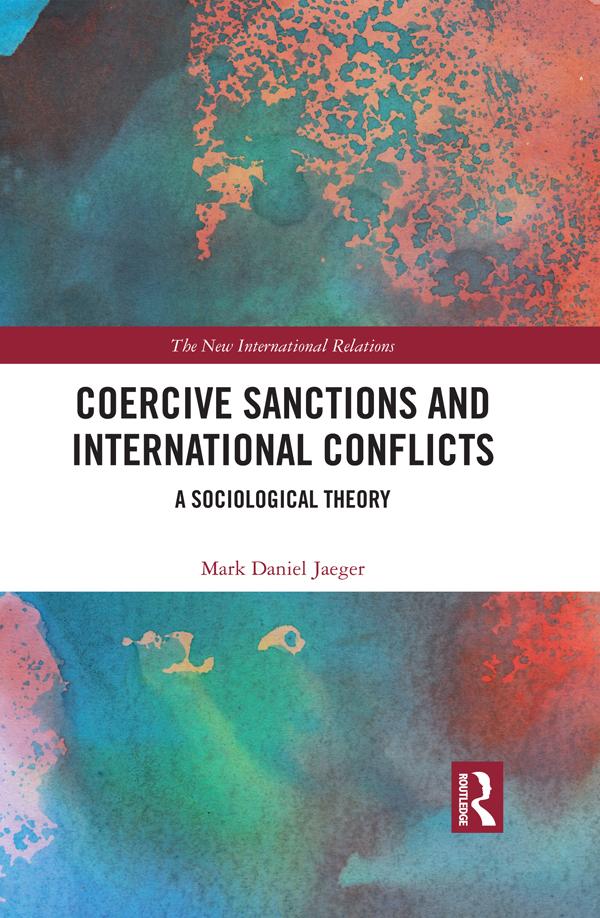
Perhaps the most common question raised in the literature on coercive international sanctions is: "Do sanctions work?" Unsurprisingly, the answer to such a sweeping question remains inconclusive. However, even the widely-presumed logic of coercive sanctions – that economic impact translates into effective political pressure – is not the primary driver of conflict developments. Furthermore, existing rationalist-economistic approaches neglect one of the most striking differences seen across sanctions conflicts: the occurrence of positive sanctions or their combination with negative sanctions, implicitly taking them as logically indifferent.
Instead of asking whether sanctions work, this book addresses a more basic question: How do coercive international sanctions work, and more substantially, what are the social conditions within sanctions conflicts that are conducive to either cooperation or non-cooperation? Arguing that coercive sanctions and international conflicts are relational, socially-constructed facts, the author explores the (de-)escalation of sanctions conflicts from a sociological perspective. Whether sanctions are conducive to either cooperation or non-cooperation depends on the one hand on the meaning they acquire for opponents as inducing decisions upon mutual conflict. On the other hand, negative sanctions, positive sanctions, or their combination each contribute differently to the way in which opponents perceive conflict, and to its potential transformation. Thus, it is premature to ‘predict’ the political effectiveness of sanctions simply based on economic impact.
The book presents analyses of the sanctions conflicts between China and Taiwan and over Iran’s nuclear program, illustrating how negative sanctions, positive sanctions, and their combination made a distinct contribution to conflict development and prospects for cooperation. It will be of great interest to researchers, postgraduates and academics in the fields of international relations, sanctions, international security and international political sociology.
Pay easily by card, Klarna, Apple Pay or Google Pay. Not happy? You always have a 14-day money-back guarantee. Read more in our terms. If you have any questions, email us at hello@memmo.org.
Memmo makes studying easier – wherever you are in the world. We bring your course books and smart study tools together in one place: summaries, quizzes, podcasts and flashcards. Plus Ted, your study buddy who answers anything you wonder. Over 50,000 students already study here – built to help you learn faster and stress less.