
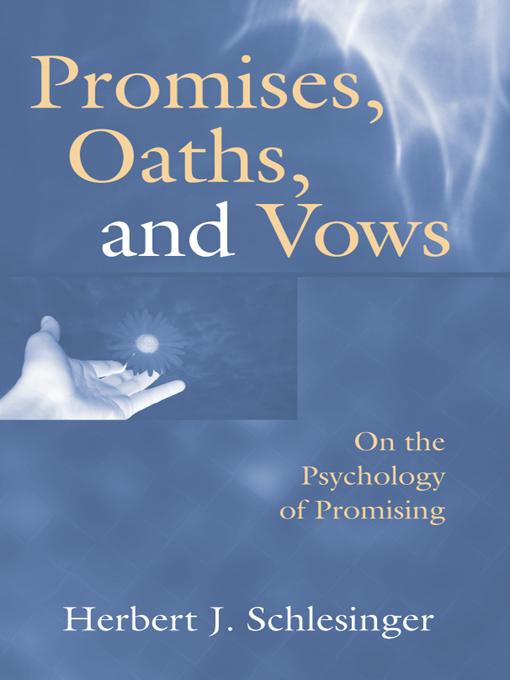
Considering that getting along in civil society is based on the expectation that (most) people will do what they say they will do, i.e., essentially live up to their explicit or implicit promises, it is amazing that so little scientific attention has been given to the act of promising. A great deal of research has been done on the moral development of children, for example, but not on the child’s ability to make and keep a promise, one of the highest moral achievements. What makes it possible developmentally, cognitively, and emotionally to make a promise in the first place? And on the other hand, what compels one to keep a promise (or vow or threat) when there seems to be no personal advantage in doing so, and even when harm can be predicted? How do we know when a promise is offered seriously to be taken at face value, and how do we understand that another is only a polite gesture, not to be taken seriously?
In Promises, Oaths, and Vows: On the Psychology of Promising, Herbert Schlesinger addresses these questions, drawing on the literature of moral development in children; the psychotherapy of a patient who regularly broke promises that were unnecessary in the first place; those who were regarded as "promising youngsters" who did not fulfill their "promise"; and those who feared making a promise, a commitment, or a threat out of fear that, once made, the utterance would take on a life of its own and could never be taken back. Furthermore, he illustrates his conclusions by examining the widespread use of promising in classical literature, such as Greek drama and the plays of Shakespeare, as well as the motivating and reifying power of the promise in Western religious traditions.
With a style honed over the penning of two previous books, Schlesinger once again produces a work grounded in a firm analytic sensibility, but which also retains the wit and candor of the seasoned analyst. His seminal investigation of this all but neglected topic in the clinical literature is as timely as it is scholarly, and – with the title firmly in mind – Promises, Oaths, and Vows is assured to be a worthy addition to any clinician’s library and a provoking investigation into Nietzsche’s notion of man as "the animal who makes promises."
Pay easily by card, Klarna, Apple Pay or Google Pay. Not happy? You always have a 14-day money-back guarantee. Read more in our terms. If you have any questions, email us at hello@memmo.org.
Memmo makes studying easier – wherever you are in the world. We bring your course books and smart study tools together in one place: summaries, quizzes, podcasts and flashcards. Plus Ted, your study buddy who answers anything you wonder. Over 50,000 students already study here – built to help you learn faster and stress less.