
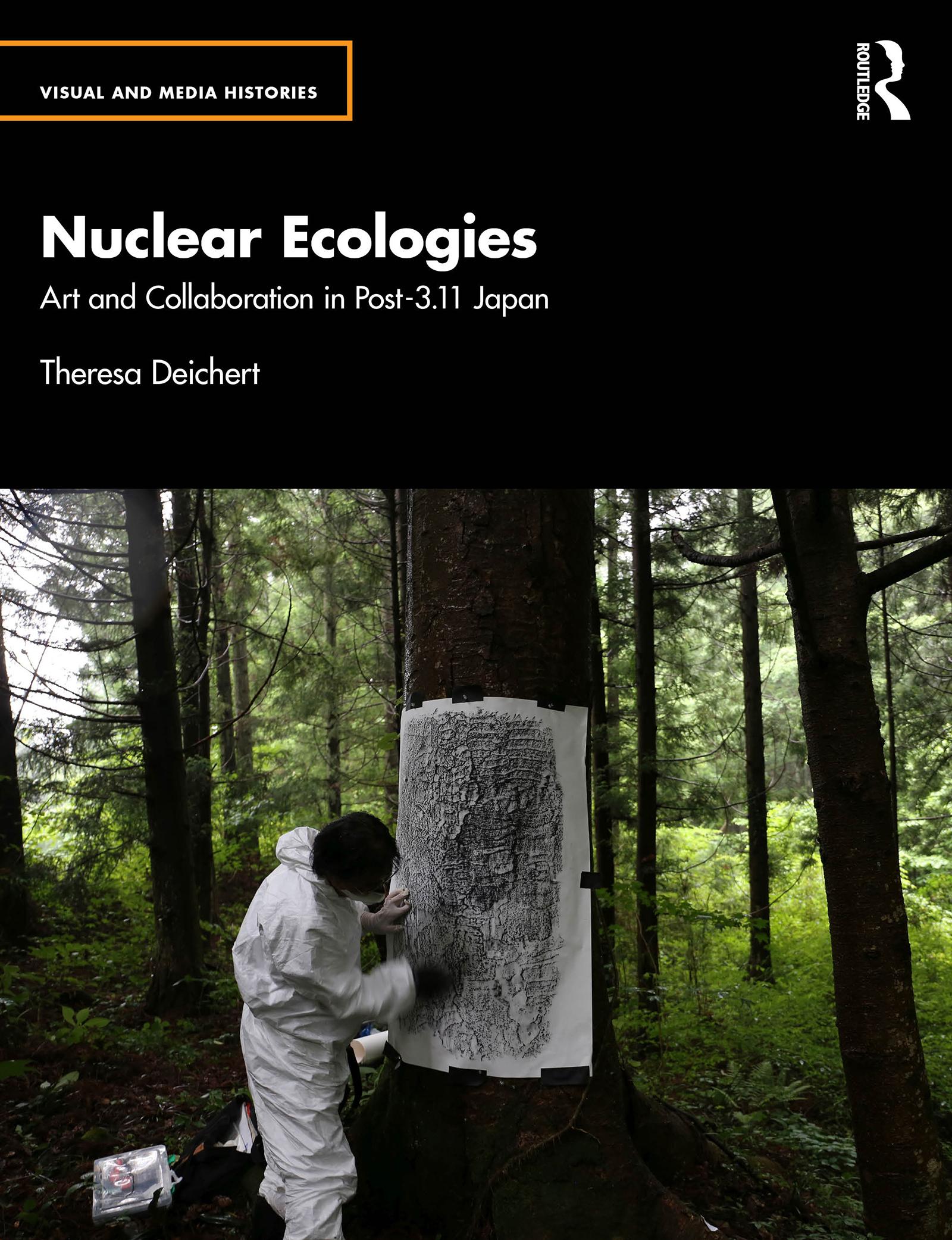
The Fukushima nuclear disaster of March 2011 left Japan grappling with profound social, political, and environmental consequences. Yet, in its wake, art emerged as a powerful response: artists turned to collaborative and ecological practices to make sense of the crisis, challenging official narratives and responding to the slow violence of radioactive contamination. This book examines how contemporary Japanese artists—among them Chim↑Pom, Kyun-Chome, Akira Takayama, Dokuyama Bontaro, Ei Arakawa-Nash, and others—have adopted strategies of collaboration that extend beyond the human, engaging with animals, plants, and even radioactivity itself as active agents in the artistic process.
Bringing ecological thought into conversation with transcultural art history, Nuclear Ecologies reconsiders collaboration not simply as a method of shared authorship, but as a distributed process shaped by complex networks of human and nonhuman agencies. Through close analysis of post-3.11 artworks, including site-specific projects within the Fukushima exclusion zone to participatory installations in Tokyo, the book explores how artists respond to, and are shaped by, local ecologies and the post-disaster politics of visibility and expression. Five in-depth case studies trace how artistic collaborations confront pressing post-disaster concerns: from radioactive contamination and structural inequalities to the lived realities of both human and nonhuman disaster victims.
Situating post-3.11 artistic practices within wider trajectories of socially engaged art and global art systems, this book—part of the Visual Media Histories series—challenges persistent boundaries between nature and culture, aesthetics and politics. It will be of interest to scholars and students in art history, Japanese studies, transcultural studies, environmental humanities, and those working across eco-aesthetics, posthumanism, and disaster studies.
Pay easily by card, Klarna, Apple Pay or Google Pay. Not happy? You always have a 14-day money-back guarantee. Read more in our terms. If you have any questions, email us at hello@memmo.org.
Memmo makes studying easier – wherever you are in the world. We bring your course books and smart study tools together in one place: summaries, quizzes, podcasts and flashcards. Plus Ted, your study buddy who answers anything you wonder. Over 50,000 students already study here – built to help you learn faster and stress less.