
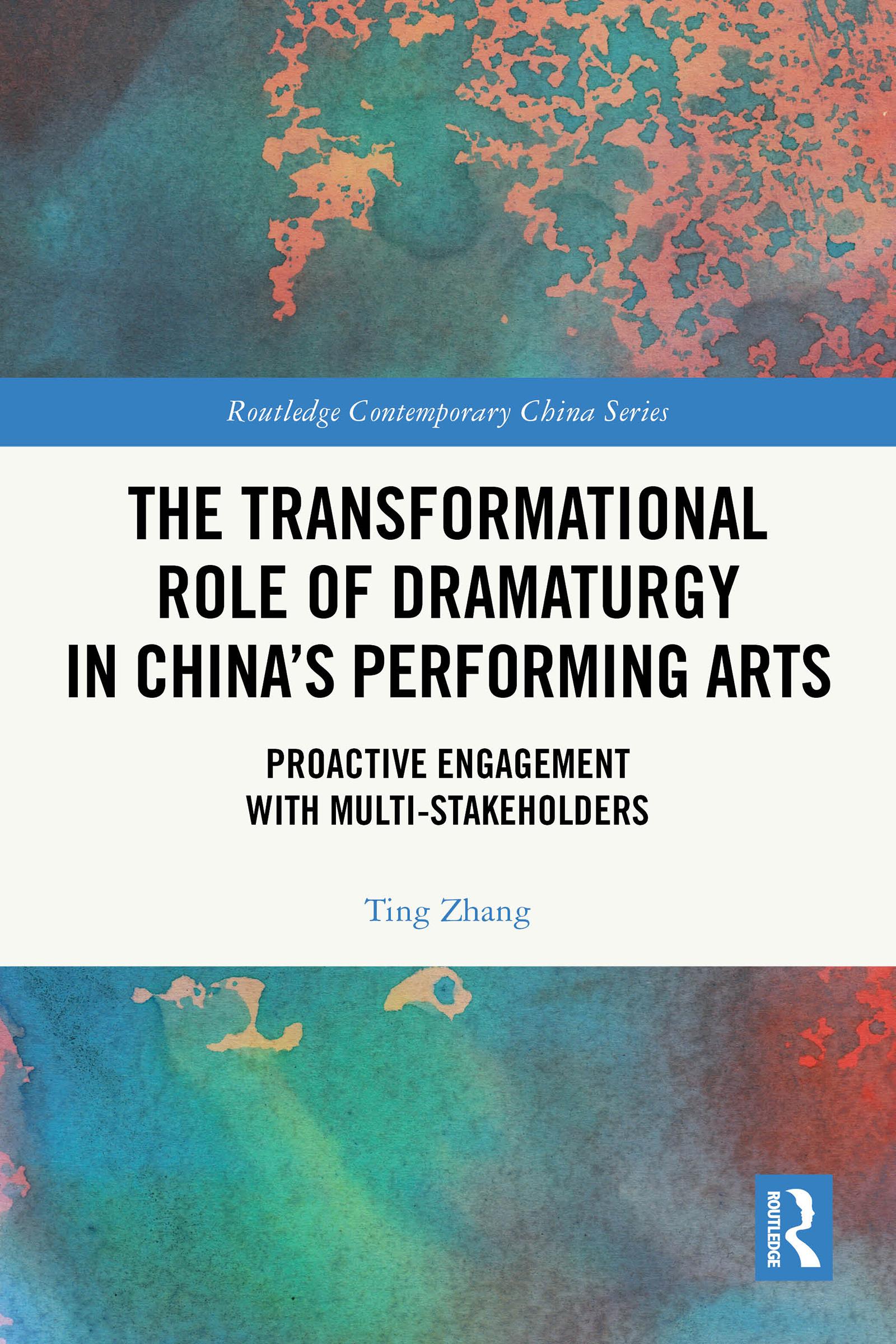
A pioneering examination of a field in its early stages, Zhang delves into a detailed exploration of the evolving role of dramaturgy in contemporary Chinese theatre, bridging the gap between established Western theories and the unique practices emerging in the Chinese theatre scene, and offering valuable insight into the reshaping of theatre production amidst a rapidly changing cultural landscape.
Compared with the development of dramaturgy in Western countries, dramaturgical practice in contemporary Chinese theatre is still in its infancy. This book aims to fill this gap by exploring dramaturgy’s evolution and current role in Chinese theatre. It embarks on a global exploration—in terms of both dramaturgical theories and practices—across Germany, the UK, the US, and the Asia-Pacific region, providing a theoretical framework. It then traces the evolution of Chinese spoken drama (Huaju) from its origins in 1907 to the present. This chronological exploration illuminates Huaju’s development from foreign influences in the early decades to a more recent era of self-exploration. The book features three key case studies: the reception of Henrik Ibsen’s work in China, the 1983 production of Arthur Miller’s Death of a Salesman in Beijing, and the writing and staging of Teahouse. It also explores contemporary dramaturgical practices in China, based on fieldwork and interviews with theatre practitioners in Beijing and Shanghai. Through an examination of the similarities and differences in dramaturgical practices across performing arts in China, the book firmly positions Chinese dramaturgy within the broader currents of global theatre discourse.
This book is a unique cross-cultural resource with practical insights and theoretical reflections of great value for academics, scholars, educators, and practitioners in the fields of theatre studies, dramaturgy, cross-cultural performance studies, contemporary Chinese theatre, and the global evolution of dramaturgy.
Pay easily by card, Klarna, Apple Pay or Google Pay. Not happy? You always have a 14-day money-back guarantee. Read more in our terms. If you have any questions, email us at hello@memmo.org.
Memmo makes studying easier – wherever you are in the world. We bring your course books and smart study tools together in one place: summaries, quizzes, podcasts and flashcards. Plus Ted, your study buddy who answers anything you wonder. Over 75,000 students already study here – built to help you learn faster and stress less.