
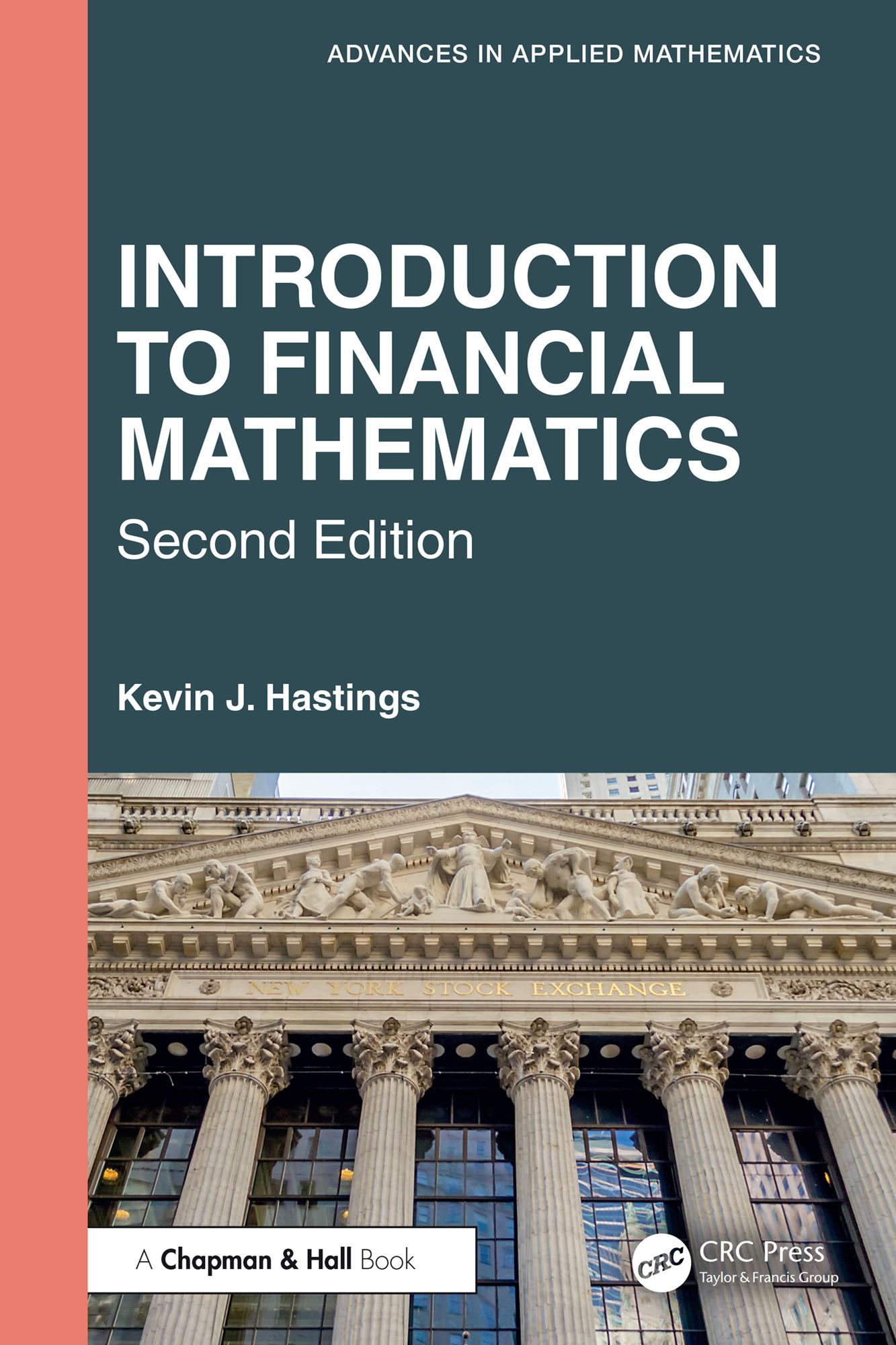
The second edition of this successful and widely recognized textbook again focuses on discrete topics. The author recognizes two distinct paths of study and careers of actuarial science and financial engineering. This text can be very useful as a common core for both.
Therefore, there is substantial material in Introduction to Financial Mathematics, Second Edition on the theory of interest (the first half of the book), as well as the probabilistic background necessary for the study of portfolio optimization and derivative valuation (the second half). A course in multivariable calculus is not required.
The material in the first two chapters should go a long way toward helping students prepare for the Financial Mathematics (FM) actuarial exam. Also, the discrete material will reveal how beneficial it is for the students to know more about loans in their personal financial lives.
The notable changes and updates to this edition are itemized in the Preface, but overall, the presentation has been made more efficient. One example is the chapter on discrete probability, which is rather unique in its emphasis on giving the deterministic problems studied earlier a probabilistic context. The section on Markov chains, which is not essential to the development, has been scaled down. Sample spaces and probability measures, random variables and distributions, expectation, conditional probability, independence, and estimation all follow.
Optimal portfolio selection coverage is reorganized and the section on the practicalities of stock transactions has been revised. Market portfolio and Capital Market Theory coverage is expanded. New sections on Swaps and Value-at-Risk have been added.
This book, like the first edition, was written so that the print edition could stand alone. At times we simplify complicated algebraic expressions, or solve systems of linear equations, or numerically solve non-linear equations. Also, some attention is given to the use of computer simulation to approximate solutions to problems.