
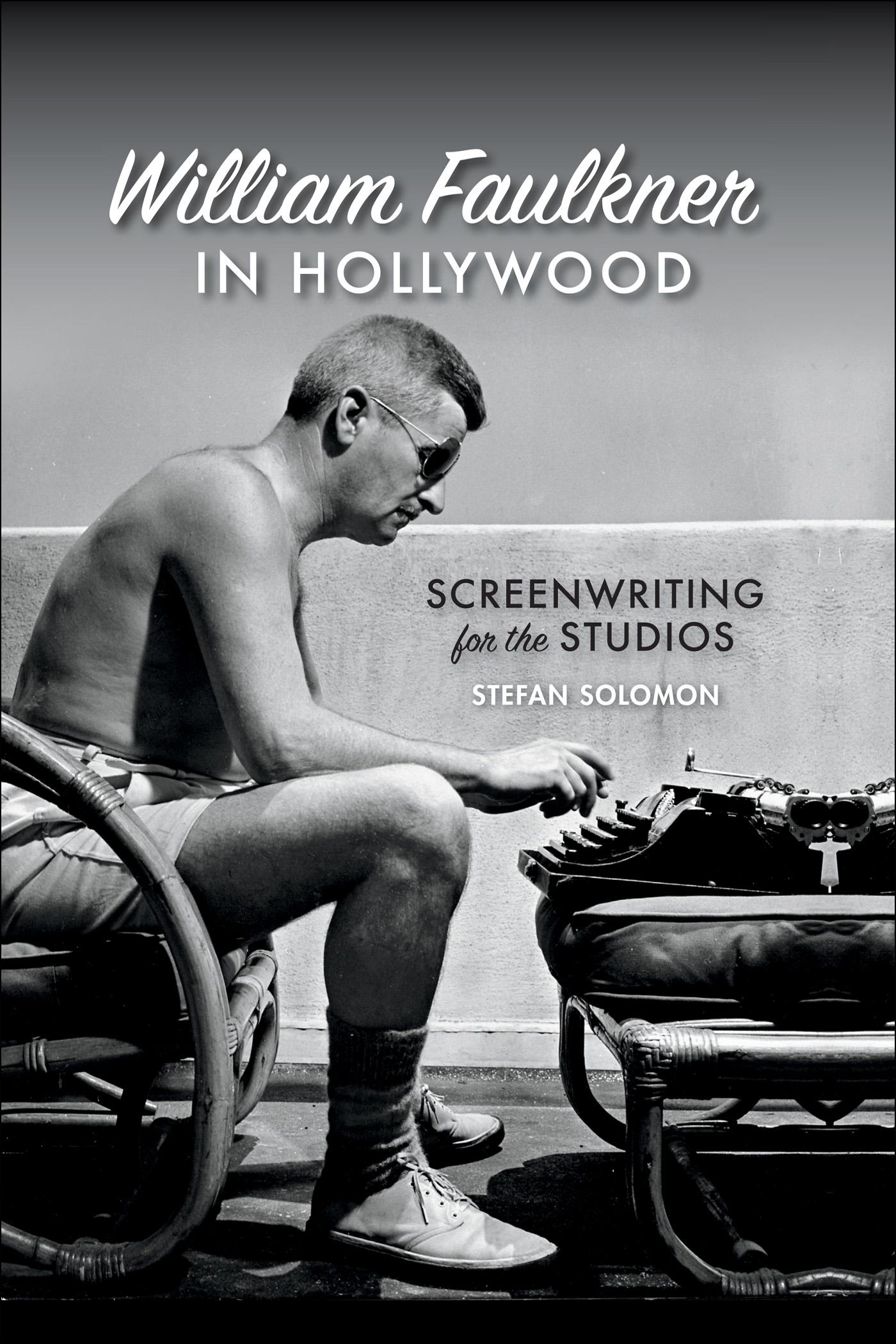
During more than two decades (1932–1954), William Faulkner worked on approximately fifty screenplays for studios, including MGM, 20th Century–Fox, and Warner Bros., and was credited on such classic films as The Big Sleep and To Have and Have Not. The scripts that Faulkner wrote for film—and, later on, television—constitute an extensive and, until now, thoroughly underexplored archival source. Stefan Solomon not only analyzes the majority of these scripts but compares them to the novels and short stories Faulkner was writing at the same time. Solomon’s aim is to reconcile two aspects of a career that were not as distinct as they first might seem: Faulkner as a screenwriter and Faulkner as a high modernist, Nobel Prize–winning author.
Faulkner’s Hollywood sojourns took place during a period roughly bounded by the publication of Light in August (1932) and A Fable (1954) and that also saw the publication of Absalom, Absalom!; Go Down, Moses; and Intruder in the Dust. As Solomon shows Faulkner attuning himself to the idiosyncrasies of the screenwriting process (a craft he never favored or admired), he offers insights into Faulkner’s compositional practice, thematic preoccupations, and understanding of both classic cinema and the emerging medium of television. In the midst of this complex exchange of media and genres, much of Faulkner’s fiction of the 1930s and 1940s was directly influenced by his protracted engagement with the film industry.
Solomon helps us to see a corpus integrating two vastly different modes of writing and a restless author, sensitive to the different demands of each. Faulkner was never simply the southern novelist or the West Coast “hack writer” but always both at once. Solomon’s study shows that Faulkner’s screenplays are crucial in any consideration of his far more esteemed fiction—and that the two forms of writing are more porous and intertwined than the author himself would have us believe. Here is a major American writer seen in a remarkably new way.
Pay easily by card, Klarna, Apple Pay or Google Pay. Not happy? You always have a 14-day money-back guarantee. Read more in our terms. If you have any questions, email us at hello@memmo.org.
Memmo makes studying easier – wherever you are in the world. We bring your course books and smart study tools together in one place: summaries, quizzes, podcasts and flashcards. Plus Ted, your study buddy who answers anything you wonder. Over 50,000 students already study here – built to help you learn faster and stress less.