
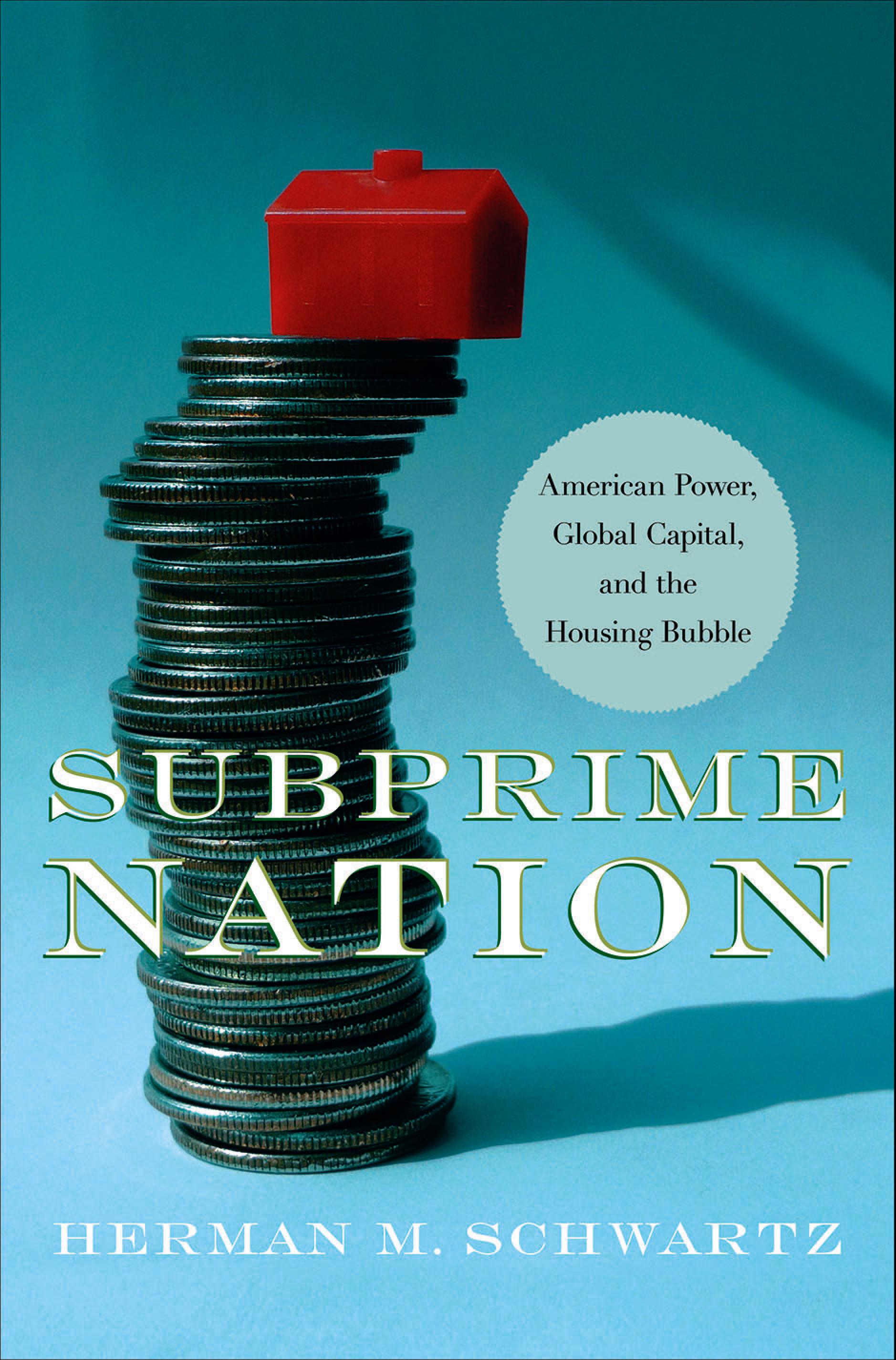
In his exceedingly timely and innovative look at the ramifications of the collapse of the U.S. housing market, Herman M. Schwartz makes the case that worldwide, U.S. growth and power over the last twenty years has depended in large part on domestic housing markets. Mortgage-based securities attracted a cascade of overseas capital into the U.S. economy. High levels of private home ownership, particularly in the United States and the United Kingdom, have helped pull in a disproportionately large share of world capital flows.
As events since mid-2008 have made clear, mortgage lenders became ever more eager to extend housing loans, for the more mortgage packages they securitized, the higher their profits. As a result, they were dangerously inventive in creating new mortgage products, notably adjustable-rate and subprime mortgages, to attract new, mainly first-time, buyers into the housing market. However, mortgage-based instruments work only when confidence in the mortgage system is maintained. Regulatory failures in the U.S. S&L sector, the accounting crisis that led to the extinction of Arthur Andersen, and the subprime crisis that destroyed Lehman Brothers and Merrill Lynch and damaged many other big financial institutions have jeopardized a significant engine of economic growth.
Schwartz concentrates on the impact of U.S. regulatory failure on the international economy. He argues that the "local" problem of the housing crisis carries substantial and ongoing risks for U.S. economic health, the continuing primacy of the U.S. dollar in international financial circles, and U.S. hegemony in the world system.