
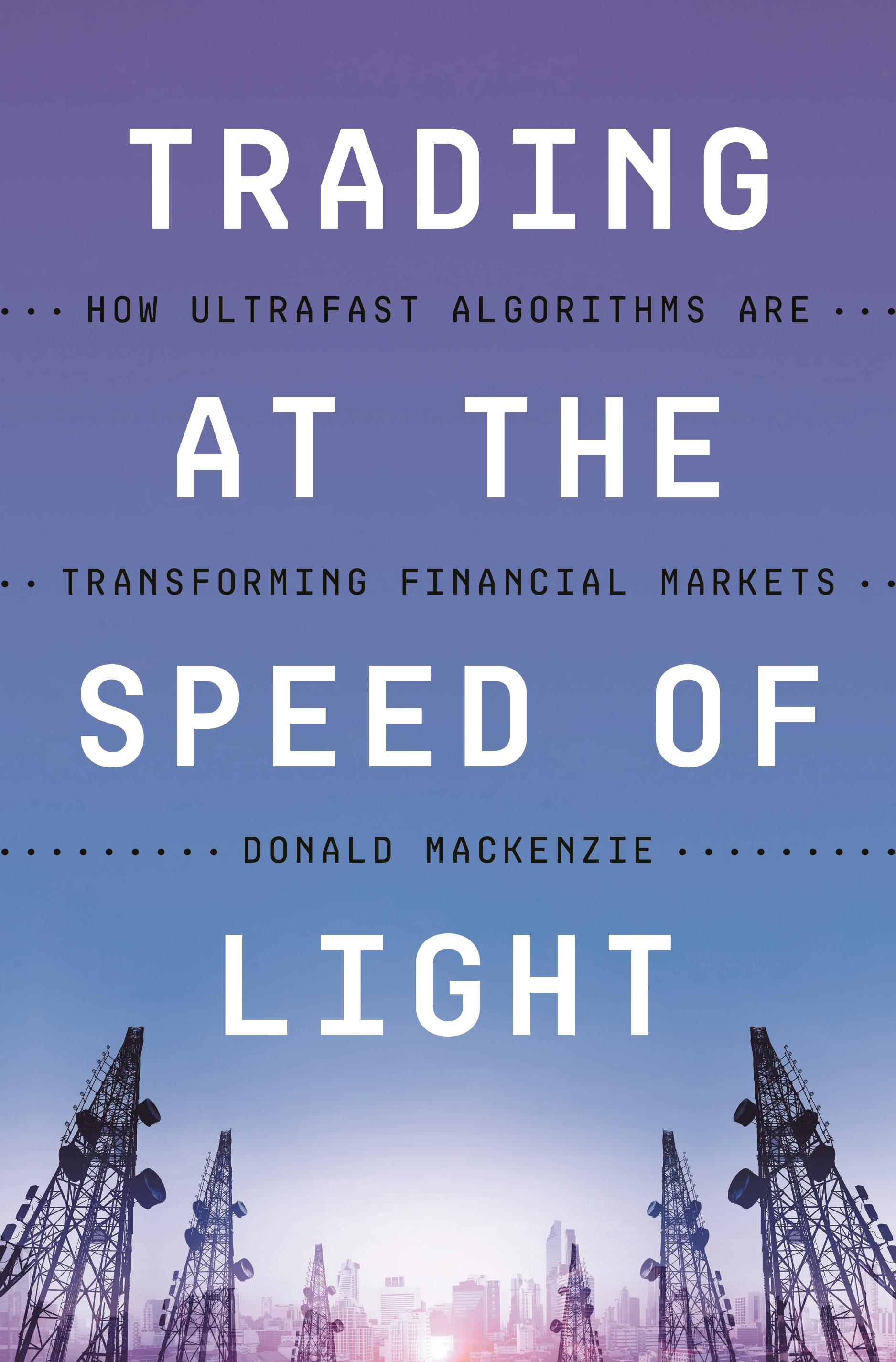
A remarkable look at how the growth, technology, and politics of high-frequency trading have altered global financial markets
In today’s financial markets, trading floors on which brokers buy and sell shares face-to-face have increasingly been replaced by lightning-fast electronic systems that use algorithms to execute astounding volumes of transactions. Trading at the Speed of Light tells the story of this epic transformation. Donald MacKenzie shows how in the 1990s, in what were then the disreputable margins of the US financial system, a new approach to trading—automated high-frequency trading or HFT—began and then spread throughout the world. HFT has brought new efficiency to global trading, but has also created an unrelenting race for speed, leading to a systematic, subterranean battle among HFT algorithms.
In HFT, time is measured in nanoseconds (billionths of a second), and in a nanosecond the fastest possible signal—light in a vacuum—can travel only thirty centimeters, or roughly a foot. That makes HFT exquisitely sensitive to the length and transmission capacity of the cables connecting computer servers to the exchanges’ systems and to the location of the microwave towers that carry signals between computer datacenters. Drawing from more than 300 interviews with high-frequency traders, the people who supply them with technological and communication capabilities, exchange staff, regulators, and many others, MacKenzie reveals the extraordinary efforts expended to speed up every aspect of trading. He looks at how in some markets big banks have fought off the challenge from HFT firms, and how exchanges sometimes engineer technical systems to favor certain types of algorithms over others.
Focusing on the material, political, and economic characteristics of high-frequency trading, Trading at the Speed of Light offers a unique glimpse into its influence on global finance and where it could lead us in the future.