
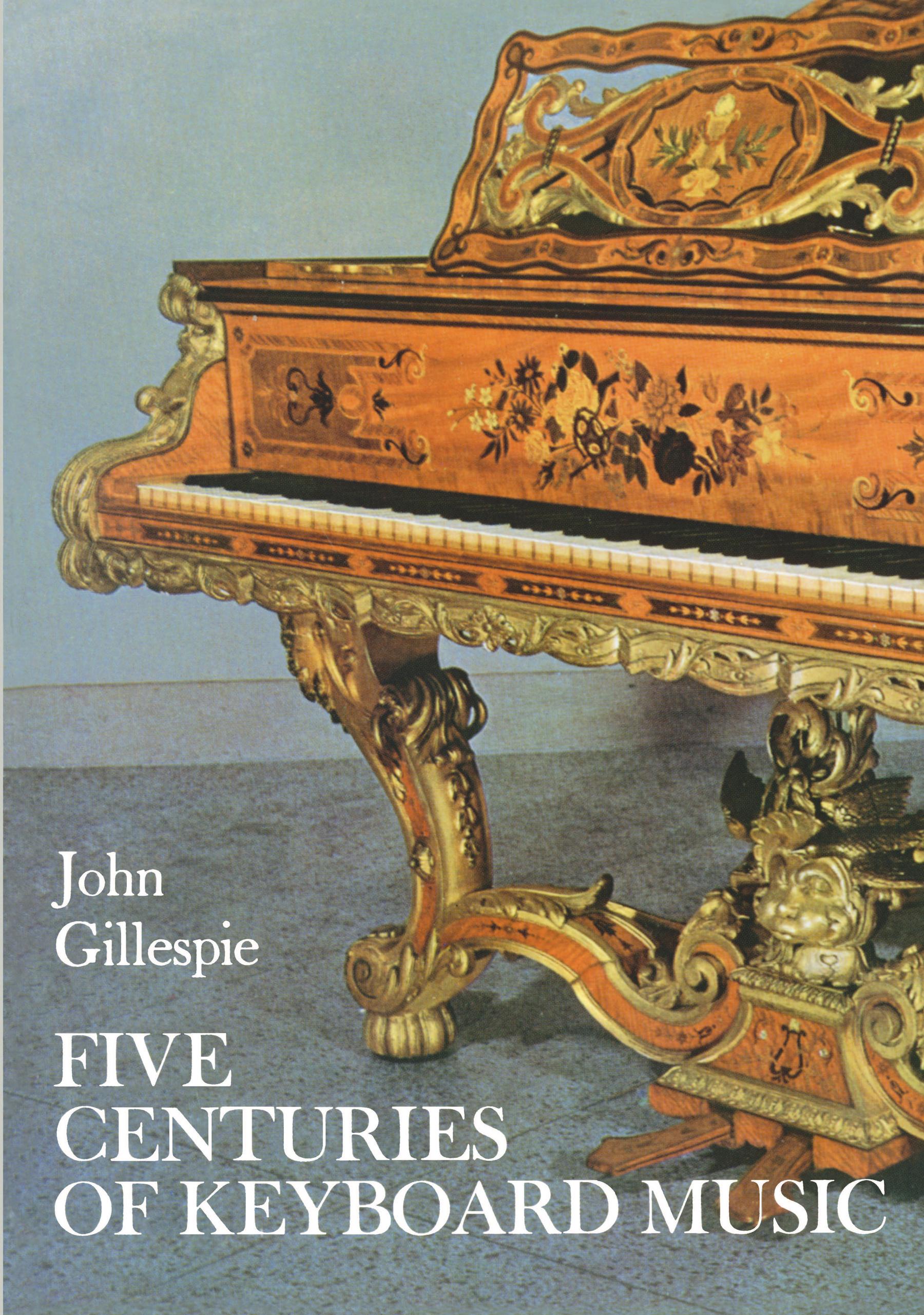
Most listeners can readily distinguish between the works of such keyboard giants as Bach, Beethoven, and Liszt and between various national schools, but when it comes to defining what the differences are, relating the various interconnections, discovering information on the hundreds of other keyboard composers, and actually finding playing editions, the task becomes much greater. To aid the performer, the listener, and the student in all these important aspects, John Gillespie, practicing pianist and harpsichordist and Professor of Music at the University of California, has prepared this, the first work in English to comprehensively survey the development of solo keyboard works.
Introductory chapters of Gillespie's literate and authoritative survey cover the backgrounds and development of keyboard instruments and early keyboard music. Later chapters cover the history as it progressed stylistically through the hands of individual composers and various schools from the sixteenth to the twentieth centuries. Emphasis is given to the masters whose works continue to be heard most often today — Bach, Handel, Mozart, Haydn, Beethoven, Schubert, Schumann, Brahms, Liszt, Chopin, Debussy, Ravel, and others. Major consideration, too, is given to composers who were influential in developing national styles. All of the Western countries — from Germany, Italy, France, and England to Norway, Russia, the United States, South America, and Canada — are included. Finally, there are discussions of now little-known composers who were important in their times. Altogether over 350 composers are discussed. Important, also, in John Gillespie's survey are his various other aids — guides to a carefully selected body of playing editions and other historical works, a great number of musical illustrations, and a 195-item glossary of musical terms.
Individual chapters and articles will be helpful in quickly locating information about particular composers, schools, and works. Footnotes and bibliographies will be important for the performer, student, or professional looking for either playing editions or further information. The book as a whole, however, when read as it should be from cover to cover, will give the reader a very good understanding of the development of works for the solo keyboard, of the traditions, and the interconnections, with accurate coverage from the first known works of the sixteenth century up to the exciting modern composers.
Pay easily by card, Klarna, Apple Pay or Google Pay. Not happy? You always have a 14-day money-back guarantee. Read more in our terms. If you have any questions, email us at hello@memmo.org.
Memmo makes studying easier – wherever you are in the world. We bring your course books and smart study tools together in one place: summaries, quizzes, podcasts and flashcards. Plus Ted, your study buddy who answers anything you wonder. Over 50,000 students already study here – built to help you learn faster and stress less.