
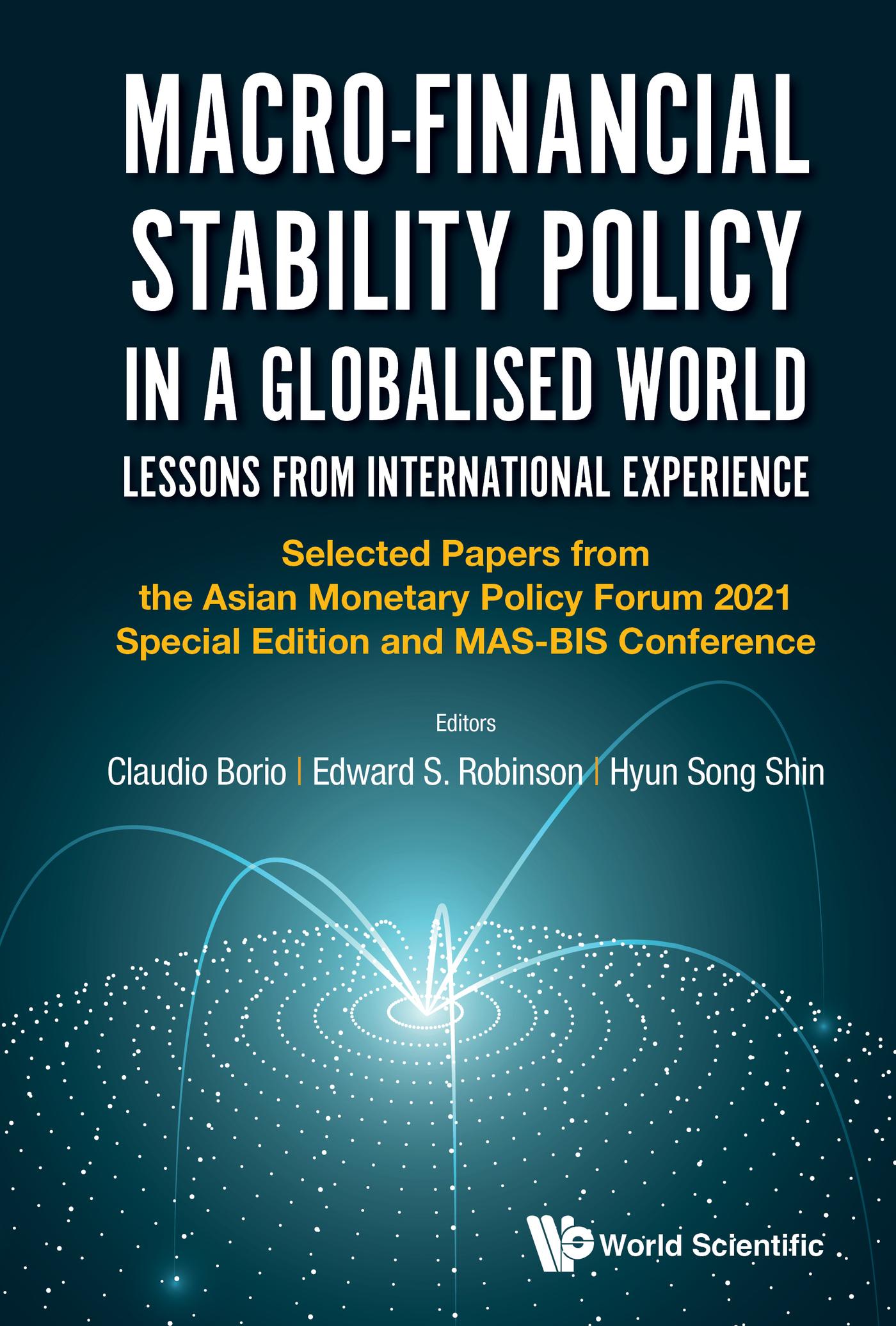
Since at least the Great Financial Crisis, authorities around the world have increasingly relied on macroprudential policy to help secure financial stability and complement monetary policy as an integral element of a broader macro-financial stability framework. In today's interconnected global financial system, policy actions taken by the major advanced economies can have spillovers on the rest of the world through their impact on capital flows and exchange rates, potentially generating vulnerabilities across borders. Conversely, in emerging market economies, macroprudential policy as well as foreign exchange intervention and/or capital flow management policy can help mitigate the corresponding impact. This can in turn generate spillbacks on advanced economies — spillbacks that have become more sizeable as the emerging market economies' heft in the world has grown. Yet little is known about these interactions.
The contents of this book are based on a conference held on 26–28 May 2021 and jointly hosted by the Monetary Authority of Singapore (MAS) and the Bank for International Settlements (BIS). It aims to contribute to existing literature on macro-financial policymaking by providing an overall conceptual framework and documenting the latest global trends and country experiences. In particular, it highlights the role of international spillovers and spillbacks, paying particular attention to emerging market economies. This book is essential reading for academics, graduate students and economic professionals. It can also serve as a handbook for policymakers at central banks, regulatory authorities and other government agencies tasked with designing and implementing macroprudential or more generally macro-financial stability policies. The book will also be of interest to researchers at international organisations.
Contents:
- About the Editors
- About the Contributors
- Welcome Remarks: The Quest for an Integrated Macro-Policy Framework (Ravi Menon)
- Welcome Remarks: Historical Evolution of Macro-Financial Stability Frameworks and a Search of a New Conceptual Framework (Agustin Carstens)
- Macro-Financial Stability Frameworks: Experience and Challenges (Claudio Borio, Ilhyock Shim and Hyun Song Shin)
- Macro-Financial Stability Frameworks: Experience and Challenges: A Discussion (Linda Goldberg)
- What Happens in Vegas Does Not Stay in Vegas (Anil K Kashyap)
- Macroprudential Policies and the COVID-19 Pandemic: Risks and Challenges for Emerging Markets (Sebastian Edwards)
- Macroprudential Policies and the COVID-19 Pandemic: Risks and Challenges for Emerging Markets: A Discussion (Eswar Prasad)
- Macroprudential Policy during COVID-19: The Role of Policy Space (Katharina Bergant and Kristin Forbes)
- Macroprudential Policy during COVID-19: The Role of Policy Space: A Discussion (Valentina Bruno)
- Macro-Financial Policy in an International Financial Centre: The UK Experience Since the Global Financial Crisis (Thorsten Beck, Simon Lloyd, Dennis Reinhardt and Rhiannon Sowerbutts)
- Macro-Financial Policy in an International Financial Centre: The UK Experience Since the Global Financial Crisis: A Discussion (Paul Tucker)
- Sweden's Experience of Deploying Monetary and Macroprudential Policies (Stefan Ingves and Johan Grip)
- Sweden's Experience of Deploying Monetary and Macroprudential Policies: A Discussion (Charles Bean)
- The 'Twin-Pillar' Framework of Monetary and Macroprudential Policies in China (Yiping Huang and Tingting Lv)
- The 'Twin-Pillar' Framework of Monetary and Macroprudential Policies in China: A Discussion (Yi Huang)
- Timely, Sustained and Effective Macroprudential Policy: Exploring the Political Economy of Hong Kong's Prudential Standards in the 1990s (Robert N McCauley and Catherine R Schenk)
- Timely, Sustained and Effective Macroprudential Policy: Exploring the Political Economy of Hong Kong's Prudential Standards in the 1990s: A Discussion (Arthur Yuen)
- Macroprudential Policies for the External Sector: India's Approach and Experience (Viral V Acharya)
- Macroprudential Policies for the External Sector: India's Approach and Experience: A Discussion (Duvvuri Subbarao)
- Legacy of Early Crisis and Incomplete Institutional Reforms on the Financial Sector in Indonesia (M Chatib Basri and Reza Y Siregar)
- Legacy of Early Crisis and Incomplete Institutional Reforms on the Financial Sector in Indonesia: A Discussion (Perry Warjiyo)
- Lessons from Macro-Financial Policy in Korea (Hyun Song Shin and Kwanho Shin)
- Lessons from Macro-Financial Policy in Korea: A Discussion (Hwanseok Lee)
- Macroprudential Policies and Financial Stability in a Small and Open Economy: The Case of Singapore (Ramkishen S Rajan, Edward S Robinson and Rosemary Lim)
- Macroprudential Policies and Financial Stability in a Small and Open Economy: The Case of Singapore: A Discussion (Yongheng Deng)
- Monetary Policy Frameworks in Latin America: Evolution, Resilience and Future Challenges (Ana Aguilar, Alexandre Tombini and Fabrizio Zampolli)
- Monetary Policy Frameworks in Latin America: Evolution, Resilience and Future Challenges: A Discussion(Enrique G Mendoza)
- Leave No Stone Unturned — Macroprudential Policy in Croatia Between the Global Financial Crisis and COVID-19 (Boris Vujčić, Mirna Dumičić Jemrić and Lana Ivičić)
- Leave No Stone Unturned — Macroprudential Policy in Croatia Between the Global Financial Crisis and COVID-19: A Discussion (Tuomas Peltonen)
- Towards a New Monetary-Macroprudential Policy Framework: Perspectives on Integrated Inflation Targeting (Pierre-Richard Agénor and Luiz A Pereira da Silva)
- Towards a New Monetary-Macroprudential Policy Framework: Perspectives on Integrated Inflation Targeting: A Discussion (Barry Eichengreen)
Readership: Academics, graduate students and economic professionals; policymakers at central banks, regulatory authorities and other government agencies tasked with designing and implementing macroprudential and macro-financial stability policies; researchers at international organisations.
'These published proceedings of the May 2021 Conference, convened by the BIS and MAS, provide a definitive account of the usage of macro-prudential policies. A stellar collection of authors have written five general and ten country/regional Chapters on this subject, with discussant comments on each, all by top names in the field. A great book and a must-read by anyone with an interest in financial regulation.' - Charles GoodhartLondon School of Economics
'The global financial crisis of 2008 prompted a global call for a new financial regulatory framework that regulates the cyclicality of the financial system as a whole rather than its individual parts. Since then, so-called macroprudential regulations have been introduced in many countries to tame financial cycles, with a view to reduce the build-up of systemic financial stability risks and increase financial buffers to absorb shocks when they arrive. This book brings together the wisdom of senior policymakers and academics with hands-on experience in the development of macroprudential policy to draw invaluable lessons for the design and implementation of macroprudential policy. I recommend especially the chapters on country experiences, showing what worked well and what did not.' - Luc LaevenEuropean Central Bank
'The COVID pandemic and geopolitical tensions brought significant stability challenges for open economies. The headwinds are prominently characterized by the pick-up in inflation and capital flow volatility. The impact has been significant, but kneejerk policy responses will prove sub-optimal. I highly recommend this book as it offers a collection of reasoned insights and systematic analyses on many important policy choices facing EMEs. Adding to its appeal is the accompanying commentaries by independent experts. Differing perspectives can help readers gain a more holistic understanding of the complex policy trade-offs at play.' - Jin-Chuan DuanNational University of Singapore
Key Features:
- Aims to reach a global readership, notably academics, graduate students and economic professionals
- Serves as a handbook for policymakers with the task of designing and implementing macroprudential or more generally macro-financial stability policies
- Contributes to the literature on macro-financial policymaking by providing an overall conceptual framework and documenting the latest global trends and country experiences
- Highlights the role of international spillovers and spillbacks and pays particular attention to EMEs
- Features content by top academics who are renowned experts in these fields, including central bank governors and senior officials as well as BIS staff
- Each chapter includes discussion remarks by top academics and current/former central bank governors/deputy governors
Zahle einfach mit Karte, Klarna, Apple Pay oder Google Pay. Nicht zufrieden? Du hast immer ein 14-tägiges Widerrufsrecht. Lies mehr in unseren AGB. Hast du Fragen, schreib uns eine E-Mail an hello@memmo.org.
Memmo macht das Lernen einfacher – wo auch immer du bist. Bei uns findest du deine Kursbücher und smarte Lerntools an einem Ort: Zusammenfassungen, Quizzes, Podcasts und Lernkarten. Und Ted, dein Lernbuddy, beantwortet alles, was du wissen möchtest. Über 50.000 Studierende lernen bereits hier – gemacht, damit du schneller lernst und weniger Stress hast.