
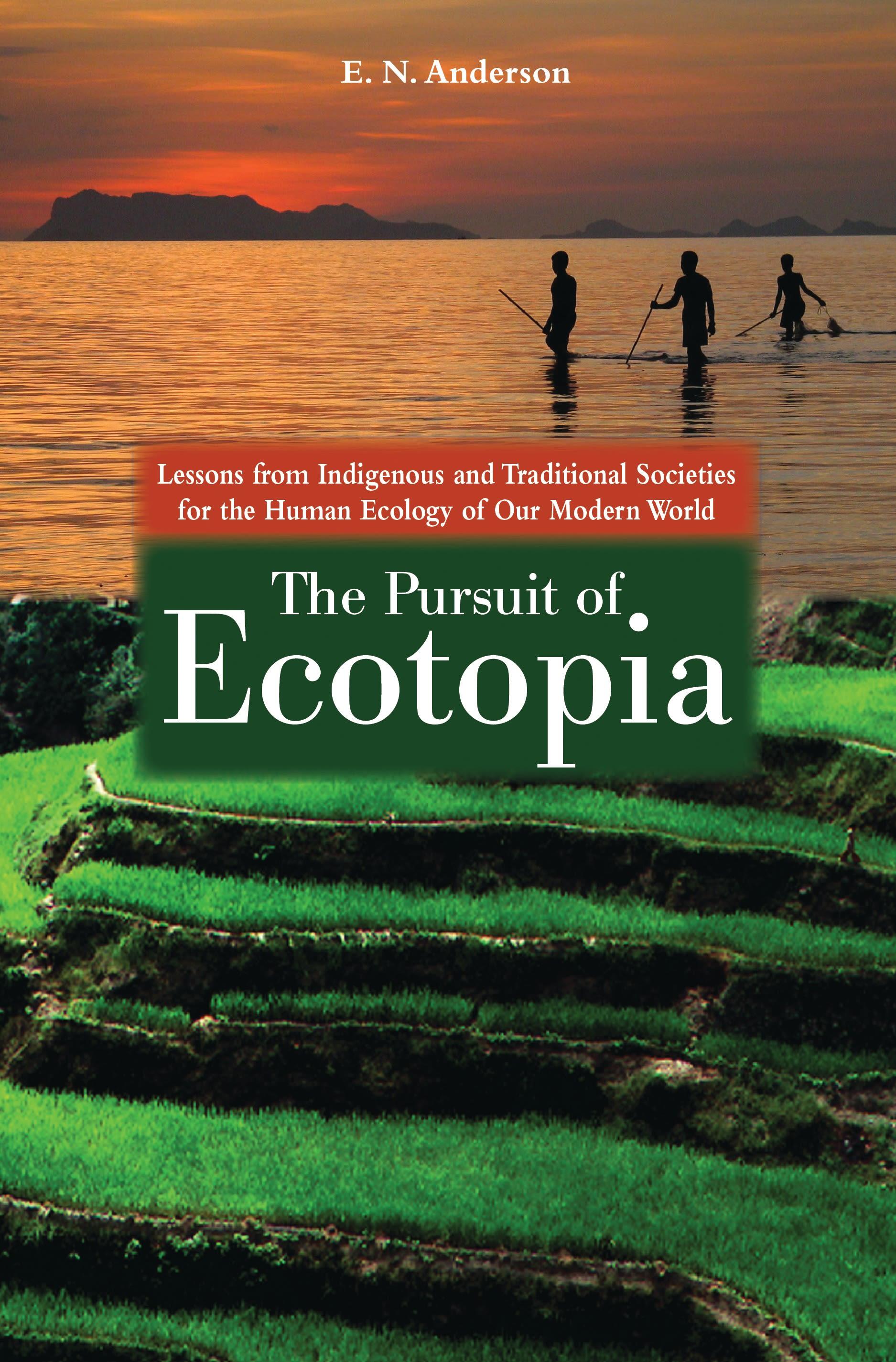
The world environmental and social justice crises brought on by our high-throughput global economy can be ameliorated only if we adapt the pragmatic ethics of social cohesion in traditional societies to the modern world.
Traditional societies have much to teach the modern world about conservation and environmental management. The Pursuit of Ecotopia: Lessons from Indigenous and Traditional Societies for the Human Ecology of Our Modern World argues that the root of our environmental crisis is that we have not devised modern ways to induce people with diverse interests to think and act cooperatively to secure shared interests. We take a short-term, narrow view of resource management and ethical conduct instead of a long-term, global view of "ecotopia"—a conception in which the destructive corollaries of consumerism are curbed by emotionally grounded policies and ethics of sustainability, social justice, and stewardship.
In this controversial and brilliantly written book, author E. N. Anderson maintains that the world can escape impending ecological disaster only by embracing a political and ethical transformation that will imbue modern societies with the same shared sense of emotional rationality practiced by traditional cultures. He draws lessons from ecologically successful traditional societies—and also draws cautionary tales from traditional societies that have responded maladaptively to disruption and failed ecologically as a result.
Traditional societies have much to teach the modern world about conservation and environmental management. The Pursuit of Ecotopia: Lessons from Indigenous and Traditional Societies for the Human Ecology of Our Modern World argues that the root of our environmental crisis is that we have not devised modern ways to induce people with diverse interests to think and act cooperatively to secure shared interests. We take a short-term, narrow view of resource management and ethical conduct instead of a long-term, global view of "ecotopia"—a conception in which the destructive corollaries of consumerism are curbed by emotionally grounded policies and ethics of sustainability, social justice, and stewardship.
In this controversial and brilliantly written book, author E. N. Anderson maintains that the world can escape impending ecological disaster only by embracing a political and ethical transformation that will imbue modern societies with the same shared sense of emotional rationality practiced by traditional cultures. He draws lessons from ecologically successful traditional societies—and also draws cautionary tales from traditional societies that have responded maladaptively to disruption and failed ecologically as a result.
Betal nemt med kort, Klarna, Apple Pay eller Google Pay. Ikke tilfreds? Du har altid 14 dages fortrydelsesret. Læs mere i vores vilkår. Har du spørgsmål, så send os en mail på hello@memmo.org.
Memmo gør det nemmere at studere – uanset hvor du er i verden. Hos os samler du dine kursusbøger og smarte studieværktøjer ét sted: resuméer, quizzer, podcasts og flashcards. Og så er der Ted, din studieven, der svarer på alt, du undrer dig over. Over 50 000 studerende studerer allerede her – bygget til at hjælpe dig med at lære hurtigere og stresse mindre.