
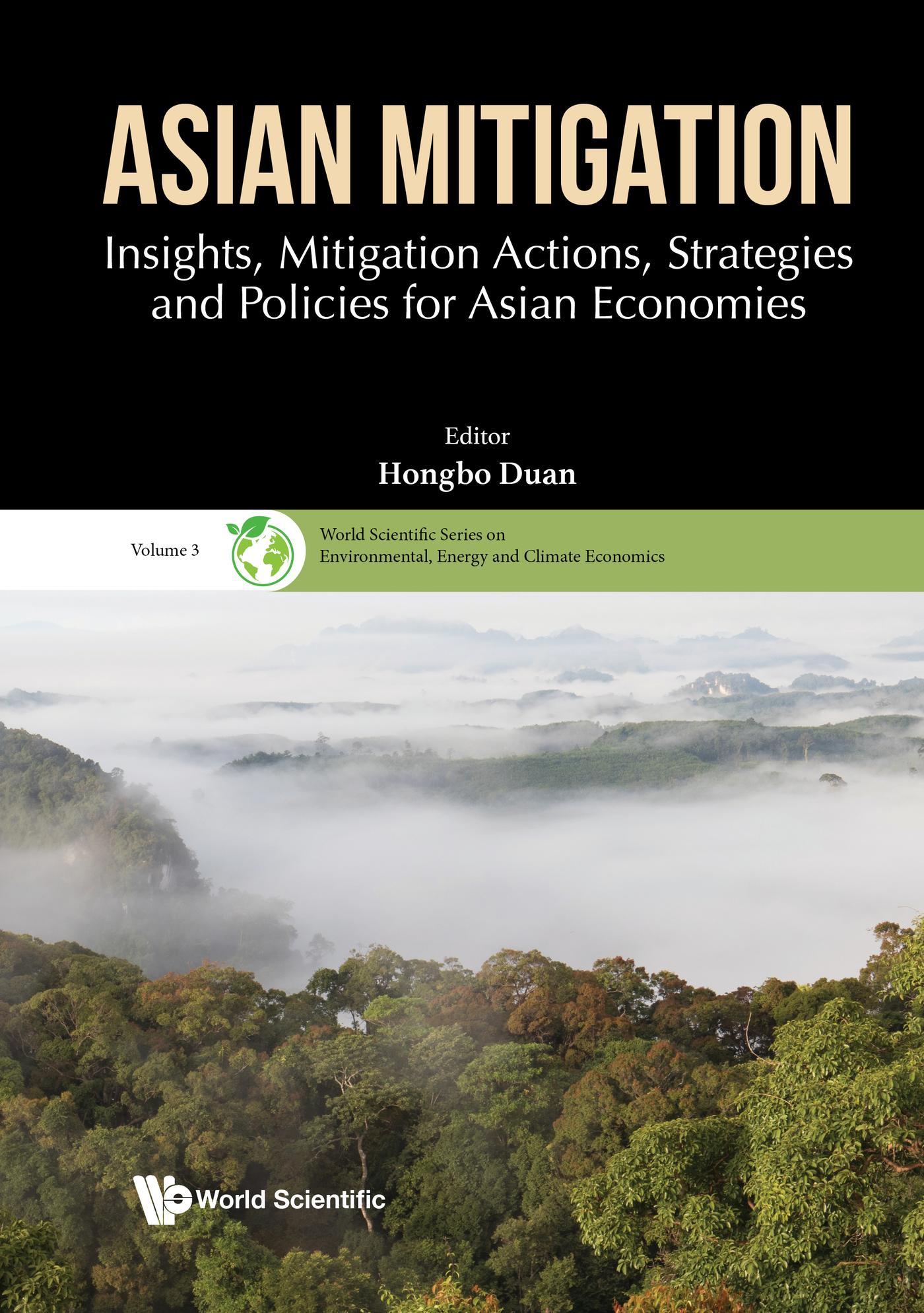
Asian countries play a significant role in emission mitigation, which is one of the central pillars of the global effort to meet the 1.5°C and 2°C climate goals pledged in the Paris Agreement. This book contains a series of essays that explore how Asian territories are contributing to substantial emission reductions by presenting in-depth insights and fresh perspectives on optimal mitigation actions, strategies, and policies in Asian economies. A set of quantitative models, such as CGE models, DSGE models, LEAP models, LCA approaches, and input–output methods are used and developed to examine roles of mitigation at different scales, including climate governance on regional levels, distributional effects at the sectoral level, and policy effectiveness assessment on the firm level. The studies included in the book make novel contributions to the existing literature about the implementation of the Paris Agreement goals, and policy making at the regional scale (in both Asian and non-Asian economies).
Contents:
- Preface
- Introduction: What Mitigation Can Asia Contribute to the Paris Agreement Goals? (H Duan, J Pan, T G Tsvetanov and B Zhang)
- The Regional Roles Alongside the Evolution of Carbon Transfer Structure Within China: A Perspective from the National Value Chain (S Wang, J Wu and G Xu)
- Plant-Level Evaluation of China's National Emissions Trading Scheme: Benchmark Matters (R Ma and H Qian)
- The Distributional Effect of Inter-Regional Transmission Grid Expansion on China's Power Industry (X Tan, S Lin and B-C Xie)
- Assessing Strategies for Reducing the Carbon Footprint of Textile Products in China Under the Shared Socioeconomic Pathways Framework (S-Y Peng, J-Y Liu and Y Geng)
- Exploring Fair and Ambitious Mitigation Contributions of Asian Economies for the Global Warming Limit Under the Paris Agreement (X Li, X Jiang and Y Xia)
- How the Satellite City Is Affecting CO2 Emissions (D Liao, L Guo, G Liu, F Wu, C Chen, X Yin, J Xue, Q Yang, H Li and M Casazza)
- Analysis of the Synergistic Effect of Carbon Taxes and Clean Energy Subsidies: An Enterprise-Heterogeneity E-DSGE Model Approach (Q Tu and Y Wang)
- A Bootstrap Assessment of the Shadow Prices of CO2 for the Industrial Sector in China's Key Cities (M Yang, J Xu, M Li and H Duan)
Readership: Graduate students and researchers in the fields of climate science, climate economics, and macroeconomics, Asia studies, China studies, Developmental economics, or other fields related to climate and environmental economics in the context of China and Asian economies; analysts and policymakers in governmental organisations or think-tanks involved with climate policy, decarbonisation or emission trading schemes, or any economic policy relating to meeting the Paris Agreement goals.
Betal nemt med kort, Klarna, Apple Pay eller Google Pay. Ikke tilfreds? Du har altid 14 dages fortrydelsesret. Læs mere i vores vilkår. Har du spørgsmål, så send os en mail på hello@memmo.org.
Memmo gør det nemmere at studere – uanset hvor du er i verden. Hos os samler du dine kursusbøger og smarte studieværktøjer ét sted: resuméer, quizzer, podcasts og flashcards. Og så er der Ted, din studieven, der svarer på alt, du undrer dig over. Over 50 000 studerende studerer allerede her – bygget til at hjælpe dig med at lære hurtigere og stresse mindre.