
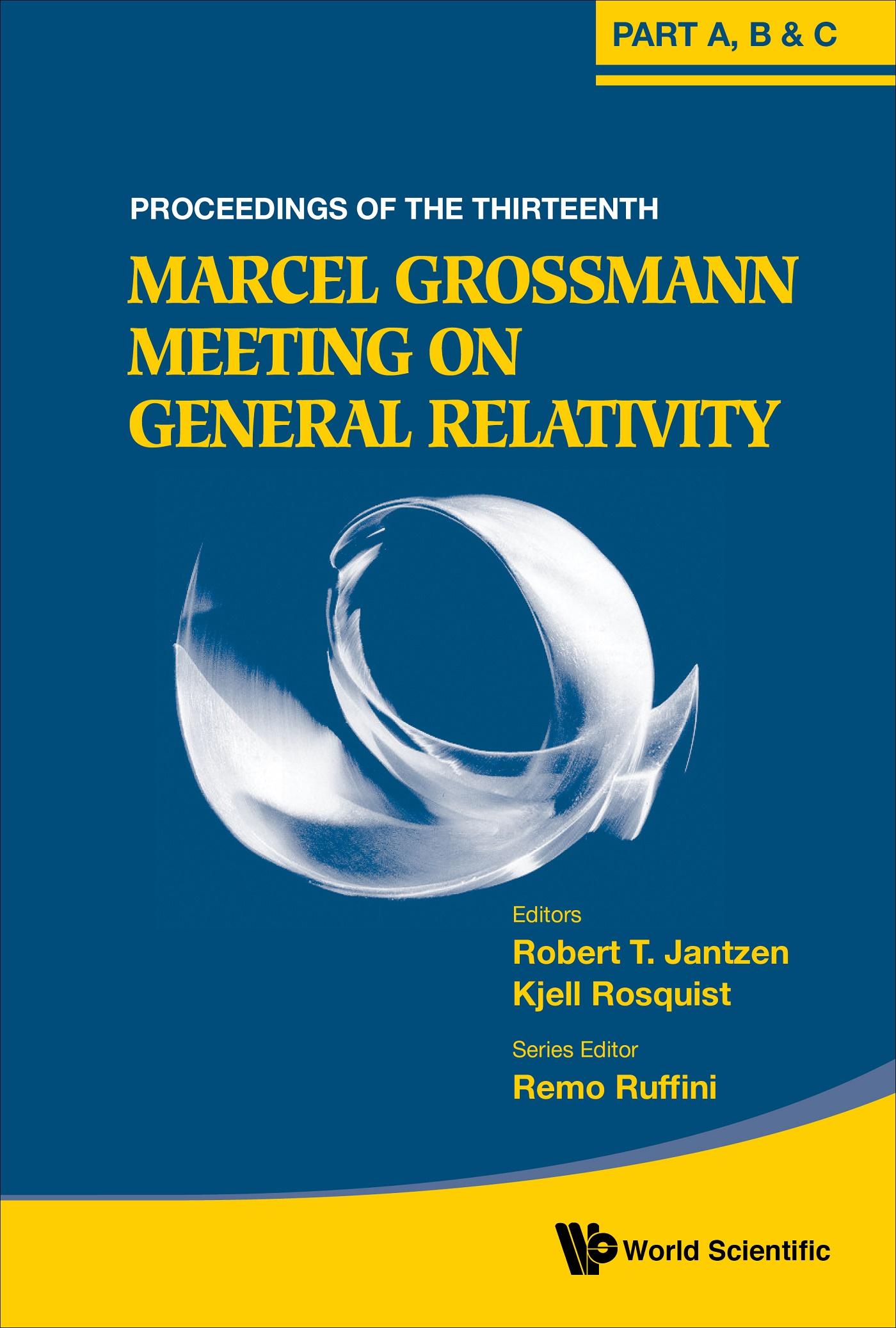
The Marcel Grossmann Meetings seek to further the development of the foundations and applications of Einstein's general relativity by promoting theoretical understanding in the relevant fields of physics, mathematics, astronomy and astrophysics and to direct future technological, observational, and experimental efforts. The meetings discuss recent developments in classical and quantum aspects of gravity, and in cosmology and relativistic astrophysics, with major emphasis on mathematical foundations and physical predictions, having the main objective of gathering scientists from diverse backgrounds for deepening our understanding of spacetime structure and reviewing the current state of the art in the theory, observations and experiments pertinent to relativistic gravitation. The range of topics is broad, going from the more abstract classical theory, quantum gravity, branes and strings, to more concrete relativistic astrophysics observations and modeling.The three volumes of the proceedings of MG13 give a broad view of all aspects of gravitational physics and astrophysics, from mathematical issues to recent observations and experiments. The scientific program of the meeting included 33 morning plenary talks during 6 days, and 75 parallel sessions over 4 afternoons. Volume A contains plenary and review talks ranging from the mathematical foundations of classical and quantum gravitational theories including recent developments in string/brane theories, to precision tests of general relativity including progress towards the detection of gravitational waves, and from supernova cosmology to relativistic astrophysics including such topics as gamma ray bursts, black hole physics both in our galaxy and in active galactic nuclei in other galaxies, and neutron star and pulsar astrophysics. Volumes B and C include parallel sessions which touch on dark matter, neutrinos, X-ray sources, astrophysical black holes, neutron stars, binary systems, radiative transfer, accretion disks, quasors, gamma ray bursts, supernovas, alternative gravitational theories, perturbations of collapsed objects, analog models, black hole thermodynamics, numerical relativity, gravitational lensing, large scale structure, observational cosmology, early universe models and cosmic microwave background anisotropies, inhomogeneous cosmology, inflation, global structure, singularities, chaos, Einstein-Maxwell systems, wormholes, exact solutions of Einstein's equations, gravitational waves, gravitational wave detectors and data analysis, precision gravitational measurements, quantum gravity and loop quantum gravity, quantum cosmology, strings and branes, self-gravitating systems, gamma ray astronomy, and cosmic rays and the history of general relativity.
Betal nemt med kort, Klarna, Apple Pay eller Google Pay. Ikke tilfreds? Du har altid 14 dages fortrydelsesret. Læs mere i vores vilkår. Har du spørgsmål, så send os en mail på hello@memmo.org.
Memmo gør det nemmere at studere – uanset hvor du er i verden. Hos os samler du dine kursusbøger og smarte studieværktøjer ét sted: resuméer, quizzer, podcasts og flashcards. Og så er der Ted, din studieven, der svarer på alt, du undrer dig over. Over 50 000 studerende studerer allerede her – bygget til at hjælpe dig med at lære hurtigere og stresse mindre.
Du kan måske også lide
Køb bogen0