
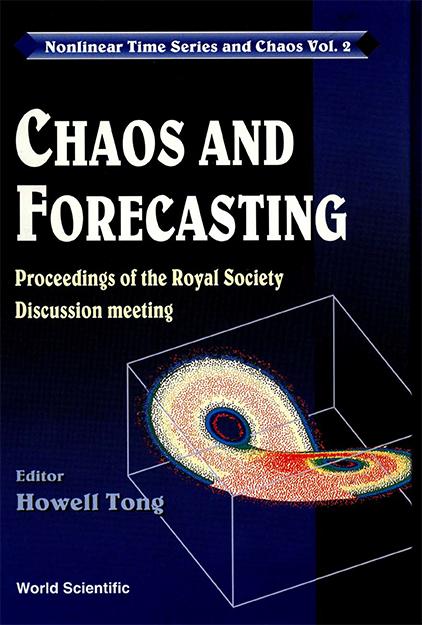
It is now generally recognised that very simple dynamical systems can produce apparently random behaviour. In the last couple of years, attention has turned to focus on the flip side of this coin: random-looking time series (or random-looking patterns in space) may indeed be the result of very complicated processes or “real noise”, but they may equally well be produced by some very simple mechanism (a low-dimensional attractor). In either case, a long-term prediction will be possible only in probabilistic terms. However, in the very short term, random systems will still be unpredictable but low-dimensional chaotic ones may be predictable (appearances to the contrary). The Royal Society held a two-day discussion meeting on topics covering diverse fields, including biology, economics, geophysics, meteorology, statistics, epidemiology, earthquake science and many others. Each topic was covered by a leading expert in the field. The meeting dealt with different basic approaches to the problem of chaos and forecasting, and covered applications to nonlinear forecasting of both artificially-generated time series and real data from context in the above-mentioned diverse fields. This book marks a rather special and rare occasion on which prominent scientists from different areas converge on the same theme. It forms an informative introduction to the science of chaos, with special reference to real data.
Betal nemt med kort, Klarna, Apple Pay eller Google Pay. Ikke tilfreds? Du har altid 14 dages fortrydelsesret. Læs mere i vores vilkår. Har du spørgsmål, så send os en mail på hello@memmo.org.
Memmo gør det nemmere at studere – uanset hvor du er i verden. Hos os samler du dine kursusbøger og smarte studieværktøjer ét sted: resuméer, quizzer, podcasts og flashcards. Og så er der Ted, din studieven, der svarer på alt, du undrer dig over. Over 50 000 studerende studerer allerede her – bygget til at hjælpe dig med at lære hurtigere og stresse mindre.
Du kan måske også lide
Køb bogen0