
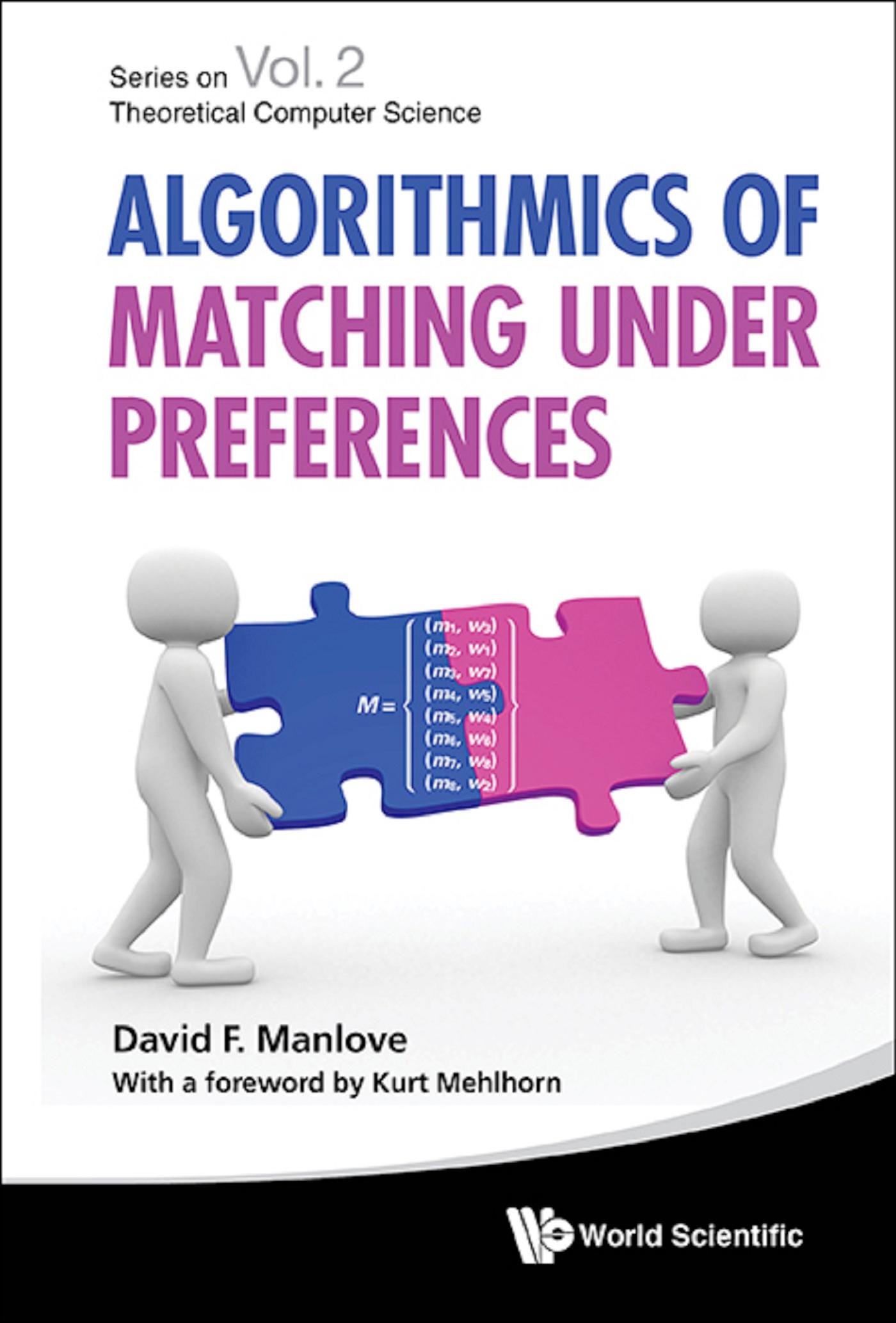
Matching problems with preferences are all around us: they arise when agents seek to be allocated to one another on the basis of ranked preferences over potential outcomes. Efficient algorithms are needed for producing matchings that optimise the satisfaction of the agents according to their preference lists.In recent years there has been a sharp increase in the study of algorithmic aspects of matching problems with preferences, partly reflecting the growing number of applications of these problems worldwide. The importance of the research area was recognised in 2012 through the award of the Nobel Prize in Economic Sciences to Alvin Roth and Lloyd Shapley.This book describes the most important results in this area, providing a timely update to The Stable Marriage Problem: Structure and Algorithms (D Gusfield and R W Irving, MIT Press, 1989) in connection with stable matching problems, whilst also broadening the scope to include matching problems with preferences under a range of alternative optimality criteria.
Betal nemt med kort, Klarna, Apple Pay eller Google Pay. Ikke tilfreds? Du har altid 14 dages fortrydelsesret. Læs mere i vores vilkår. Har du spørgsmål, så send os en mail på hello@memmo.org.
Memmo gør det nemmere at studere – uanset hvor du er i verden. Hos os samler du dine kursusbøger og smarte studieværktøjer ét sted: resuméer, quizzer, podcasts og flashcards. Og så er der Ted, din studieven, der svarer på alt, du undrer dig over. Over 50 000 studerende studerer allerede her – bygget til at hjælpe dig med at lære hurtigere og stresse mindre.
Du kan måske også lide
Køb bogen0