
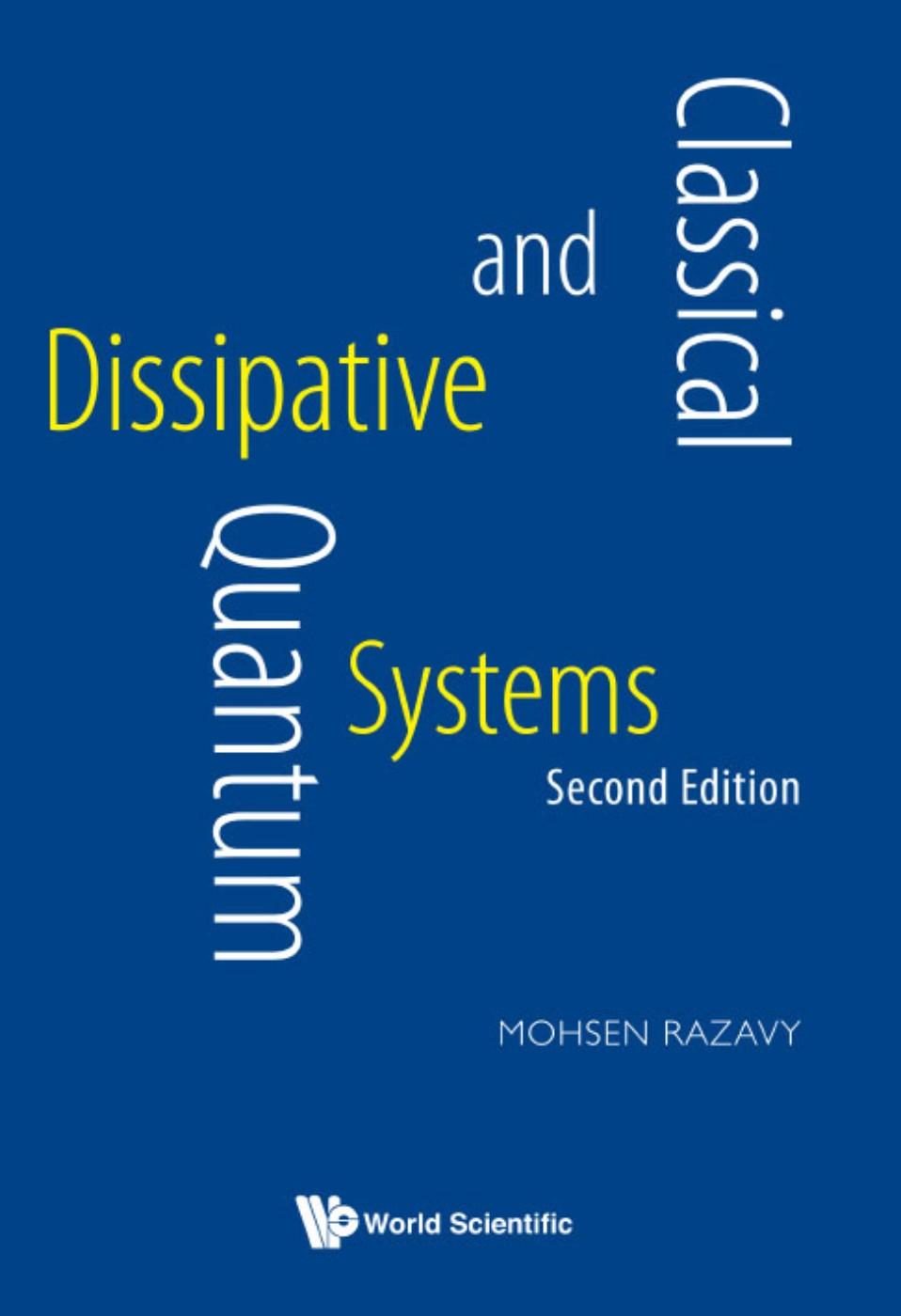
Dissipative forces play an important role in problems of classical as well as quantum mechanics. Since these forces are not among the basic forces of nature, it is essential to consider whether they should be treated as phenomenological interactions used in the equations of motion, or they should be derived from other conservative forces. In this book we discuss both approaches in detail starting with the Stoke's law of motion in a viscous fluid and ending with a rather detailed review of the recent attempts to understand the nature of the drag forces originating from the motion of a plane or a sphere in vacuum caused by the variations in the zero-point energy. In the classical formulation, mathematical techniques for construction of Lagrangian and Hamiltonian for the variational formulation of non-conservative systems are discussed at length. Various physical systems of interest including the problem of radiating electron, theory of natural line width, spin-boson problem, scattering and trapping of heavy ions and optical potential models of nuclear reactions are considered and solved.
Betal nemt med kort, Klarna, Apple Pay eller Google Pay. Ikke tilfreds? Du har altid 14 dages fortrydelsesret. Læs mere i vores vilkår. Har du spørgsmål, så send os en mail på hello@memmo.org.
Memmo gør det nemmere at studere – uanset hvor du er i verden. Hos os samler du dine kursusbøger og smarte studieværktøjer ét sted: resuméer, quizzer, podcasts og flashcards. Og så er der Ted, din studieven, der svarer på alt, du undrer dig over. Over 50 000 studerende studerer allerede her – bygget til at hjælpe dig med at lære hurtigere og stresse mindre.
Du kan måske også lide
Køb bogen0