
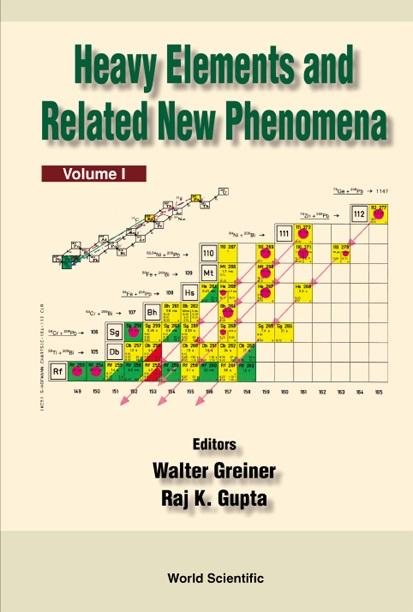
This book reviews recent developments in the field of superheavy elements and the related phenomena of fission, cluster radioactivity, and drip line physics. Both the experimental and theoretical aspects are dealt with in detail. For the production of new elements in the laboratory, the process of cold compound nucleus formation is found to be most favorable both theoretically and experimentally. However, experimentally, hot fusion of nuclei has also been used. Both the physical and chemical methods of synthesizing new elements are discussed. The theoretical approaches considered here are those of the quantum-mechanical fragmentation theory, the self-consistent Hartree-Fock theory, and the relativistic mean field theory. Fission, a process inverse to the fusion of two nuclei, is also observed to be most favourably a cold phenomenon. Other important results are bi-modal fission and high n-multiplicity fission, which leads to the hyperdeformed scission mode. Cluster radioactivity is discussed both as a heavy cluster emission process and as super-asymmetric fission. The theory as well as the present experimental status are reviewed. Physics at drip lines is interesting not only for their structural properties but also for their use in the fusion of two nuclei; both aspects are discussed.
Betal nemt med kort, Klarna, Apple Pay eller Google Pay. Ikke tilfreds? Du har altid 14 dages fortrydelsesret. Læs mere i vores vilkår. Har du spørgsmål, så send os en mail på hello@memmo.org.
Memmo gør det nemmere at studere – uanset hvor du er i verden. Hos os samler du dine kursusbøger og smarte studieværktøjer ét sted: resuméer, quizzer, podcasts og flashcards. Og så er der Ted, din studieven, der svarer på alt, du undrer dig over. Over 50 000 studerende studerer allerede her – bygget til at hjælpe dig med at lære hurtigere og stresse mindre.
Du kan måske også lide
Køb bogen0