
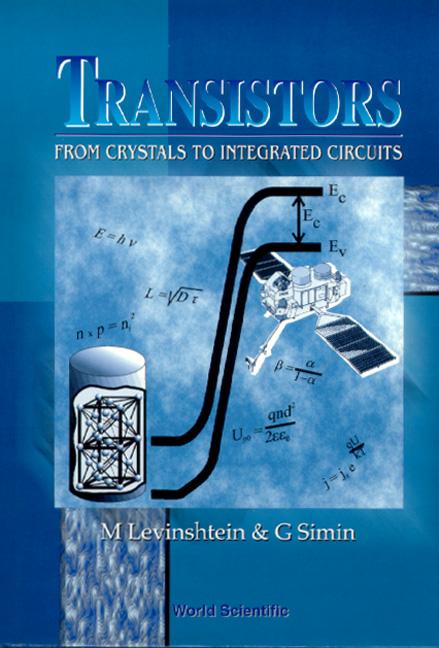
This new book by M Levinshtein and G Simin tells the readers about the design and work of the most important and most interesting semiconductor devices — the transistors.The book is written in a friendly and easy to read manner and is meant primarily for young people, high school students, freshmen and sophomores. However, the original approach to semiconductor physics makes this book attractive to physics teachers and professors as well.The book consists of 3 parts:Part I: The section on semiconductors describes the main properties of semiconductors, explains the difference between the semiconductors, metals and dielectrics. We find here the explanation of the appearance of those wonderful properties of semiconductors which underlie their numerous applications. This part also contains a vivid and detailed description of the main types of motion of the charge carriers in semiconductors: thermal motion, motion in the electric field and diffusion.Part II covers Barriers and Junctions. In order to understand the principles of the work of the most important semiconductor devices, it is not sufficient just to get to know the properties of semiconductors. It is also quite essential to study certain specific and interesting phenomena — the so-called junctions. This part of the book contains a detailed and vivid description of those properties and in that view of the properties of the p-n junctions and diodes: photodiodes, varicaps, light emitting diodes, solar cells and rectifier diodes.Part III covers Transitors. It describes the basis of the work of the Bipolar and Field Effect Transistors. Without making use of rather complicated equations or notions of quantum mechanics the authors give a clear and simple explanation of the cause of ability of those devices to amplify and generate electric signals. They tell the readers how transistors are manufactured and describe the work of the transistor's simplest circuits.The last chapter of the book is devoted to the ideas underlying the transistors: integrated circuits. It is these integrated circuits which are the foundation of modern electronics: from telephone apparatus to supercomputers, from medical instruments to cosmic communication systems.In conclusion, the authors make an attempt to foresee and imagine, together with the reader what other devices may come to substitute the transistor in the future.
Betal nemt med kort, Klarna, Apple Pay eller Google Pay. Ikke tilfreds? Du har altid 14 dages fortrydelsesret. Læs mere i vores vilkår. Har du spørgsmål, så send os en mail på hello@memmo.org.
Memmo gør det nemmere at studere – uanset hvor du er i verden. Hos os samler du dine kursusbøger og smarte studieværktøjer ét sted: resuméer, quizzer, podcasts og flashcards. Og så er der Ted, din studieven, der svarer på alt, du undrer dig over. Over 50 000 studerende studerer allerede her – bygget til at hjælpe dig med at lære hurtigere og stresse mindre.
Du kan måske også lide
Køb bogen0