
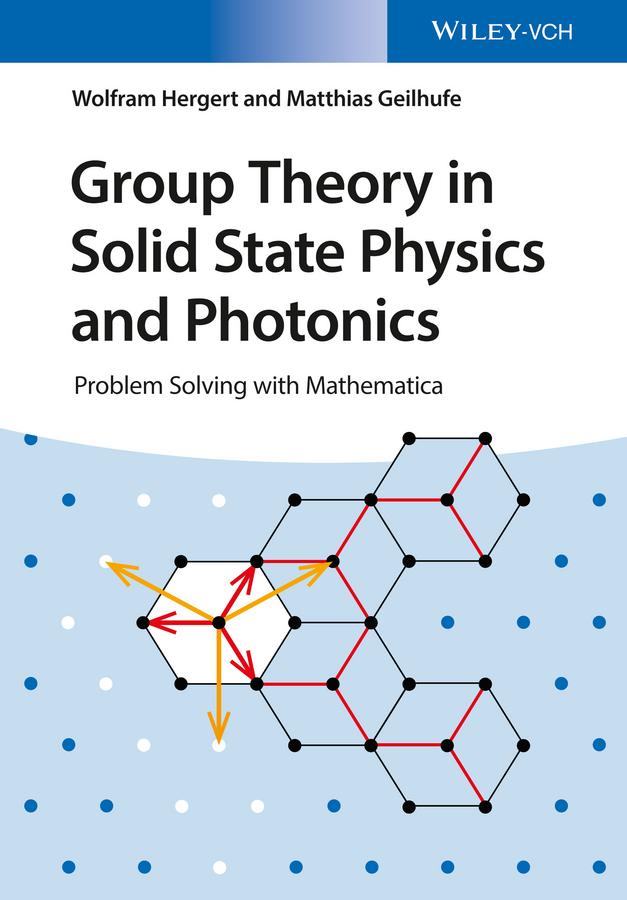
While group theory and its application to solid state physics is well established, this textbook raises two completely new aspects. First, it provides a better understanding by focusing on problem solving and making extensive use of Mathematica tools to visualize the concepts. Second, it offers a new tool for the photonics community by transferring the concepts of group theory and its application to photonic crystals.
Clearly divided into three parts, the first provides the basics of group theory. Even at this stage, the authors go beyond the widely used standard examples to show the broad field of applications. Part II is devoted to applications in condensed matter physics, i.e. the electronic structure of materials. Combining the application of the computer algebra system Mathematica with pen and paper derivations leads to a better and faster understanding. The exhaustive discussion shows that the basics of group theory can also be applied to a totally different field, as seen in Part III. Here, photonic applications are discussed in parallel to the electronic case, with the focus on photonic crystals in two and three dimensions, as well as being partially expanded to other problems in the field of photonics.
The authors have developed Mathematica package GTPack which is available for download from the book's homepage. Analytic considerations, numerical calculations and visualization are carried out using the same software. While the use of the Mathematica tools are demonstrated on elementary examples, they can equally be applied to more complicated tasks resulting from the reader's own research.
Clearly divided into three parts, the first provides the basics of group theory. Even at this stage, the authors go beyond the widely used standard examples to show the broad field of applications. Part II is devoted to applications in condensed matter physics, i.e. the electronic structure of materials. Combining the application of the computer algebra system Mathematica with pen and paper derivations leads to a better and faster understanding. The exhaustive discussion shows that the basics of group theory can also be applied to a totally different field, as seen in Part III. Here, photonic applications are discussed in parallel to the electronic case, with the focus on photonic crystals in two and three dimensions, as well as being partially expanded to other problems in the field of photonics.
The authors have developed Mathematica package GTPack which is available for download from the book's homepage. Analytic considerations, numerical calculations and visualization are carried out using the same software. While the use of the Mathematica tools are demonstrated on elementary examples, they can equally be applied to more complicated tasks resulting from the reader's own research.
Betal nemt med kort, Klarna, Apple Pay eller Google Pay. Ikke tilfreds? Du har altid 14 dages fortrydelsesret. Læs mere i vores vilkår. Har du spørgsmål, så send os en mail på hello@memmo.org.
Memmo gør det nemmere at studere – uanset hvor du er i verden. Hos os samler du dine kursusbøger og smarte studieværktøjer ét sted: resuméer, quizzer, podcasts og flashcards. Og så er der Ted, din studieven, der svarer på alt, du undrer dig over. Over 50 000 studerende studerer allerede her – bygget til at hjælpe dig med at lære hurtigere og stresse mindre.