
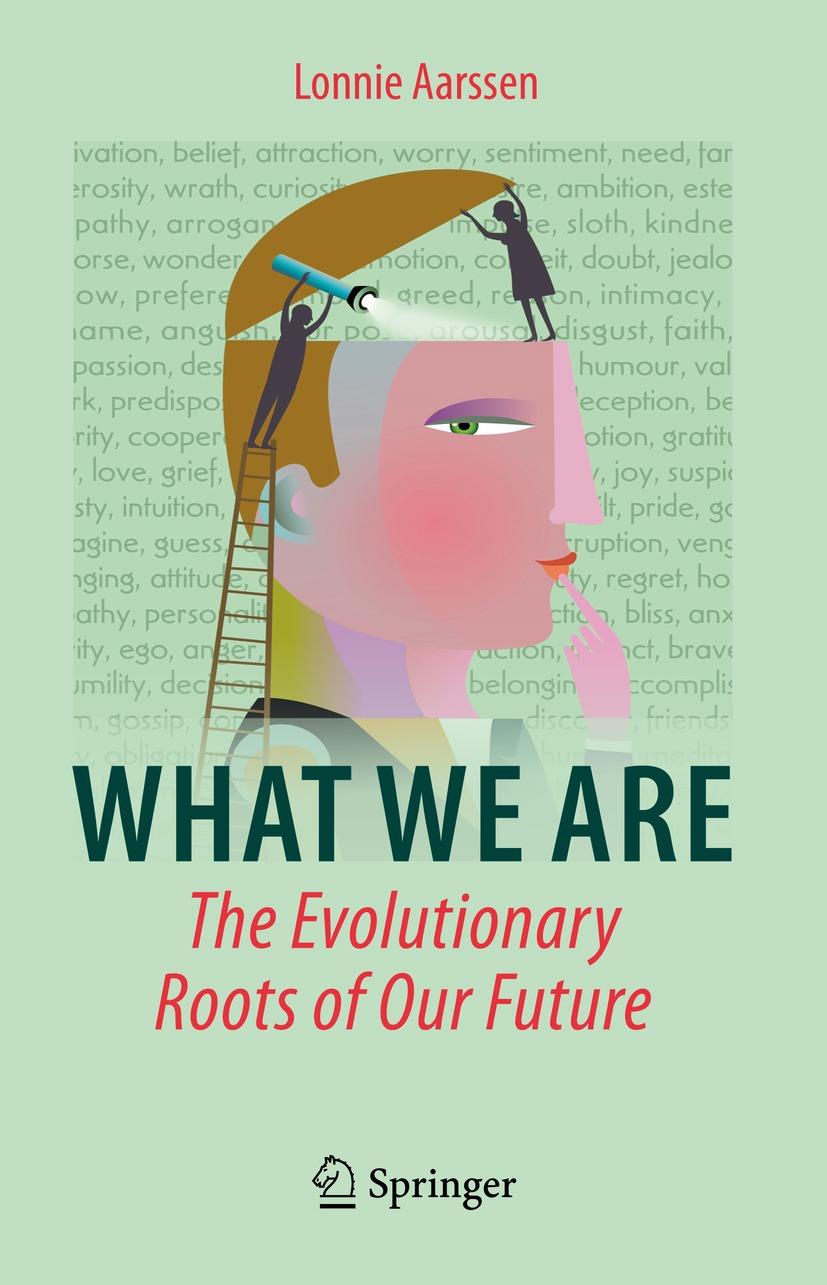
Other animals are driven to spend essentially their whole lives just trying to get fed, stay alive, and get laid. That’s about it. The same was true for our proto-human ancestors. And modern humans of course also require a Survival Drive and a Sex Drive in order to leave descendants. But today we spend most of our lives mainly just trying to convince ourselves that our existence is not absurd.
In What We Are, Queen’s University biologist, Lonnie Aarssen, traces how our biocultural evolution has shaped Homo sapiens into the only creature that refuses to be what it is — the only creature preoccupied with a deeply ingrained, and absurd sentiment: I have a distinct ‘mental life’—an ‘inner self’—that exists separately and apart from ‘material life’, and so, unlike the latter, need not come to an end. This delusion conceivably gave our distant ancestors some wishful thinking for finding some measure of relief from the terrifying, uniquely human knowledge of the eventual loss of corporeal survival. But this came with an impulsive, nagging doubt — an obsessive underlying uncertainty: ‘self-impermanence anxiety’. Biocultural evolution, however, was not finished. It also gave us two additional, uniquely human, primal drives, both serving to help quell the burden of this anxiety. Legacy Drive generates delusional cultural domains for ‘extension’ of self; and Leisure Drive generates pleasurable cultural domains for distraction – ‘escape’ – from self.
Legacy Drive and Leisure Drive, Aarssen argues, represent two of the most profound consequences of human cognitive and cultural evolution. What We Are advances propositions regarding how a visceral susceptibility to self-impermanence anxiety has — paradoxically — played a pivotal role in rewarding the reproductive success of our ancestors, and has thus been a driving force in shaping fundamental motivations and cultural norms of modern humans. More than any other milestone in the evolution of human minds, self-impermanence anxiety, and its mitigating Drives for Legacy and Leisure, account for not just the advance of civilization over the past many thousands of years, but also now, its impending collapse. Effective management of this crisis, Aarssen insists, will require a deeper and more broadly public understanding of its Darwinian evolutionary roots — as laid out in What We Are.
Betal nemt med kort, Klarna, Apple Pay eller Google Pay. Ikke tilfreds? Du har altid 14 dages fortrydelsesret. Læs mere i vores vilkår. Har du spørgsmål, så send os en mail på hello@memmo.org.
Memmo gør det nemmere at studere – uanset hvor du er i verden. Hos os samler du dine kursusbøger og smarte studieværktøjer ét sted: resuméer, quizzer, podcasts og flashcards. Og så er der Ted, din studieven, der svarer på alt, du undrer dig over. Over 50 000 studerende studerer allerede her – bygget til at hjælpe dig med at lære hurtigere og stresse mindre.