
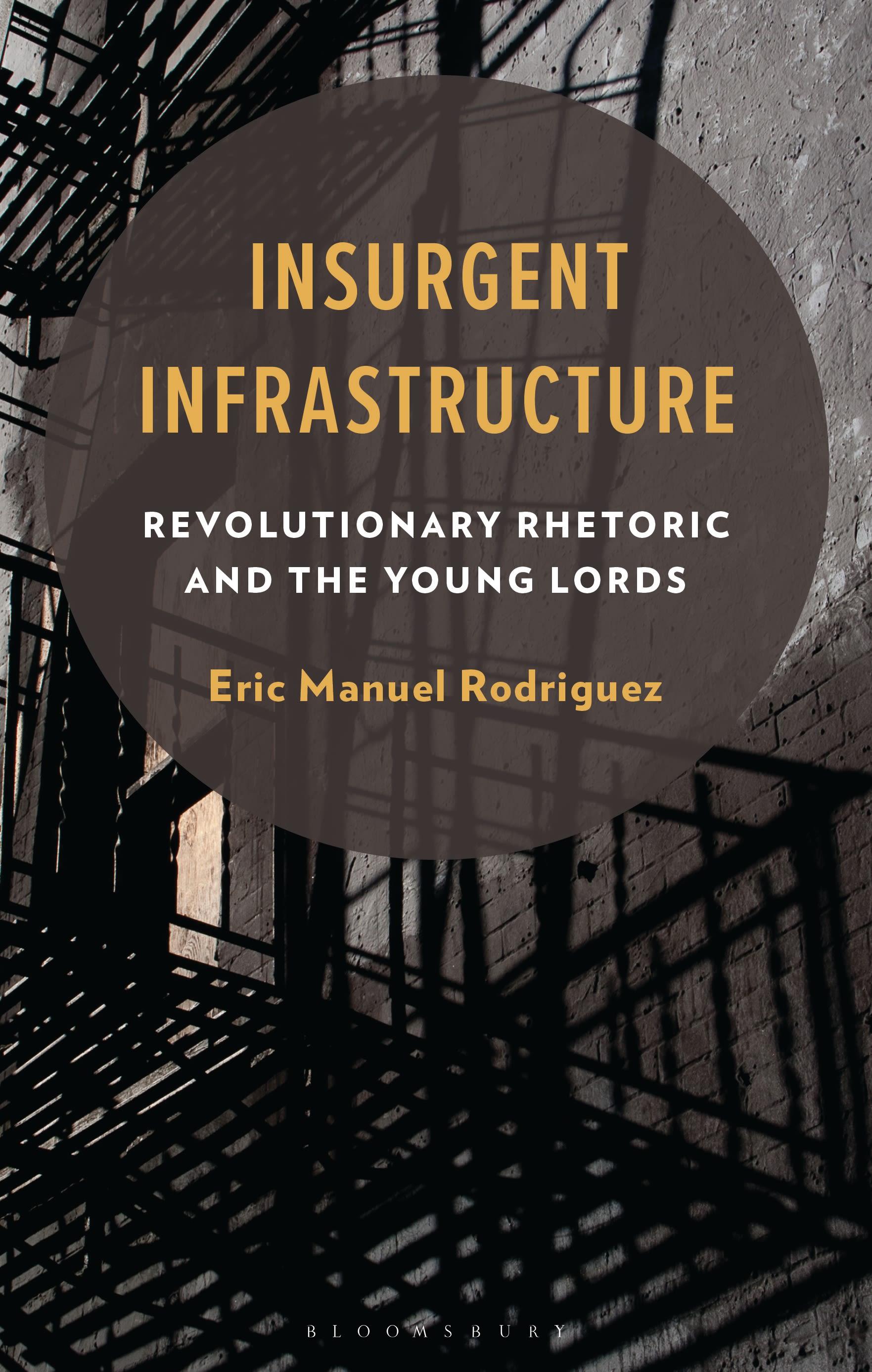
Eric Manuel Rodriguez argues that revolutionary rhetoric operates as insurgent infrastructure rather than symbolic performance.
Examining the Young Lords, a revolutionary nationalist organization forged from conditions of colonial displacement, racial capitalism, and urban neglect, this book argues that rhetorical studies requires recalibration to account for rhetoric's material dimensions and its capacity to coordinate collective survival. Through sustained analysis of the Young Lords' bilingual newspaper Palante, their 13-Point Program and Platform, Rules of Discipline, and the occupations, clinics, and educational programs that constituted their revolutionary praxis, Rodriguez demonstrates how rhetoric coordinated bodies, resources, and time under conditions of organized abandonment.
Drawing on decolonial theory, foquismo, and the concept of kairos, the study reframes rhetorical action as the construction of counter-institutions – free clinics, autonomous media, community defense, liberation schools – that sustained collective survival. Tracing the organization's rhetorical evolution from Chicago to New York and its eventual fracture, Eric Manuel Rodriguez reveals how print, pedagogy, and occupation functioned as logistical media for mobilization, and how the three principles – insurgent infrastructure, dialectical pedagogy, and collective logistics – connect the Young Lords' legacy to contemporary movements and abolitionist organizing.
Examining the Young Lords, a revolutionary nationalist organization forged from conditions of colonial displacement, racial capitalism, and urban neglect, this book argues that rhetorical studies requires recalibration to account for rhetoric's material dimensions and its capacity to coordinate collective survival. Through sustained analysis of the Young Lords' bilingual newspaper Palante, their 13-Point Program and Platform, Rules of Discipline, and the occupations, clinics, and educational programs that constituted their revolutionary praxis, Rodriguez demonstrates how rhetoric coordinated bodies, resources, and time under conditions of organized abandonment.
Drawing on decolonial theory, foquismo, and the concept of kairos, the study reframes rhetorical action as the construction of counter-institutions – free clinics, autonomous media, community defense, liberation schools – that sustained collective survival. Tracing the organization's rhetorical evolution from Chicago to New York and its eventual fracture, Eric Manuel Rodriguez reveals how print, pedagogy, and occupation functioned as logistical media for mobilization, and how the three principles – insurgent infrastructure, dialectical pedagogy, and collective logistics – connect the Young Lords' legacy to contemporary movements and abolitionist organizing.
Sider: 192
Kategori: Kultur-, Genus- & Postkoloniala studier
e-ISBN: 9781978769427
Forsendelsesvægt: 1.2 kg
Sendes inden for: 1-2 dage
Betal nemt med kort, Klarna, Apple Pay eller Google Pay. Ikke tilfreds? Du har altid 14 dages fortrydelsesret. Læs mere i vores vilkår. Har du spørgsmål, så send os en mail på hello@memmo.org.
Memmo gør det nemmere at studere – uanset hvor du er i verden. Hos os samler du dine kursusbøger og smarte studieværktøjer ét sted: resuméer, quizzer, podcasts og flashcards. Og så er der Ted, din studieven, der svarer på alt, du undrer dig over. Over 50 000 studerende studerer allerede her – bygget til at hjælpe dig med at lære hurtigere og stresse mindre.