
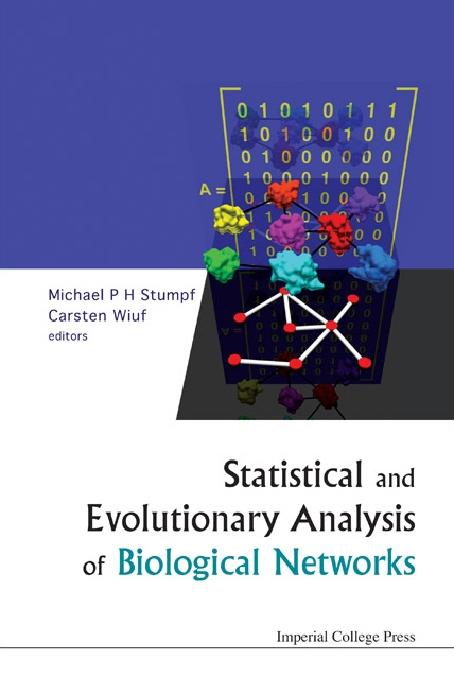
Networks provide a very useful way to describe a wide range of different data types in biology, physics and elsewhere. Apart from providing a convenient tool to visualize highly dependent data, networks allow stringent mathematical and statistical analysis.In recent years, much progress has been achieved to interpret various types of biological network data such as transcriptomic, metabolomic and protein interaction data as well as epidemiological data. Of particular interest is to understand the organization, complexity and dynamics of biological networks and how these are influenced by network evolution and functionality.This book reviews and explores statistical, mathematical and evolutionary theory and tools in the understanding of biological networks. The book is divided into comprehensive and self-contained chapters, each of which focuses on an important biological network type, explains concepts and theory and illustrates how these can be used to obtain insight into biologically relevant processes and questions. There are chapters covering metabolic, transcriptomic, protein interaction and epidemiological networks as well as chapters that deal with theoretical and conceptual material. The authors, who contribute to the book, are active, highly regarded and well-known in the network community.
Betal nemt med kort, Klarna, Apple Pay eller Google Pay. Ikke tilfreds? Du har altid 14 dages fortrydelsesret. Læs mere i vores vilkår. Har du spørgsmål, så send os en mail på hello@memmo.org.
Memmo gør det nemmere at studere – uanset hvor du er i verden. Hos os samler du dine kursusbøger og smarte studieværktøjer ét sted: resuméer, quizzer, podcasts og flashcards. Og så er der Ted, din studieven, der svarer på alt, du undrer dig over. Over 50 000 studerende studerer allerede her – bygget til at hjælpe dig med at lære hurtigere og stresse mindre.
Du kan måske også lide
Køb bogen0