
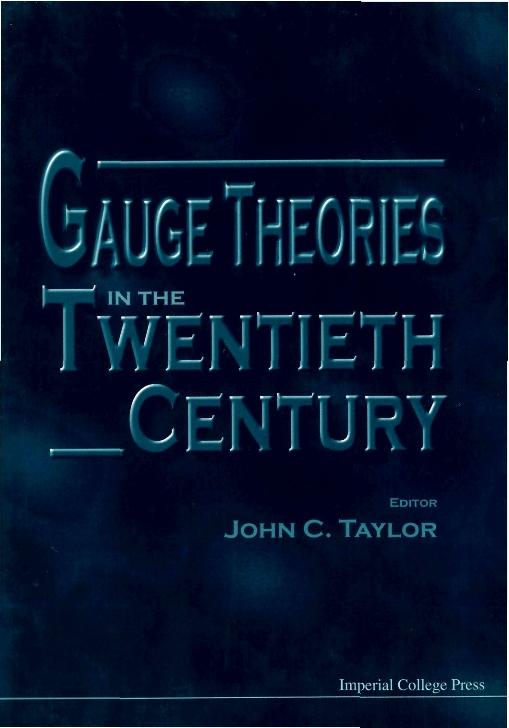
By the end of the 1970s, it was clear that all the known forces of nature (including, in a sense, gravity) were examples of gauge theories, characterized by invariance under symmetry transformations chosen independently at each position and each time. These ideas culminated with the finding of the W and Z gauge bosons (and perhaps also the Higgs boson). This important book brings together the key papers in the history of gauge theories, including the discoveries of: the role of gauge transformations in the quantum theory of electrically charged particles in the 1920s; nonabelian gauge groups in the 1950s; vacuum symmetry-breaking in the 1960s; asymptotic freedom in the 1970s. A short introduction explains the significance of the papers, and the connections between them.
Betal nemt med kort, Klarna, Apple Pay eller Google Pay. Ikke tilfreds? Du har altid 14 dages fortrydelsesret. Læs mere i vores vilkår. Har du spørgsmål, så send os en mail på hello@memmo.org.
Memmo gør det nemmere at studere – uanset hvor du er i verden. Hos os samler du dine kursusbøger og smarte studieværktøjer ét sted: resuméer, quizzer, podcasts og flashcards. Og så er der Ted, din studieven, der svarer på alt, du undrer dig over. Over 50 000 studerende studerer allerede her – bygget til at hjælpe dig med at lære hurtigere og stresse mindre.
Du kan måske også lide
Køb bogen0