
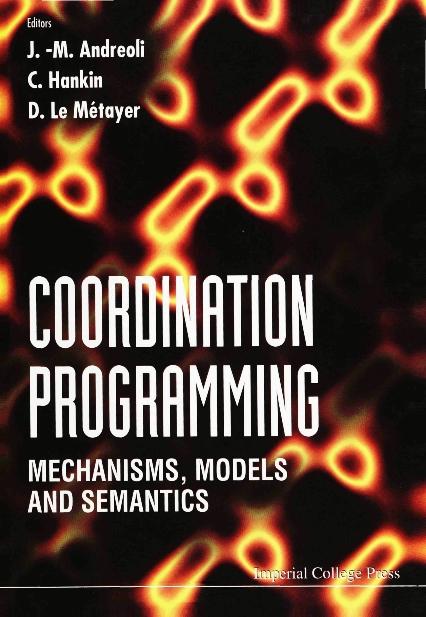
Coordination, considered abstractly, is an ubiquitous notion in computer science: for example, programming languages coordinate elementary instructions; operating systems coordinate accesses to hardware resources; database transaction schedulers coordinate accesses to shared data; etc. All these situations have some common features, which can be identified at the abstract level as “coordination mechanisms”. This book focuses on a class of coordination models where multiple pieces of software coordinate their activities through some shared dataspace. The book has three parts. Part 1 presents the main coordination models studied in this book (Gamma, LO, TAO, LambdaN). Part 2 focuses on various semantics aspects of coordination, applied mainly to Gamma. Part 3 presents actual implementations of coordination models and an application.
Betal nemt med kort, Klarna, Apple Pay eller Google Pay. Ikke tilfreds? Du har altid 14 dages fortrydelsesret. Læs mere i vores vilkår. Har du spørgsmål, så send os en mail på hello@memmo.org.
Memmo gør det nemmere at studere – uanset hvor du er i verden. Hos os samler du dine kursusbøger og smarte studieværktøjer ét sted: resuméer, quizzer, podcasts og flashcards. Og så er der Ted, din studieven, der svarer på alt, du undrer dig over. Over 50 000 studerende studerer allerede her – bygget til at hjælpe dig med at lære hurtigere og stresse mindre.
Du kan måske også lide
Køb bogen0