
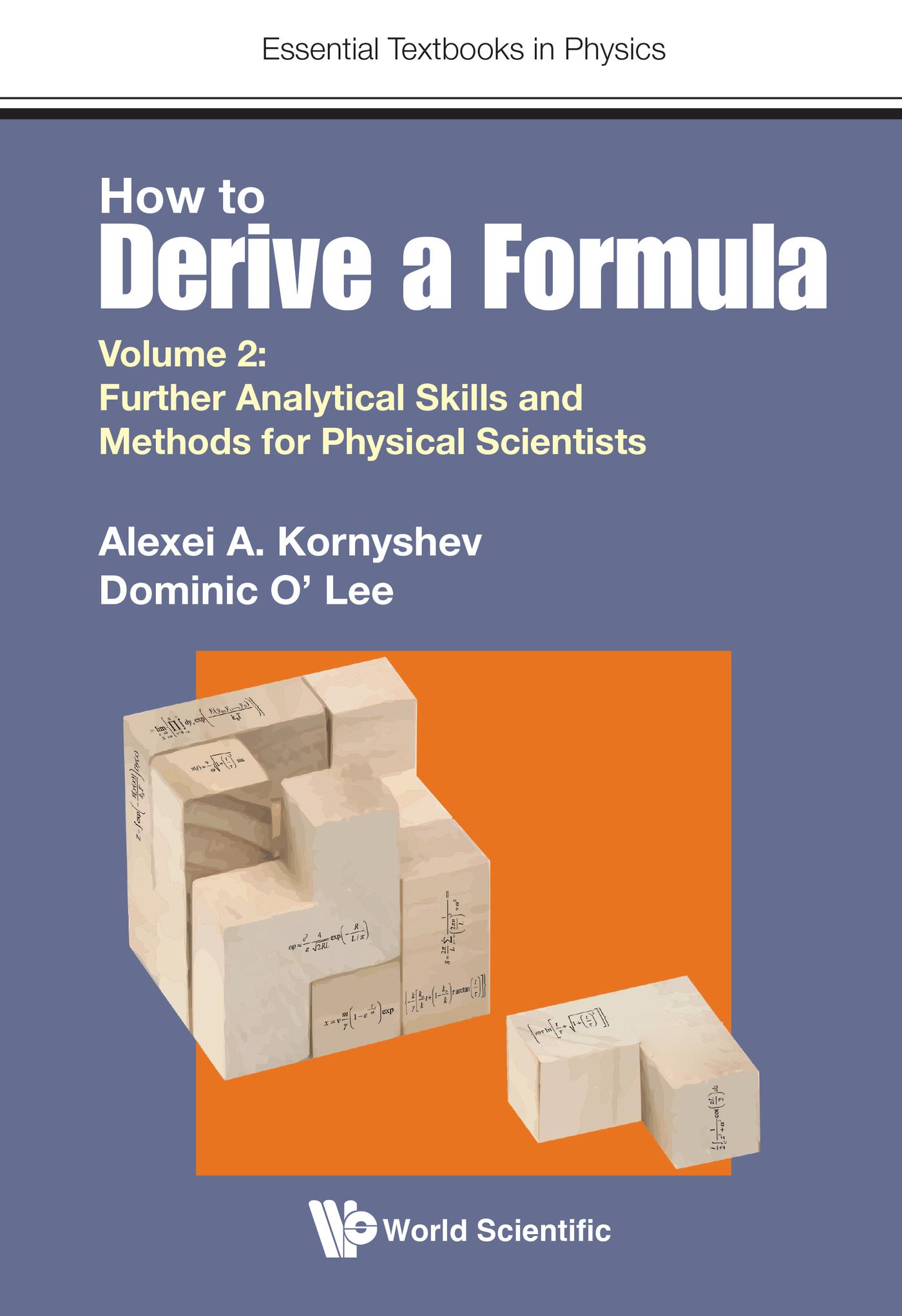
Will artificial intelligence make scientific formulae redundant by eventually solving all current and future physical problems? The authors of this book would argue that there is still a vital role for humans to play in making sense of the laws of nature. To derive a formula one follows a series of steps, only the last of which is to check that the result is correct. The book is about unravelling this machinery.
Mathematics is the 'queen of all sciences', but students encounter many obstacles in learning the subject: familiarization with the proofs of hundreds of theorems, mysterious symbols, and technical routines for which the usefulness is not obvious upfront. Learners could lose motivation, not seeing the wood for the trees.
This two-volume book How to Derive a Formula is an attempt to engage learners by presenting mathematical methods in as simple terms as possible, with more of an emphasis on skills as opposed to technical knowledge. Based on intuition and common sense rather than mathematical rigour, it teaches students from scratch using pertinent examples, many taken from across the physical sciences to demonstrate the application of the methods taught.
This book draws on humour and historical facts to provide an interesting new perspective on what a mathematics textbook could be. The two volumes are presented as an ascent to Everest. Volume 1 covered the necessary basics, taking readers from Base Camp to Camps 1 and 2. This volume moves readers from Camp 2 up to Camps 3 and 4, tackling more advanced methods for deriving formulae. Inevitably, Volume 2 requires readers to tackle more challenging terrain than was experienced in Volume 1 and so is targeted at more advanced students.
Contents:
- Preface
- About the Authors
- From Camp 2: In the Multidimensional and Complex World:
- Multiple Integration in More Depth
- Surfaces and Vectors
- Vector Fields and More Vector Calculus
- Differential Eigenvalue Equations and Special Functions
- Coupled Linear Second Order Differential Equations and Higher Order Equations
- Approximation Techniques for Ordinary Differential Equations
- Homogeneous Partial Differential Equations
- Complex Contour Integration
- More Involved Methods for the Summation of Series
- Concluding Remarks
- From Camp 3: From Becoming at Ease with Inhomogeneous Partial Differential Equations to a Glimpse of Integral Equations, Functionals, Variation Calculus, Functional Integration, and a Snapshot of the 'Fractional World':
- Dealing with Inhomogeneous Partial Differential Equations
- A Brief Look into the World of Integral Equations
- Principles of Variational Calculus
- Path Integrals — A First Look
- In the Thin Air of the Fractional World
- Concluding Remarks
- The Final Ascent to Everest
Readership: Undergraduate and graduate students (in any disciplines of exact sciences), and postdoctoral researchers in physical sciences, university lecturers for teaching the material of some of the chapters of the book.
Betal nemt med kort, Klarna, Apple Pay eller Google Pay. Ikke tilfreds? Du har altid 14 dages fortrydelsesret. Læs mere i vores vilkår. Har du spørgsmål, så send os en mail på hello@memmo.org.
Memmo gør det nemmere at studere – uanset hvor du er i verden. Hos os samler du dine kursusbøger og smarte studieværktøjer ét sted: resuméer, quizzer, podcasts og flashcards. Og så er der Ted, din studieven, der svarer på alt, du undrer dig over. Over 50 000 studerende studerer allerede her – bygget til at hjælpe dig med at lære hurtigere og stresse mindre.