
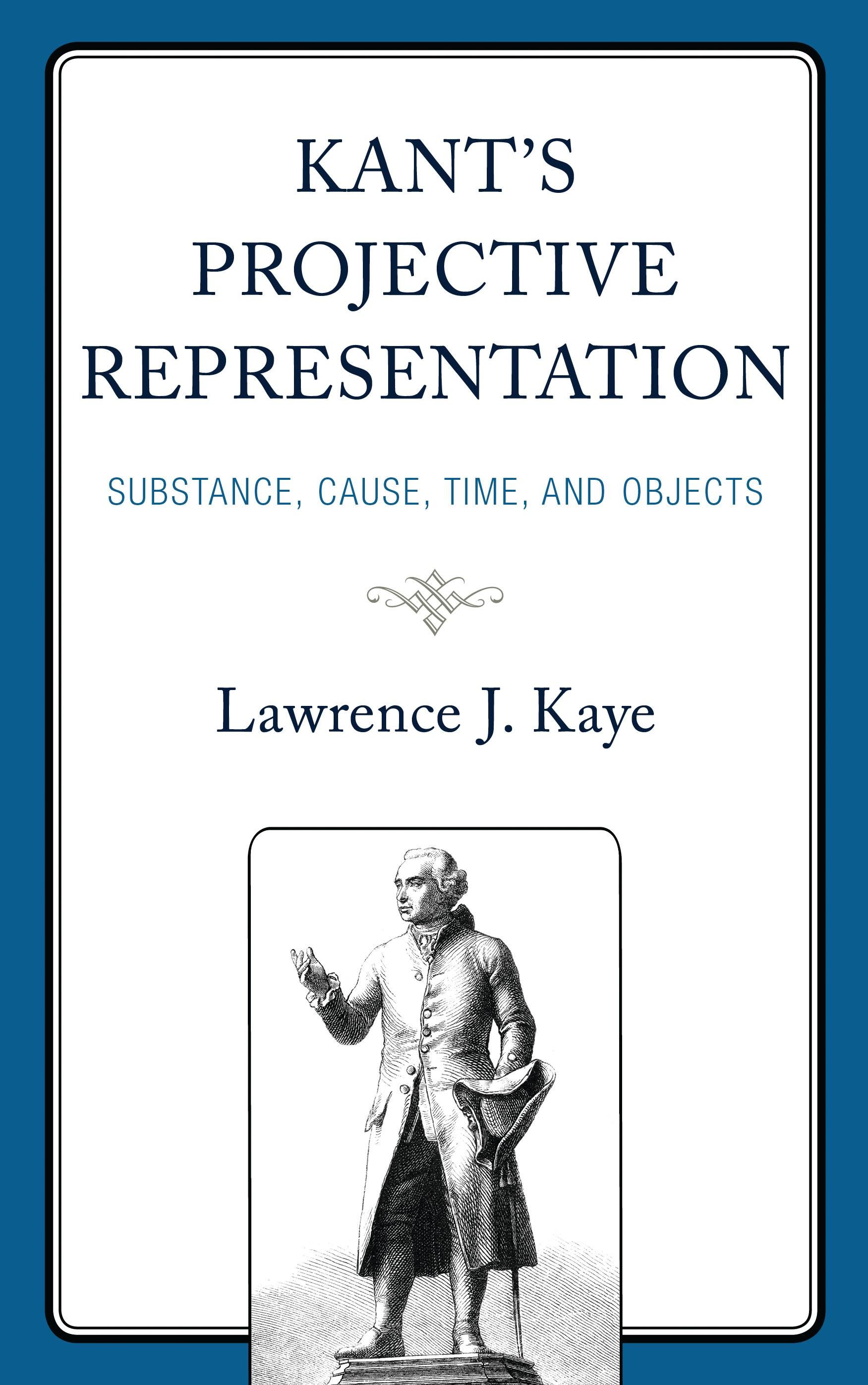
Kant’s Projective Representation: Substance, Cause, Time, and Objects is a textually thorough study of Kant’s account of mental representation that yields a new understanding of the primary doctrines of the Critique of Pure Reason. Lawrence J. Kaye argues that in the Transcendental Deduction, the analytic unity of concepts establishes the necessary unity of consciousness, which also constitutes representation. In the First Analogy, Kant argues that our ability to represent sequences, simultaneity, and durations rests on the conceptually prior representation of persistence. Without persistence in empirical perceptions, we must represent persistence with identities across intuitions that project an external world of persistent matter. The other Analogies explain how we represent sequences through necessitated state transitions in objects and how we represent simultaneity through mutual influence. These pure unifications that constitute representation are the schematized (relational) categories—instances of the same types of unifying functions that underlie the concepts of substance, causation, and community. We know a priori that all perceptual experiences will project a world with this structure, which is synthetic a priori metaphysical knowledge. This interpretation also shows how Kant reconciles realism and idealism: we empirically represent a world that is external to consciousness, but we do so by using unities that are purely mental constructions.
Betal nemt med kort, Klarna, Apple Pay eller Google Pay. Ikke tilfreds? Du har altid 14 dages fortrydelsesret. Læs mere i vores vilkår. Har du spørgsmål, så send os en mail på hello@memmo.org.
Memmo gør det nemmere at studere – uanset hvor du er i verden. Hos os samler du dine kursusbøger og smarte studieværktøjer ét sted: resuméer, quizzer, podcasts og flashcards. Og så er der Ted, din studieven, der svarer på alt, du undrer dig over. Over 50 000 studerende studerer allerede her – bygget til at hjælpe dig med at lære hurtigere og stresse mindre.