
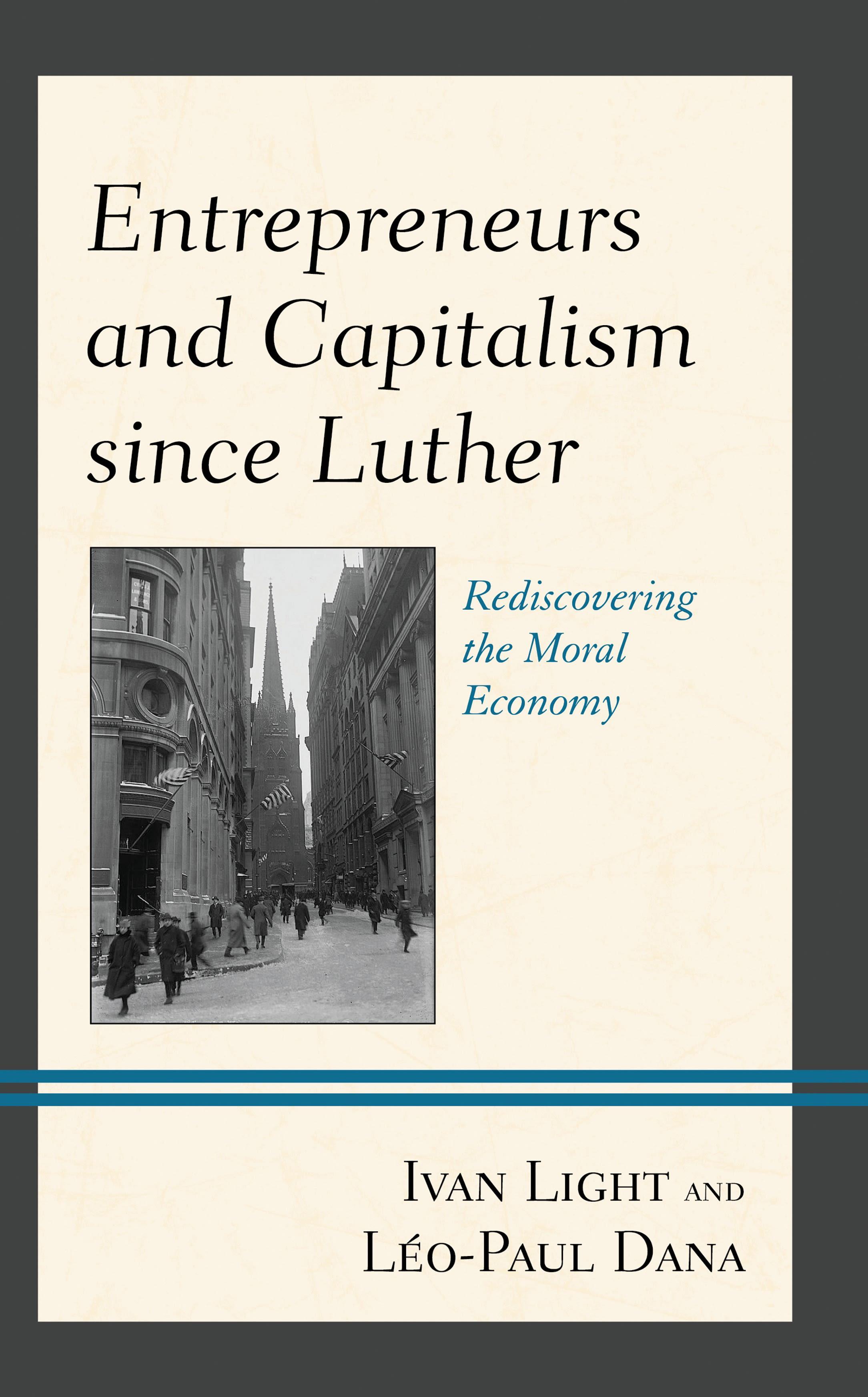
In Entrepreneurs and Capitalism since Luther: Rediscovering the Moral Economy, Ivan Light and Léo-Paul Dana study the history of business, capitalism, and entrepreneurship to examine the values of social and cultural capital. Six chapters evaluate case studies that illustrate contrasting relationships between social networks, vocational culture, and entrepreneurship. Light and Dana argue that, in capitalism’s early stages, cultural capital is scarcer than social capital and therefore more crucial for business owners. Conversely, when capitalism is well established, social capital is scarcer than cultural capital and becomes more crucial. Light and Dana then trace moral legitimations of capitalism from the Reformation to the Enlightenment, the Gilded Age, and finally to Joseph Schumpeter whose concept of “creative destruction” freed elite entrepreneurs from moral restraints that encumber small business owners. After examining the availability of social and cultural capital in the contemporary United States, Light and Dana show that business owners’ social capital enforces conventional morality in markets, facilitating commerce and legitimating small businesses the old-fashioned way. As their networks become more isolated, elite entrepreneurs must claim and ultimately deliver successful results to earn public toleration of immoral or predatory conduct.
Betal nemt med kort, Klarna, Apple Pay eller Google Pay. Ikke tilfreds? Du har altid 14 dages fortrydelsesret. Læs mere i vores vilkår. Har du spørgsmål, så send os en mail på hello@memmo.org.
Memmo gør det nemmere at studere – uanset hvor du er i verden. Hos os samler du dine kursusbøger og smarte studieværktøjer ét sted: resuméer, quizzer, podcasts og flashcards. Og så er der Ted, din studieven, der svarer på alt, du undrer dig over. Over 50 000 studerende studerer allerede her – bygget til at hjælpe dig med at lære hurtigere og stresse mindre.