
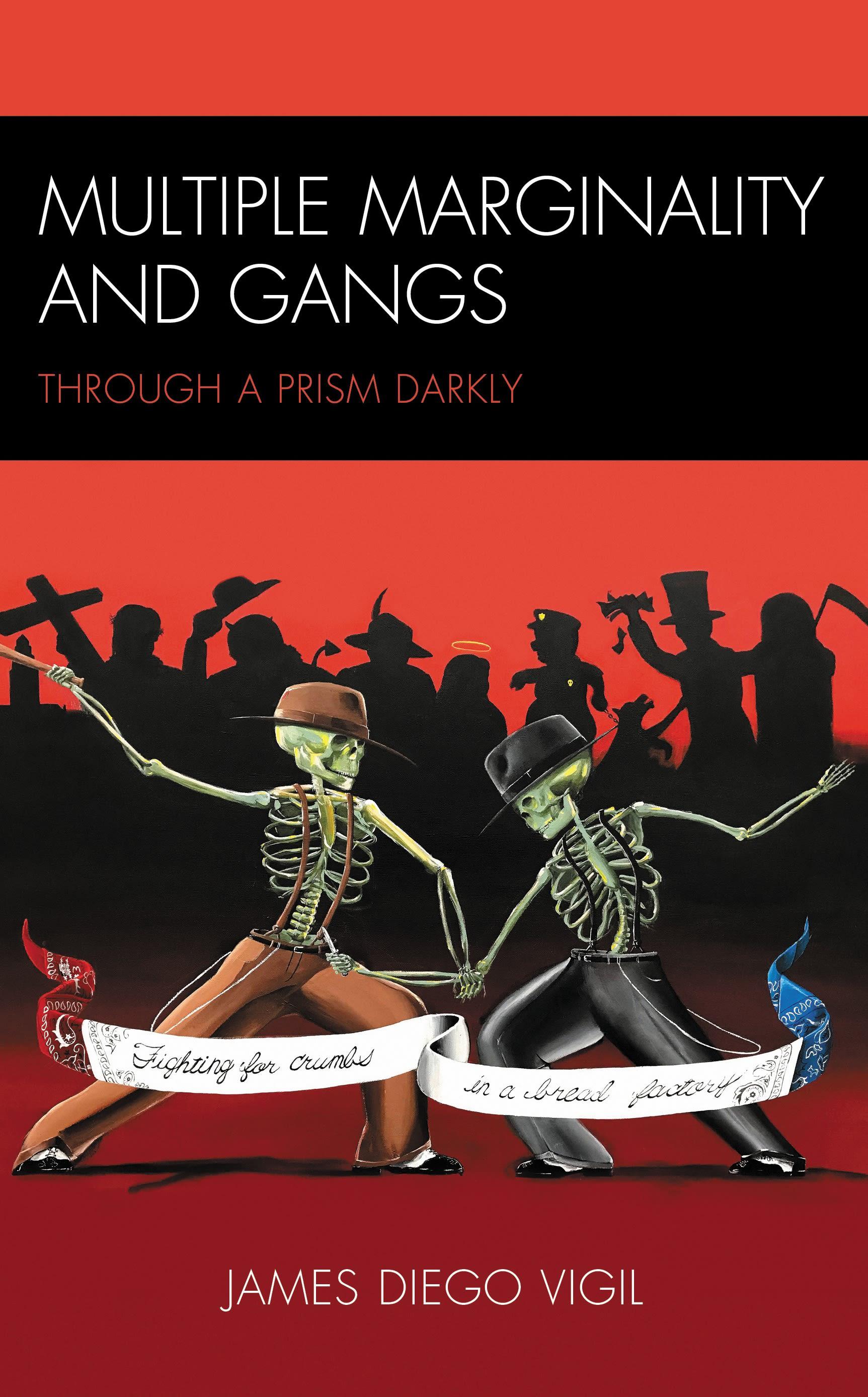
Multiple Marginality and Gangs: Through a Prism Darkly unravels the youth gang problem in a multidimensional approach that encompasses the place, status, social control, subcultural, and identity facets of urban street gangs. The power of place and the status of persons and groups are the major forces that generate the many situations and conditions that give rise to gangs. In its simplest trajectory, Multiple Marginality can be modeled as follows: place/status to street socialization to street subculture to street identity. It is the actions and reactions among them that we fathom. As we witness detrimental or absent family influence, we also observe weaker, underfunded schools that limit educators’ reach. At the same time, there has been an increase in the militarization of law enforcement to deal with the youth street populations, the heaviest hand is that of the police. There is a causal relationship between social marginalization factors and gang membership. A psychological analysis also entails how street socialization leads to a street identity. In a place and status group, the cascading effects of marginalization have certainly affected—and mostly thwarted—social control institutions.
Betal nemt med kort, Klarna, Apple Pay eller Google Pay. Ikke tilfreds? Du har altid 14 dages fortrydelsesret. Læs mere i vores vilkår. Har du spørgsmål, så send os en mail på hello@memmo.org.
Memmo gør det nemmere at studere – uanset hvor du er i verden. Hos os samler du dine kursusbøger og smarte studieværktøjer ét sted: resuméer, quizzer, podcasts og flashcards. Og så er der Ted, din studieven, der svarer på alt, du undrer dig over. Over 50 000 studerende studerer allerede her – bygget til at hjælpe dig med at lære hurtigere og stresse mindre.