
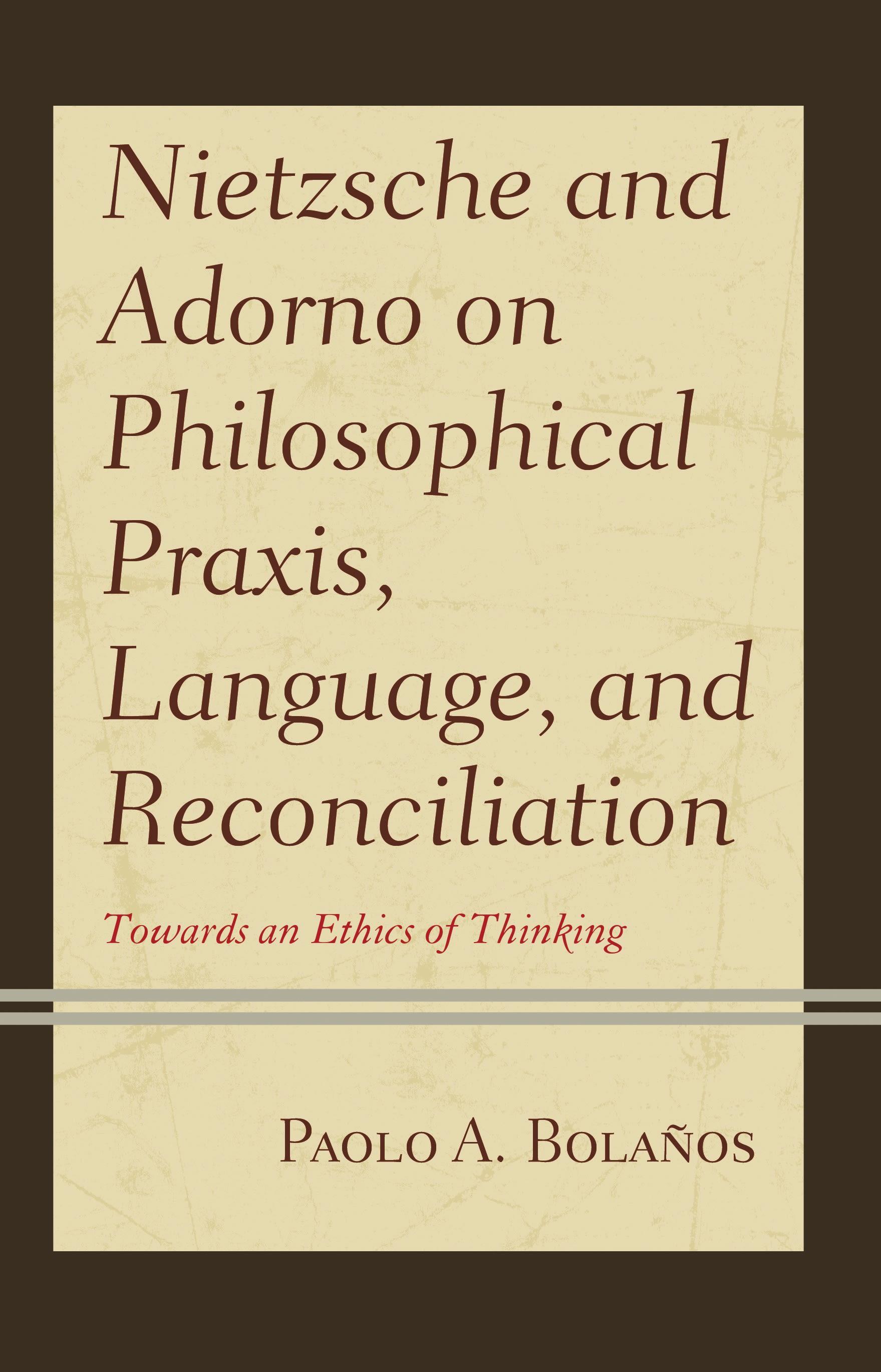
Nietzsche and Adorno on Philosophical Praxis, Language, and Reconciliation: Towards an Ethics of Thinking offers a philosophical notion of an “ethics of thinking,” a kind of thinking that is receptive to the non-identical character of the world of human and non-human objects. Paolo A. Bolaños experiments with the ideas of Friedrich Nietzsche and Theodor W. Adorno, who are presented as contemporary proponents of the Frühromantik tradition. Bolaños offers a reconstruction of the respective philosophies of language of Nietzsche and Adorno, as well as a rehearsal of their critique of metaphysics and identity thinking, in order to develop a notion of philosophical praxis that is grounded in the ethical dimension of thinking. Via Nietzsche and Adorno, Bolaños argues that thinking’s performative participation in uncertainty broadens the domain of reason, thereby also broadening our conceptual capacities and our receptivity to new possibilities of thinking. As an ethical praxis, thinking guards itself from the error of solidification, thereby opening philosophy to a reconciliatory, as opposed to domineering, reception of the world.
Betal nemt med kort, Klarna, Apple Pay eller Google Pay. Ikke tilfreds? Du har altid 14 dages fortrydelsesret. Læs mere i vores vilkår. Har du spørgsmål, så send os en mail på hello@memmo.org.
Memmo gør det nemmere at studere – uanset hvor du er i verden. Hos os samler du dine kursusbøger og smarte studieværktøjer ét sted: resuméer, quizzer, podcasts og flashcards. Og så er der Ted, din studieven, der svarer på alt, du undrer dig over. Over 50 000 studerende studerer allerede her – bygget til at hjælpe dig med at lære hurtigere og stresse mindre.